
CNS Pharmaceuticals’ Strategic Pivot: Can Capital and Leadership Fuel a Pipeline Rebuild?
With legacy clinical programs winding down and a sizeable cash infusion in hand, CNS Pharmaceuticals is betting on asset acquisition to reshape its future.
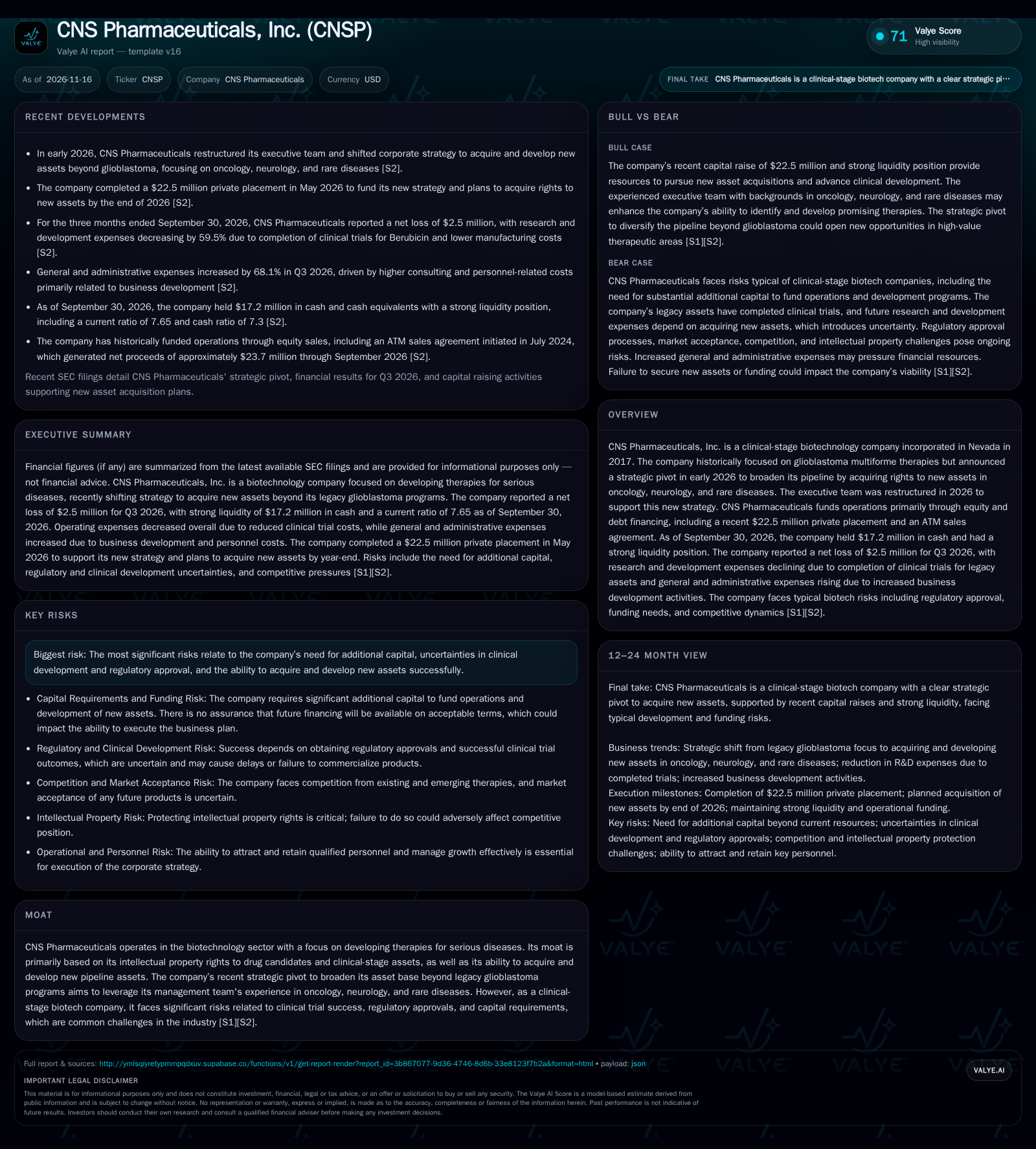
CNS Pharmaceuticals has shifted from a single-asset focus on glioblastoma to a broader strategy targeting asset acquisitions in oncology, neurology, and rare diseases. Backed by a $22.5 million private placement and strong cash reserves as of September 2026, the company is poised for a year-end push to secure new pipeline assets. The sustainability of this pivot depends on successful deal execution, regulatory navigation, and the ability to manage rising business development costs.
CNS Pharmaceuticals stands at a crossroads following a decisive shift from its original focus on glioblastoma therapies. Armed with fresh capital from a $22.5 million private placement and a newly restructured executive team, the company is actively seeking new pipeline assets in oncology, neurology, and rare diseases.
Strategic Pivot, Capital Injection, and Executive Overhaul Define CNS’s Present
CNS Pharmaceuticals’ current landscape is shaped by three pivotal developments. First, the company executed a clear strategic pivot in early 2026, moving away from a singular focus on glioblastoma multiforme to a broader mandate targeting asset acquisitions in oncology, neurology, and rare diseases [S2]. Second, the firm completed a $22.5 million private placement in May 2026, boosting its cash reserves to $17.2 million as of September 30, 2026, and achieving a current ratio of 7.65—an unusually high liquidity position for a clinical-stage biotech [S2]. Third, CNS overhauled its executive leadership in early 2026, bringing in a new CEO, CFO, CTO, and CMO with backgrounds in biotechnology and pharmaceuticals [S1]. These changes set the stage for an accelerated asset search and acquisition strategy, but also shift the company’s risk profile from clinical execution to dealmaking and integration.
How CNS Pharmaceuticals’ Economics Could Evolve with Asset Acquisitions
The company’s business model is in transition. Historically, CNS Pharmaceuticals incurred high fixed R&D costs tied to advancing its lead glioblastoma asset through clinical trials. With those trials now completed, R&D expenses dropped by 59.5% year-over-year in Q3 2026, while general and administrative costs surged by 68.1%, reflecting the uptick in consulting and business development activity required for asset sourcing [S2]. This shift means that near-term economics will be dominated by up-front acquisition or licensing payments, diligence costs, and ongoing G&A, rather than steady R&D progress.
If CNS secures new pipeline assets, future cost structure will depend on the stage and modality of those assets. Early-stage programs typically require incremental investment in preclinical and clinical development, while later-stage or in-licensed assets may bring milestone and royalty obligations. The absence of revenue-generating products makes the firm entirely dependent on external financing until a new asset reaches commercialization. Operating leverage could improve if CNS acquires assets with near-term clinical catalysts, but the capital intensity and risk profile remain high. Any significant delay or failure in asset acquisition would leave the company with a costly overhead base and eroding cash.
Competitive Dynamics: From Pipeline Scarcity to Differentiation Challenge
CNS Pharmaceuticals competes in a biotechnology landscape where capital, talent, and differentiated assets determine survival. The company’s pipeline is currently in flux, with legacy programs winding down and no new clinical assets disclosed as of Q3 2026 [S2]. The near-term competitive challenge is twofold: first, acquiring high-potential assets in a crowded market where many clinical-stage companies are similarly seeking deals; and second, differentiating those assets against both large pharma incumbents and smaller, nimble biotechs.
Intellectual property strength and clinical-stage differentiation are the primary sources of durable advantage in this sector. If CNS acquires assets with strong IP and clear clinical rationale in underserved indications, it could carve out a defensible position. However, competition for attractive assets is intense, and the risk of overpaying or acquiring undifferentiated programs is high. Established players often have greater deal-making resources, and CNS’s ability to attract experienced personnel is crucial for both diligence and post-acquisition execution.
If Acquisitions Align and Clinical Milestones Arrive, Value Could Re-Rate Rapidly
The most favorable scenario for CNS Pharmaceuticals is one in which the company leverages its capital base and experienced leadership to acquire one or more high-potential assets in late 2026. These assets would ideally be in indications with significant unmet need and clear clinical or regulatory catalysts within 12-24 months. If the company successfully executes these deals, initiates new clinical trials, and generates positive early data, investor perception and valuation could shift quickly, enabling further capital raises or strategic partnerships.
Confirmation of this scenario would include announcements of asset acquisitions with disclosed terms, initiation of new clinical programs, and evidence of early clinical progress (e.g., trial enrollment, interim data). Falsification would involve failure to close deals, delays in asset integration, or a lack of new clinical development activity, leaving the company dependent on its cash reserves with no clear growth trajectory.
Asset Deals Take Time: Near-Term Cash Burn, Medium-Term Execution Risk
The most plausible outcome is a period of continued cash burn as CNS Pharmaceuticals pursues asset sourcing and due diligence through late 2026. Given the competitive asset market and the need for careful evaluation, it is likely that the company will announce one or more acquisitions, but these may be early-stage or require substantial additional development work. R&D expenses would rise again as new programs are launched, but revenue would remain absent for the foreseeable future.
This scenario is confirmed if CNS discloses asset deals by year-end and begins investing in new clinical trials, but also if ongoing G&A and deal-related expenses continue to pressure the income statement. Falsification would be indicated by persistent delays in asset acquisition or an inability to secure attractive programs, leading to a shrinking cash balance without tangible pipeline progress.
Failure to Acquire or Integrate New Assets Could Trigger Value Erosion
Adverse outcomes for CNS Pharmaceuticals would stem from either failing to acquire new pipeline assets or acquiring programs that prove unviable or undifferentiated. If the company is unable to secure deals due to competitive bidding, regulatory hurdles, or internal execution gaps, its cash position would erode amid rising G&A costs with no replenishment from new assets or revenue streams. Even if deals are completed, failure to integrate or advance acquired programs could result in costly write-downs and loss of investor confidence.
Evidence supporting this downside would include repeated delays or negative updates on the asset search process, lack of new trial initiations, or disclosure of adverse regulatory or clinical events post-acquisition. Further, continued increases in G&A without offsetting progress in R&D or pipeline advancement would signal execution risk is materializing.
What Could Change the Trajectory for CNS Pharmaceuticals’ Pipeline Rebuild
Announced acquisitions of new clinical or preclinical assets—including terms, stage, and indication—would directly test the company’s execution on its stated strategy.
Initiation of new clinical trial programs, including regulatory filings and enrollment milestones, would indicate pipeline progress.
Trends in research and development versus general and administrative expenses: a useful metric would be the speed at which R&D ramps relative to G&A as new assets are integrated.
Cash burn rate and projected runway, especially after any asset acquisition, would help assess the sustainability of operations.
Disclosures of partnerships, out-licensing, or co-development deals would provide evidence of external validation or non-dilutive funding.
Retention and recruitment of key scientific and operational personnel, if disclosed, would be a leading indicator of organizational capability during the pivot.
Updates on regulatory interactions or designations (e.g., orphan drug status, fast track), if any, for new pipeline assets would signal progress on the path to approval.
Disclaimer: This is research-only, informational analysis and not investment advice. It may include AI-generated interpretation and general industry context. Always verify important details using primary sources.

Comments