
Conexeu Sciences: Regenerative Medicine Ambition Meets the Realities of Early-Stage Execution
Conexeu Sciences aims to bridge critical tissue restoration gaps in wound care and aesthetics, leveraging a proprietary biomaterial platform. With no revenue and escalating operating losses, the company’s future hinges on regulatory milestones, capital access, and its ability to carve out a defensible niche in a competitive and capital-intensive sector.
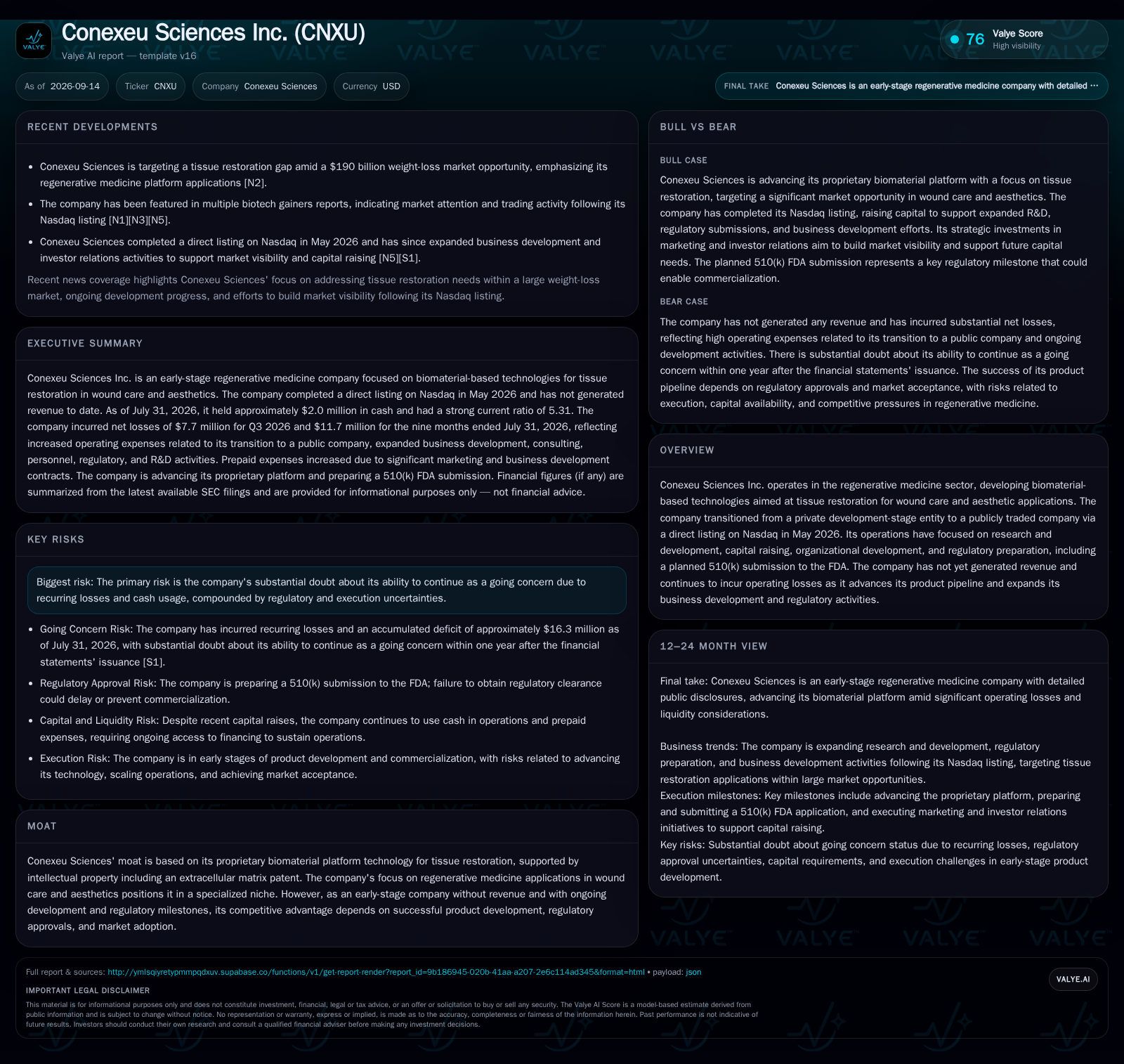
Conexeu Sciences has transitioned to public markets with a focus on biomaterial-based tissue restoration technologies targeting wound care and aesthetics. Despite significant cash burn and no revenue, recent capital raises and a planned FDA 510(k) submission signal a push toward commercialization. The company's trajectory will be shaped by its ability to secure regulatory clearance, sustain funding, and differentiate its platform in a crowded regenerative medicine landscape. [S1] [N2] [N5]
Conexeu Sciences Inc. stands at a familiar but fraught crossroads for early-stage biotech: a compelling technology platform targeting a large unmet need, but with no commercial traction, mounting losses, and a business model that remains entirely dependent on future regulatory and capital market milestones. The company's focus on biomaterial-based tissue restoration in wound care and aesthetics aligns with high-growth industry segments, and its public listing has raised its profile. Yet, the core questions—can Conexeu secure FDA clearance, sustain its cash needs, and distinguish its technology in a competitive field—remain open, with the company's future largely determined by its next 12-24 months of execution.
Recent Milestones and Financial Position Shape Conexeu’s Near-Term Outlook
Conexeu Sciences completed its direct listing on Nasdaq in May 2026, marking a transition from private development to public scrutiny. As of July 2026, the company reported approximately $2.0 million in cash and a current ratio of 5.31, reflecting a strong near-term liquidity position. However, it has not generated any revenue and posted a net loss of $11.7 million for the nine months ended July 31, 2026. The SEC filing explicitly notes substantial doubt about Conexeu’s ability to continue as a going concern within one year after the financial statements' issuance, underscoring acute funding risk. The company’s operating expenses have surged due to business development, regulatory preparation, and increased R&D, all in support of advancing its biomaterial platform and a planned 510(k) FDA submission. [S1]
How Conexeu Could Monetize Regenerative Medicine: Economics and Capital Demands
As a pre-revenue company, Conexeu’s future business economics are hypothetical, hinging on successful regulatory clearance and commercial adoption. If the company secures 510(k) approval, initial revenue would likely depend on direct product sales to wound care clinics, hospitals, or aesthetic practices, or possibly through partnerships with established medtech distributors. Pricing power in this space can be substantial for differentiated, FDA-cleared biomaterials, but reimbursement dynamics, clinical evidence, and physician adoption are critical gatekeepers.
The regenerative medicine field typically features high gross margins post-approval due to the proprietary nature of biomaterial platforms and limited variable costs per unit. However, fixed costs are substantial: ongoing R&D, regulatory compliance, market development, and clinical education require sustained investment. Operating leverage could be significant if Conexeu achieves scale, but the road to profitability is long and capital-intensive. The company’s recent large prepaid marketing and business development contracts suggest a strategy to accelerate market entry and investor interest, but these represent sunk costs if regulatory or commercial milestones are missed. [S1]
In considering the scalability of Conexeu’s business model, an important factor is the potential for recurring revenue streams beyond initial product sales. If the biomaterial platform can be integrated into treatment protocols that require repeat applications or maintenance therapies, this would enhance lifetime customer value and stabilize revenue projections. Conversely, if the product is a one-time use with limited patient follow-up, the company must rely heavily on continuous new patient acquisition, which could increase sales and marketing costs significantly. Additionally, reimbursement policies and payer acceptance will critically influence pricing strategies and market penetration, as limited or inconsistent reimbursement could constrain adoption despite clinical benefits.
Evaluating Differentiation and the Challenge of Standing Out in Regenerative Medicine
Conexeu’s competitive thesis rests on its proprietary biomaterial platform, reportedly protected by intellectual property including an extracellular matrix patent. In wound care and aesthetics, competition is intense, with incumbent medtech firms, specialty biotech startups, and university spinouts all vying for share. Many established products already enjoy reimbursement pathways, clinical trust, and distribution reach.
Switching costs in this sector are often moderate: while physicians may be open to new solutions with clear clinical advantages, inertia and established procurement relationships can act as barriers. The company’s focus on tissue restoration related to the weight-loss market could open a differentiated use case if it can demonstrate unique efficacy or usability for patients undergoing rapid body composition change. However, until clinical data and regulatory clearance are secured, Conexeu’s true position versus substitutes remains theoretical. [N2]
Another dimension to Conexeu’s competitive positioning lies in the platform’s adaptability across multiple clinical indications. If the biomaterial can be tailored or modified to address a broader spectrum of tissue restoration needs beyond the initial wound care and aesthetic targets, this would diversify revenue sources and reduce dependency on any single market segment. However, expanding indications often requires incremental clinical trials and regulatory clearances, increasing time and capital requirements. Furthermore, the company must consider the competitive landscape within each indication, as some segments may be more saturated or technologically mature, impacting the relative ease of market entry and differentiation.
The durability and defensibility of Conexeu’s intellectual property portfolio are also pivotal. While patents on extracellular matrix compositions provide a barrier to entry, the regenerative medicine field is characterized by rapid innovation and frequent patent challenges. The company’s ability to maintain exclusivity and fend off generic or biosimilar competitors will depend on continuous innovation, patent prosecution strategy, and potential licensing arrangements. Additionally, strategic partnerships with established players could enhance market reach and provide resources for defending IP, but may also dilute control or margins. The balance between protecting proprietary technology and fostering collaborative growth is a nuanced strategic consideration.
Path to Value Creation: What a Breakout Success Would Require
A favorable outcome for Conexeu hinges on a tight sequence of events: timely and successful 510(k) FDA clearance, followed by positive early clinical adoption and validation in wound care and aesthetic settings. If the company’s platform demonstrates clear advantages—such as faster healing, reduced complications, or new applications tied to the weight-loss market—it could attract commercial partners or acquirers, enabling rapid scaling.
Confirmation of this scenario would come from regulatory approvals, announced distribution partnerships, and initial revenue bookings. Further, evidence of repeat orders, favorable reimbursement decisions, and published clinical results would signal traction. A sustained ability to raise non-dilutive capital or secure strategic investments would also indicate growing confidence in the business model.
Bridging the Gap: Plausible Progressions and Execution Hurdles Ahead
The most probable near-term pathway is a continuation of R&D and regulatory preparation, with the company advancing its 510(k) submission but facing delays and incremental costs. Modest additional capital raises—potentially through further warrant exercises or secondary offerings—may provide temporary runway extensions, but the risk of dilution for existing shareholders is high. Commercial traction is unlikely before late 2027 even if regulatory milestones are met on schedule.
This scenario would be confirmed by steady but unspectacular R&D updates, additional small financings, and controlled increases in operating expenses. Conversely, any acceleration in cash burn or material setbacks in regulatory timelines would falsify the base case and tilt the risk profile further negative.
When Execution Falters: How Funding or Regulatory Delays Could Derail the Thesis
A negative outcome for Conexeu would likely stem from a failure to secure timely regulatory clearance, leading to a protracted period of zero revenue and mounting losses. If capital markets become less receptive—or if the company is unable to raise sufficient funds at acceptable terms—operations could be severely curtailed or halted altogether. In this scenario, prepaid marketing and development contracts become sunk costs, and the company may be forced into a distressed sale, restructuring, or even liquidation.
Confirmation would come in the form of delayed or rejected 510(k) submissions, sharp reductions in staff or R&D activity, missed contractual obligations, or auditor warnings escalating beyond the current going concern note. An inability to attract further investment, especially in the face of broader biotech market volatility, would further compound the downside risk. [S1]
Milestones and Data That Will Define Conexeu’s Next Chapter
Timing and outcome of the planned 510(k) submission to the FDA for its lead biomaterial platform.
Monthly or quarterly cash burn and the pace at which cash and working capital are depleted, especially as prepaid expenses are expensed.
Ability to raise additional non-dilutive or minimally dilutive capital, including follow-on financings or strategic investments.
Disclosure of clinical trial results or real-world case studies demonstrating efficacy and safety in wound care or aesthetic applications.
Any announced commercial, distribution, or strategic partnership agreements with established medtech or healthcare organizations.
Evidence of physician or patient adoption, including initial orders, reorders, or pilot program results—if disclosed.
Regulatory feedback, queries, or setbacks that could impact the 510(k) timeline or require further clinical evidence.
Progress in expanding or defending the intellectual property portfolio, including patent grants or challenges.
Disclaimer: This is research-only, informational analysis and not investment advice. It may include AI-generated interpretation and general industry context. Always verify important details using primary sources.

Comments