
Hemab Therapeutics Advances Rare Bleeding Disorder Pipeline with Strong IPO Momentum
Hemab’s Q1 2026 financials and corporate reorganization, combined with a significant upsized IPO, establish a solid capital base to support clinical-stage development for rare coagulation disorders.
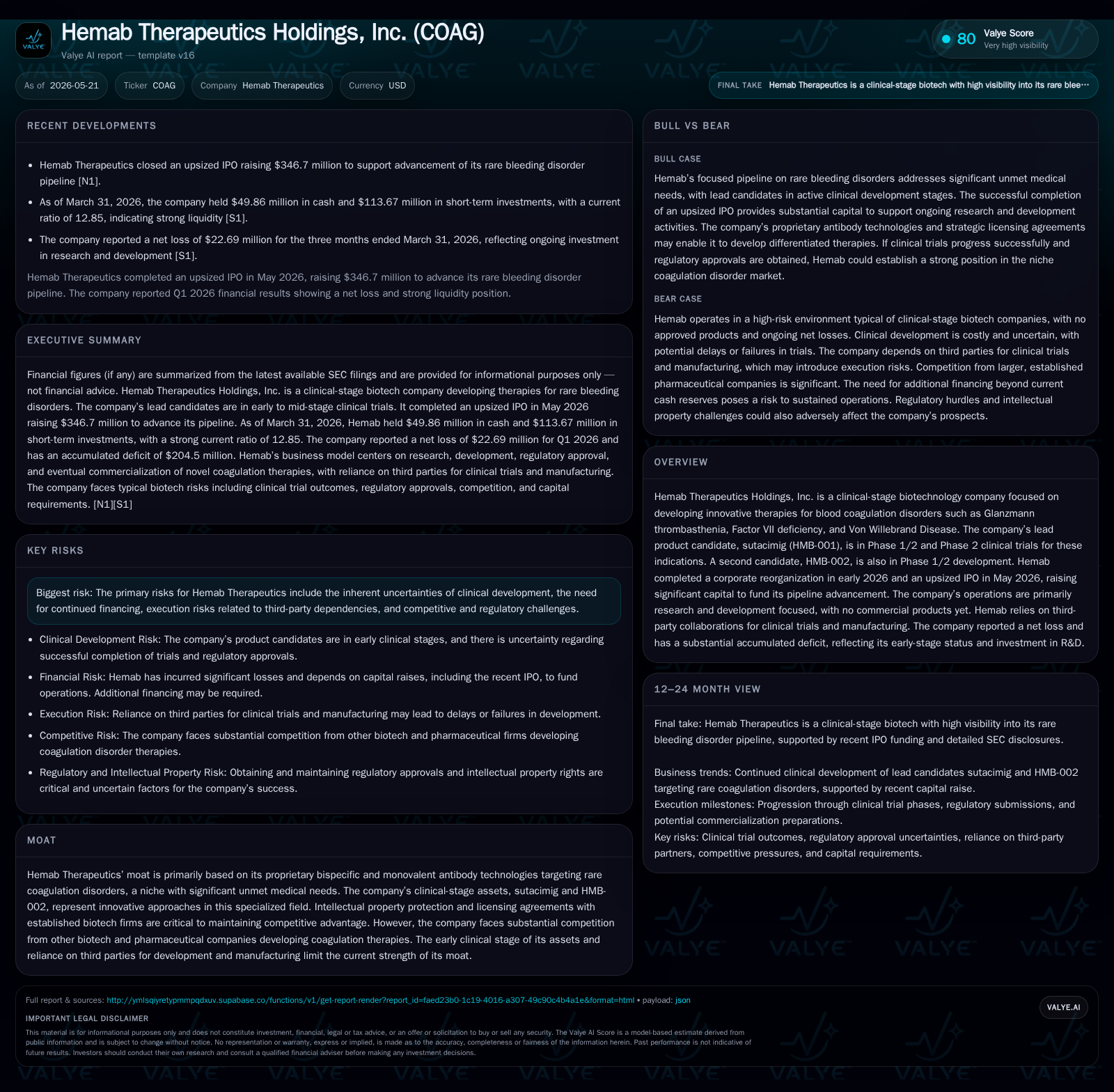
In Q1 2026, Hemab Therapeutics completed a major corporate reorganization and raised approximately $346.7 million in an upsized IPO, substantially bolstering its liquidity and operational runway. The biotechnology company remains focused on advancing its lead bispecific antibody candidate, sutacimig (HMB-001), alongside HMB-002 in early-phase clinical trials targeting rare coagulation disorders such as Glanzmann thrombasthenia and Von Willebrand disease. While the company has no products on the market yet and continues to incur significant losses due to R&D expenses, these recent financial and structural developments position Hemab to pursue key clinical milestones. Risks persist around dependences on external collaborators, regulatory hurdles, and competitive pressures within the specialized coagulation therapeutics sector.
Latest Operating Highlights and Capital Raise
Hemab Therapeutics’ latest quarterly filing dated May 21, 2026 ([S2]) confirms completion of a pivotal corporate reorganization executed March 30, 2026. This restructuring converted Hemab ApS’s shareholders into holders of shares in the newly formed Delaware entity Hemab Therapeutics Holdings, Inc., which now consolidates ownership of all subsidiaries including Hemab Therapeutics Inc. alongside Hemab ApS as wholly owned subsidiaries ([S2], [S13], [S28]). This legal restructuring was preparatory to the company’s successful upsized initial public offering (IPO) closed on May 4, 2026 ([N1], [S2], [S14]).
The IPO generated approximately $346.7 million gross proceeds ([N1]), significantly augmenting the company's capital base used primarily to fund ongoing clinical-stage product development activities. As of Q1-end March 31, 2026, prior to the IPO proceeds hitting the balance sheet in full but inclusive of designated marketable securities from anticipated offerings and other financings, Hemab reported cash and equivalents totaling approximately $49.9 million with current assets aggregating $169.4 million relative to modest current liabilities near $13.2 million ([F1]). This yielded an exceptionally strong current ratio of about 12.85 ([F1]), indicating robust short-term liquidity ahead.
Management disclosed it expects this strengthened cash position combined with marketable securities stemming from the IPO proceeds (net proceeds approximated $317.2 million after deductions) to finance operational expenses and capital requirements for at least one year beyond filing date ([S7], [S9]). Meanwhile, quarterly cash burn remains elevated at roughly $21.6 million derived from continued research & development and administrative expenditures typical for clinical-stage biotechs ([S23]) with no revenues generated yet.
Business Model and Clinical-Stage Product Profile
Operating exclusively as a pre-commercial clinical-stage biotech focused on coagulation disorders inherently defines Hemab Therapeutics’ business model: value creation depends chiefly on advancing novel therapeutic candidates through stages of increasingly costly and complex clinical trials toward eventual regulatory approvals and commercialization ([S13], valye_report_excerpt). Revenue generation is absent at this stage; instead funding inflows stem from equity offerings like the recent IPO plus partnerships and licenses. The R&D focus centers on developing recombinant antibody therapeutics addressing rare bleeding diseases marked by severe unmet medical needs.
Hemab’s lead asset sutacimig (HMB-001) is a proprietary bispecific antibody engineered for prophylactic use in Glanzmann thrombasthenia patients currently enrolled in Phase 1/2 trials while simultaneously being studied in Phase 2 for Factor VII deficiency ([S13]). These are orphan indications where treatment options are limited due to rarity and complexity of underlying pathology.
A second candidate HMB-002 employs monovalent antibody technology targeting Von Willebrand Disease—a more common but still significantly underserved bleeding disorder—also undergoing Phase 1/2 development toward subcutaneous prophylactic application ([S13]). Beyond these clinical candidates, Hemab maintains earlier-stage discovery programs aimed at expanding its coagulation-focused pipeline.
Due to the absence of approved products or sales traction so far, net losses continue unabated—$22.7 million recorded during Q1 alone—reflecting heavy spending on research personnel, clinical trial execution managed mostly through third-party collaborations, manufacturing partnerships for drug substance production, and supporting infrastructure ([F1], [S2]). This accumulated deficit underscores the early-stage nature of its operations but also emphasizes reliance on sustained financing.
Competitive Landscape in Rare Coagulation Therapeutics
The rare bleeding disorder space lies at an intersection of high scientific complexity, significant patient unmet need due to scarcity of effective therapies, and concentrated competition largely from biotech firms specializing in biologic modalities plus large pharmaceutical companies with legacy coagulation franchises ().
Hemab competes by leveraging its unique bispecific and monovalent antibody platforms designed to achieve targeted modulation within coagulation pathways implicated across multiple distinct disorders—a nuanced differentiator within niche rare disease subsets where tailored approaches may deliver meaningful clinical benefits absent with broader spectrum agents.
Its competitive moat derives primarily from intellectual property estates securing novel molecular constructs alongside licensing arrangements that grant access or rights alignment with established biotech entities contributing complementary capabilities or validation (). Nonetheless, given the early clinical status of candidates combined with outsourcing dependencies for manufacturing scale-up and trial conduct means that operational execution risk tempers near-term defensibility.
Peers include companies developing recombinant factor replacement therapies as well as next-generation antibody-based agents advancing through various stages—many attempting chronic prophylaxis positioning requiring stringent safety profiles amidst concerns such as thrombosis risk observed historically even within Hemab’s own sutacimig trials ([S22], ).
Emerging Growth Drivers and Strategic Catalysts
Looking forward, Hemab’s primary growth opportunity opens upon successful advancement of sutacimig's clinical program reaching Phase 3 initiation as management indicates plans for pivotal efficacy trials targeting Glanzmann thrombasthenia ([S9], [S22]). Positive outcomes there would underpin potential marketing authorization filings across multiple jurisdictions.
Secondary growth levers include progression of HMB-002 through dose escalation phases aiming at Von Willebrand Disease prophylaxis indication expansion as well as exploration of additional pipeline assets currently in discovery or preclinical testing stages that could broaden both indication scope or therapeutic modality mix ([S13], ).
Capital from the upsized IPO affords greater operational freedom to accelerate enrollment rates supported by third-party clinical research organizations (CROs), scale manufacturing readiness activities potentially via contract manufacturing organizations (CMOs), enhance regulatory engagement activities involving preset milestones approvals conversations, and explore collaborations either upstream licensing or downstream commercialization partnerships enhancing geographic reach or reimbursement access strategies.
Key Risks and Operational Constraints
The foremost risk remains intrinsic uncertainty inherent in drug development including potential adverse trial safety signals such as thrombosis observed during sutacimig assessment necessitating protocol modifications or program termination ([S22]). Clinical recruitment challenges posed by rarity compounded by competitive trial enrollment targeting same patient populations raise timing delays possibility.
Operational risks stem from reliance on outsourced vendors including CROs for trial monitoring adherence timelines plus CMOs meeting quality regulatory standards needed to avoid lot release setbacks affecting supply continuity should approvals be granted ([S22], valye_report_excerpt).
Finally competition evolves rapidly in biotech realm inviting rivalry not only from new entrants but also larger pharma companies leveraging scale advantages including global commercial machines that may compress pricing power once marketed therapies emerge broadly disrupting treatment paradigms.
Milestones and Indicators to Monitor Ahead
Critical near-term indicators encompass:
- Confirmation timing and progress updates regarding initiation of Phase 3 sutacimig trial targeted at Glanzmann thrombasthenia patients which sets valuation inflection point ([S9], [S22])
- Safety and efficacy interim results disclosures during ongoing Phase 1/2 studies across both lead pipeline candidates which impact confidence in durability/potential label breadth ([S9])
- Regulatory communications pertaining to trial designs amendments acceptance or breakthrough designations issuance which abbreviate timelines ([S9])
- New strategic alliances announcements expanding collaborative network for development/commercialization that might deepen funding sources aside from capital markets ()
- Financial reporting updates illuminating cash spend pacing vis-à-vis initial IPO projections anchoring sustainability outlook while assessing near-term needs ([F1], [S2])
Liquidity Position and Financial Health Summary
At March-end Q1 2026 prior to inclusion of net IPO proceeds yet considering deferred offering costs related thereto approximately $2.7 million capitalized but not expensed until closing ([S8]), Hemab held nearly $50 million cash & equivalents complemented by marketable securities culminating in total current assets exceeding $169 million against current liabilities barely above $13 million resulting in exceptional short-term liquidity coverage ratio (~12.85) ([F1]). This balance sheet strength supports ongoing operations through anticipated product development inflection points without immediate fundraising pressure.
Nevertheless operating loss sustained was substantial at over $23 million this quarter highlighting persistent negative cash flow typical among early-phase biotech firms investing heavily in R&D infrastructure ahead of product commercialization readiness ([F1], [S23]). Conservative treasury management combined with measured deployment pace will remain critical until product candidates stabilize into late-phase development phases poised for eventual revenue generation.
This analysis incorporates only publicly disclosed information as provided primarily through SEC filings up to May 21, 2026. It is not investment advice but seeks to illuminate operational realities underlying Hemab Therapeutics Holdings' strategic developments amid rare coagulation disorder biotech contexts.

Comments