
Chilean Cobalt Corp Advances Strategic Partnerships and ESG Frameworks to Build Americas-Centric Supply Chain
The latest quarterly report confirms steady progress in governance, strategic alliances, and ESG integration critical for the company’s development stage.
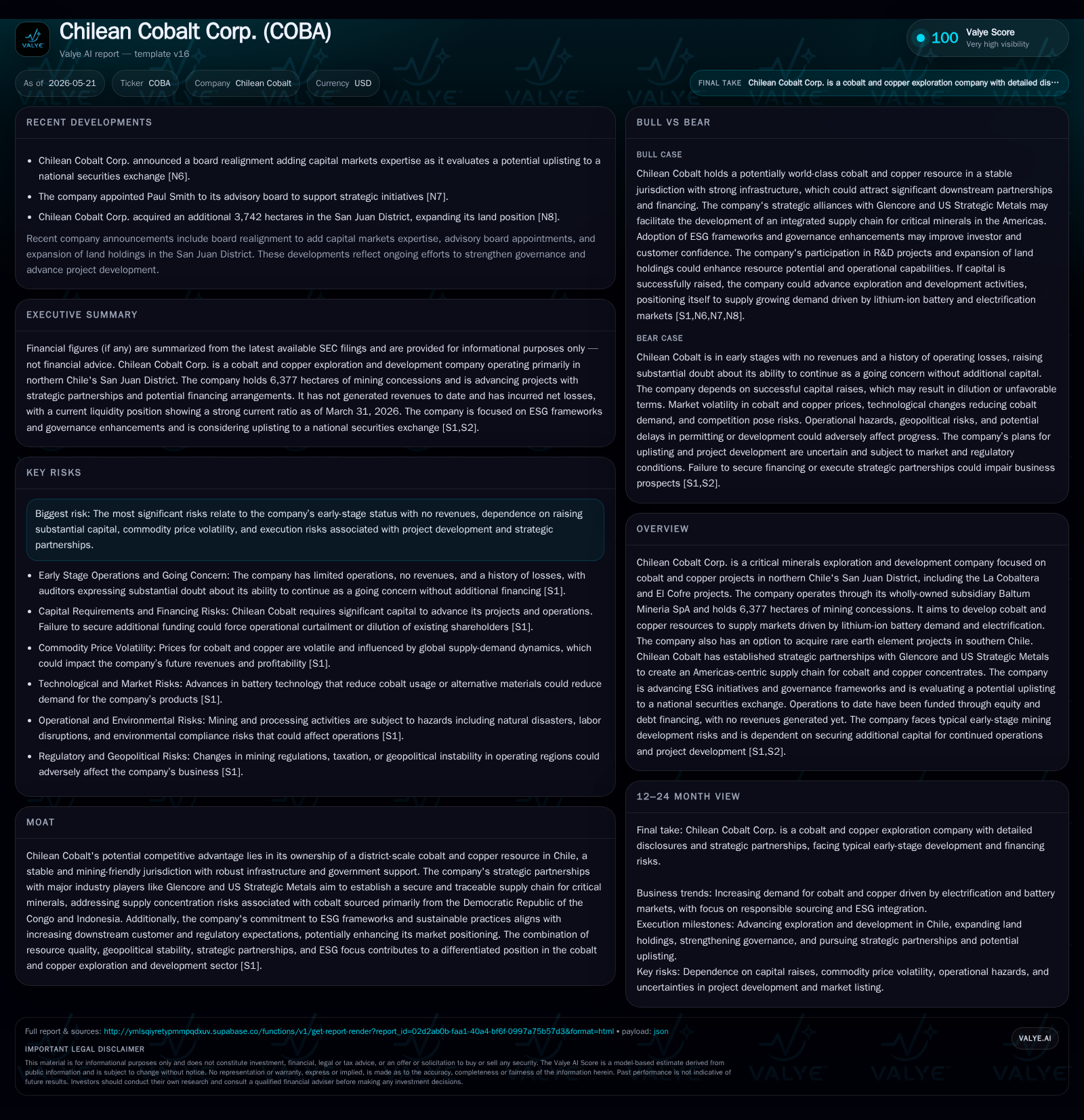
Chilean Cobalt Corp’s May 2026 10-Q reiterates unchanged risk factors but signals advancing maturity through board appointments and deepening partnerships with Glencore and US Strategic Metals. The company’s business model centers on district-scale cobalt-copper exploration in Chile’s mining-friendly San Juan District, leveraging infrastructure and regulatory stability for a potential Americas supply chain. Growth is underpinned by strategic off-take agreements, an accelerated exploration program, and robust ESG frameworks aligned with Digbee and IRMA standards. Key challenges remain in capital raising, market volatility, and operational execution as the company transitions from exploration to development phase. Short-term catalysts include securing additional funding, possible exchange uplisting, and progress on downstream processing setups.
Latest Quarterly Developments: Strategic Stability Amid Early-Stage Risks
Chilean Cobalt Corp's latest quarterly report filed May 20, 2026 (Form 10-Q) reaffirms the company's risk profile remains consistent with the disclosures presented in its March 31, 2026 annual report (10-K), indicating no material changes to known operating or financial risks including execution uncertainties typical of early-stage mineral explorers [S2]. Nonetheless, the quarter brought important governance strides highlighted by the appointment of new board members such as Tom Diffely in March 2026 [S3], supporting greater oversight capabilities essential for operational scaling.
These incremental organizational refinements underpin management’s broader strategy to mature corporate structures ahead of anticipated uplisting plans while advancing project development milestones. The absence of operational disruption or emergent risks underscores management's disciplined approach to navigating early-stage challenges while laying groundwork for near-term commercialization.
Business Model Overview: Exploration to Sustainable Cobalt Supply
Chilean Cobalt Corp operates predominantly through its wholly-owned subsidiary Baltum Mineria SpA, holding approximately 6,377 hectares of fully exploitable mining concessions in Chile's San Juan District within the Atacama Region—a jurisdiction renowned for its mining-friendly policies and robust infrastructure including roads, electric grid access, water availability, and port proximity [S1]. The principal focus lies on two flagship projects: La Cobaltera and El Cofre.
These projects feature significant primary cobalt alongside secondary copper oxide and sulphide mineralization with indications of gold at depth. Their district-scale scope offers strategic scale advantages rare among peers given Chile’s global status as the leading copper producer. This integrated cobalt-copper resource base positions Chilean Cobalt well to serve growing electrification-related markets given cobalt's critical role in lithium-ion batteries for EVs and copper's centrality in electrical infrastructure [S1][S24].
Commercially, revenue generation will flow from future saleable concentrates produced from these concessions after progressing through feasibility studies, permitting, development capex deployment, and production ramp-up phases [S6][S16]. The company’s strategy emphasizes responsible sourcing evidenced by applying Digbee and IRMA ESG frameworks designed to meet intense scrutiny from downstream battery manufacturers seeking transparent supply chains
Competitive Positioning and Industry Backdrop in Critical Minerals
The cobalt market is a niche base metal segment characterized by concentrated supply sources primarily located in geopolitically sensitive regions such as the Democratic Republic of the Congo (DRC) and Indonesia. These origins present significant geopolitical risks along with governance concerns that increasingly challenge buyers aiming for ethically sourced materials [S1]. Against this backdrop, Chilean Cobalt's wholly owned assets in Chile—a country recognized for political stability and supportive mining regulations—offer a distinct competitive advantage.
By forging strategic partnerships with global industry heavyweight Glencore plc—which holds first refusal rights on future production—and US Strategic Metals (USSM), a domestic refining operation located in Missouri that is set to receive processed concentrates via these arrangements [S4], Chilean Cobalt attempts to establish an Americas-centric value chain that improves supply traceability while reducing dependency on traditional high-risk geographies.
Stability in supply origin combined with traceability creates intangible value underpinning customer willingness to engage under longer-term agreements.
Growth Enablers: Strategic Partnerships, Infrastructure, and ESG Integration
Central growth levers include:
- Strategic Off-take Agreements: The November 2025 Deed of Undertaking with Glencore grants it lifelong first-and-last refusal rights on mine production from La Cobaltera and El Cofre projects. Parallel ongoing negotiations toward an LOI with USSM contemplate dedicated processing lines at US facilities aimed at refined cobalt-copper intermediate products crucial for advanced energy storage technologies [S4].
- Local Infrastructure: The Atacama region benefits from mature mining infrastructure enabling lower logistical barriers relative to peers operating in remote or underdeveloped areas. Road networks, stable electricity supply essential for mining operations, water availability despite regional aridity via managed systems all mitigate typical site-level constraints [S1].
- ESG Framework Adoption: The Board’s formal adoption of Digbee and IRMA ESG standards alongside completion of an independent Digbee assessment attests to Chilean Cobalt’s commitment toward continuous improvement in sustainability metrics broadly valued by end-customers facing tighter regulatory environments globally [S6][S19]. Governance frameworks initiated during early-stage development augment transparency levels necessary for institutional investors while differentiating from competitors lacking similar rigor or traceability commitments.
- Exploration Technology: Advanced geophysical programs incorporating LIDAR surveys, hyperspectral imaging scheduled for 2026 enhance geological modeling reliability supporting resource estimation processes critical before reserve declaration or production permitting [S11].
Collectively these elements function not only as growth catalysts but position Chilean Cobalt within evolving industrial ecosystems emphasizing ESG-compliant critical mineral supplies concentrated within friendly jurisdictions aligned with Western policy priorities.
Key Risks and Execution Challenges in Project Development
Despite promising fundamentals there remain substantial risks:
- Capital Intensity & Dilution: Operating losses since inception reflect high cash burn driven largely by ongoing exploration expenditures compounded by corporate overheads typical at this stage totaling roughly $404K monthly. Current liquidity reserves approximate $2.1 million against nominal liabilities producing an extremely healthy current ratio (~32.55) yet future operational phases require substantial incremental capital estimated near $400 million over time necessitating successful equity or debt raises which may significantly dilute shareholders or impose onerous financial terms if debt is utilized excessively [F1][S6][S15].
- Commodity Price Volatility: Fluctuations especially downward pressure on cobalt prices can materially impact feasibility analyses underpinning project financing decisions given raw material revenues directly influence project economics [S1].
- Permitting & Regulatory Complexity: Although Chile is mining-friendly permits required beyond exploration—such as environmental assessments for production—entail prolonged approval cycles subject to government discretion or change impacting timelines unpredictably [S20][S26].
- Technological Shifts: Potential emergence of alternative battery chemistries diminishing cobalt intensity poses structural demand uncertainty impacting long-term revenue realizations.
- Execution Complexity: Coordinating extensive exploration data acquisition followed rapidly by feasibility study advancement requires expert management bandwidth concurrently managing capital markets engagement posing operational stresses exacerbated by early stage organizational size constraints.
Near-Term Catalysts and Business Milestones to Monitor
Key upcoming indicators include:
- Exchange Uplisting Efforts: Governance framework amendments accepted by Board in principle springboard intentions toward listing on a major national exchange during 2026 pending meeting quantitative listing criteria which would broaden access to institutional capital pools crucial for scale funding [S16].
- Export-Import Bank Debt Facility Discussions: Negotiations targeting up to $317 million package remain non-binding but represent a potentially transformative financing source assuming favorable structuring enabling accelerated development timelines [S4].
- Processing Line Development at US Strategic Metals: Progress completing definitive agreements on construction/operation of dedicated refining capacity supporting concentrate throughput will materially de-risk downstream marketing execution while improving product margin capture over concentrate sales alone [S4].
- Exploration Progression: Delivery of LIDAR/hyperspectral survey results expected during calendar 2026 augment dataset robustness supporting eventual NI43-101 compliant resource estimates foundational for pre-feasibility workstreams focused on delineation drilling campaign success at La Cobaltera/El Cofre sites where initial assays previously indicated promising grades [S11][S1].
Concise Financial Profile: Liquidity and Capital Raising Considerations
As reported in the March 31, 2026 quarter-end balance sheet data sourced from companyfacts cache [F1], Chilean Cobalt reflects a healthy liquidity cushion with current assets near $2.1 million offset against current liabilities under $65 thousand translating into a strong current ratio approximating 32.55 indicative of no immediate solvency concerns post latest financing rounds recorded up through December 2025 filings. However, this liquidity does not imply sufficiency beyond near term given monthly cash usage approximates $404K predicated largely on exploration activities plus general administrative expenses as disclosed during the year-end filing commentary [S15].
The company has cumulatively raised approximately $34 million since inception principally via equity issuance supplemented by smaller debt components reflecting active efforts to finance exploration plus preliminary development activities without generating revenues to date typical among junior mineral explorers focused solely on geological asset maturation rather than producing streams currently [F1][S15][S6]. Forward-looking financial stability depends heavily upon successful recapitalizations likely linked closely to milestone achievements underpinning valuation steps such as resource definition successes or binding off-take agreements crystallizing commercial viability prospects
This analysis synthesizes publicly available SEC filings without offering investment advice or price forecasts. Readers should consider operational risks inherent at early-stage resource companies especially those dependent on capital markets access amid volatile commodity environments.
Disclaimer: This is research-only, informational analysis and not investment advice. It may include AI-generated interpretation and general industry context. Always verify important details using primary sources.

Comments