
Chilean Cobalt Corp.: Resource Ambition Meets Funding Hurdles in the Global Critical Minerals Race
With substantial cobalt and copper holdings in Chile and strategic partnerships aiming to build a North American supply chain, Chilean Cobalt Corp. stands at the intersection of resource potential and acute capital needs. The company’s lack of revenue and large funding requirements highlight a classic junior mining risk/reward profile, while ESG commitments and market shifts in battery metals add further complexity.
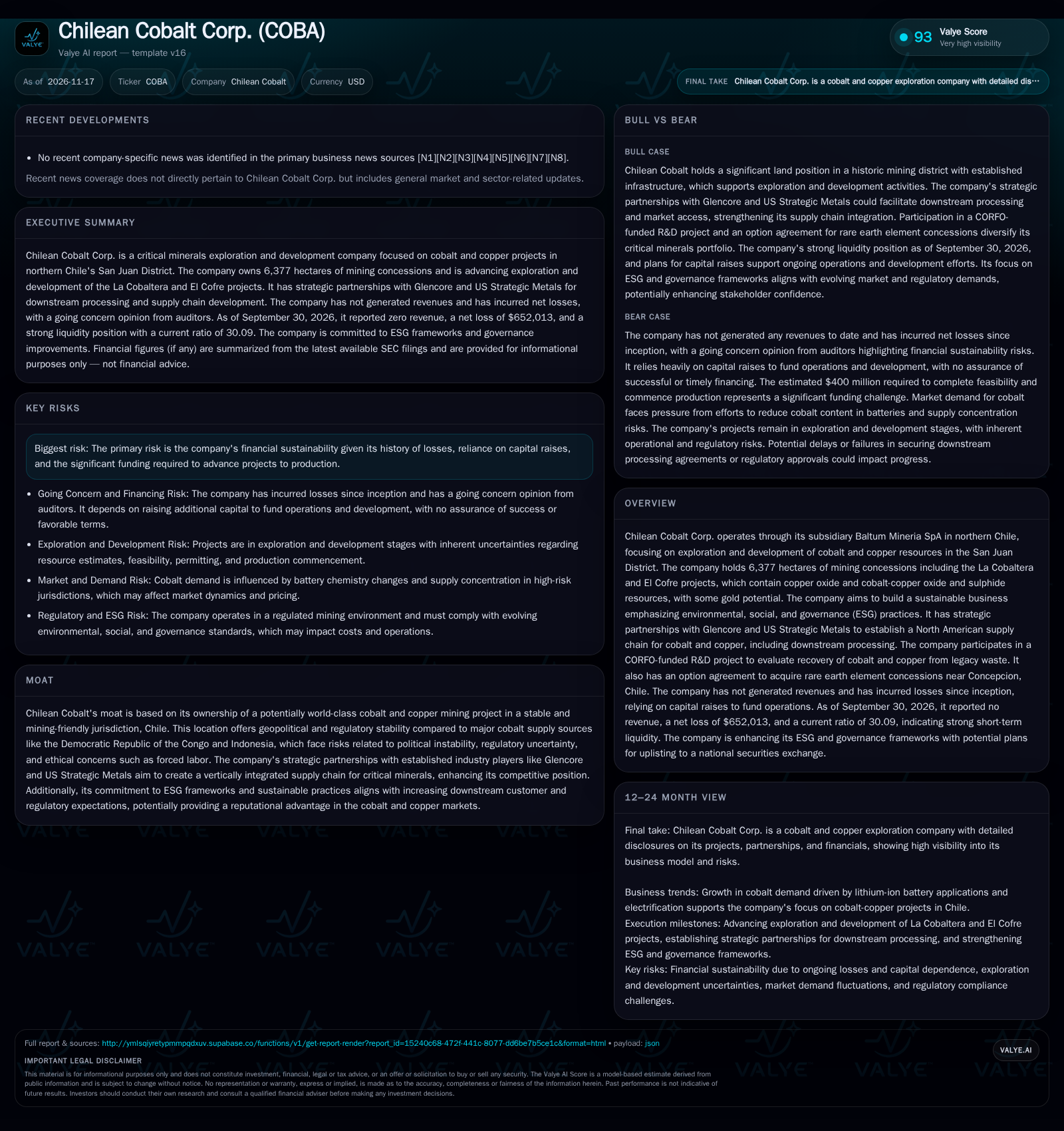
Chilean Cobalt Corp. owns 6,377 hectares of cobalt and copper concessions in Chile’s San Juan District, is developing two primary projects, and has strategic partnerships with Glencore and US Strategic Metals for downstream integration. Despite a robust current ratio, the company has not generated revenue, operates at a loss, and faces a $400 million capital need to reach production. The pathway to value realization depends on funding, resource validation, and evolving cobalt market dynamics. [S1] [S2]
Chilean Cobalt Corp. is positioning itself as a future supplier of critical cobalt and copper resources, crucial for the electrification and battery sectors. Owning extensive mining rights in Chile’s San Juan District and engaging with major industry partners, the company has staked out a potentially valuable position in the global supply chain. However, with ongoing net losses, zero revenue, and a $400 million funding requirement to reach production, Chilean Cobalt’s path to commercial viability is fraught with operational, financial, and market uncertainties. The company’s ability to convert its resource base into a sustainable business will depend on financing, project execution, and the shifting landscape for battery metals.
Recent Developments Define a High-Stakes Exploration Phase
Chilean Cobalt Corp. currently owns 6,377 hectares of unencumbered mining concessions in the San Juan District of northern Chile, with two primary projects—La Cobaltera and El Cofre—hosting cobalt and copper oxide and sulphide resources, and gold potential at depth [S1]. As of September 30, 2026, the company has not generated revenue and reported a net loss of $652,013 for the quarter, continuing a pattern of losses since inception [S2]. Despite this, Chilean Cobalt reported liquidity-ratio trends of 30.09, with $3.3 million in current assets against $110,024 in current liabilities, indicating reported liquidity position but not solving the long-term capital challenge [S2]. The company estimates it will need approximately $400 million to move from feasibility through to saleable product and has raised $34.1 million to date, with further capital raises planned [S1]. Strategic partnerships with Glencore and US Strategic Metals aim to facilitate downstream processing and establish a North American supply chain for cobalt and copper [S1].
Project Economics: High Fixed Costs and the Search for Scale
Chilean Cobalt’s business model, like most junior miners, is characterized by high upfront capital intensity and long lead times before revenue generation. The company’s primary assets are its mining concessions and resource potential; value realization depends on progressing from exploration and feasibility to actual production. The estimated $400 million required to reach commercial output reflects the need for extensive drilling, feasibility studies, permitting, infrastructure, and the construction of processing facilities [S1]. Until production, fixed costs—such as monthly operating expenses of approximately $404,000—are funded by periodic capital raises [S1].
If the company advances to production, revenue would derive from the sale of cobalt and copper concentrates or refined product, with pricing tied to global commodity markets. The potential for downstream integration via partnerships with Glencore and US Strategic Metals could allow for margin capture beyond the mine gate, but commercial terms, offtake agreements, and processing arrangements are not yet established [S1]. Operating leverage could be significant once the fixed cost base is covered, but the risk is that delays or cost overruns could erode project economics. The company’s participation in a CORFO-funded R&D project to recover metals from legacy waste piles may offer a lower-capex, higher-margin route if technically and commercially viable [S1].
Resource Location, Strategic Partners, and ESG: Building Blocks of Differentiation
Chilean Cobalt’s competitive position rests on three pillars: location, partnerships, and ESG posture. Its mining assets are in Chile, a jurisdiction with established mining infrastructure, regulatory stability, and lower geopolitical risk than dominant cobalt sources like the Democratic Republic of the Congo (DRC). This could be attractive to OEMs and battery manufacturers seeking ethically sourced, traceable supply.
Strategic partnership frameworks with Glencore and US Strategic Metals aim to create a North American supply chain, potentially offering offtake certainty, technical support, and downstream market access [S1]. However, the effectiveness of these partnerships will depend on execution and the eventual terms negotiated. The company’s commitment to ESG frameworks—such as Digbee and IRMA—and participation in independent assessments may enhance its appeal to sustainability-focused investors and customers, potentially reducing risk premiums or opening access to green capital pools [S1].
Counterforces include the volatility of cobalt pricing, substitution risk from battery chemistries reducing cobalt intensity, and competition from both established producers and new entrants, including those in Indonesia and Africa. Without a demonstrated resource, proven processing flow sheet, and a clear path to market, Chilean Cobalt’s competitive advantages remain largely potential rather than realized.
From Exploration to Production: How a Funding and Execution Breakthrough Could Create Value
The most favorable scenario for Chilean Cobalt is a successful transition from exploration to development, underpinned by securing the full $400 million required to fund feasibility studies, construction, and commissioning. This would likely require a combination of equity, debt (potentially including the non-binding Export-Import Bank of the United States interest for up to $317.4 million [S1]), and possibly strategic investment from partners.
If exploration confirms robust, economically recoverable cobalt and copper resources with competitive grades and costs, and if downstream processing partnerships materialize on favorable terms, the company could become a key supplier to North American and European battery value chains. ESG credentials and Chilean provenance could further enhance product premiums or offtake terms. Confirmation of this scenario would come from: (1) successful completion of feasibility studies; (2) binding offtake or financing agreements; (3) permitting milestones; and (4) demonstration of technical viability in processing legacy waste or primary ore.
Incremental Progress Amid Funding and Technical Uncertainty
The most plausible near-term outcome is a period of incremental progress characterized by continued exploration/development work, ongoing capital raises, and gradual de-risking of the project portfolio. The company may secure additional non-dilutive funding through grants or partnerships, but is likely to remain pre-revenue and loss-making over the next 12-24 months.
Evidence supporting this scenario would include regular technical updates (e.g., resource estimates, metallurgical results), successful small-scale pilot programs (such as the CORFO waste recovery project), and continued engagement with strategic partners. Signs of slippage would be persistent delays in feasibility milestones, inability to secure meaningful new funding, or adverse shifts in cobalt/copper market sentiment. The base case assumes that the company remains a leveraged play on the global critical minerals theme, but without a near-term catalyst for re-rating until commercial viability is more clearly established.
Funding Shortfalls and Market Shifts Could Stall Project Advancement
In a negative scenario, Chilean Cobalt could face acute funding constraints, failing to raise the capital needed to advance feasibility studies or maintain project momentum. This could result in project delays, forced asset sales, or even insolvency if equity markets tighten or strategic partners withdraw.
Compounding this risk is the potential for adverse market developments: a sustained downturn in cobalt or copper prices, accelerated substitution of cobalt in battery chemistries, or regulatory/permitting setbacks in Chile. Confirmation of this scenario would include missed capital-raising targets, deterioration in partner relationships, negative technical results, or a material going concern warning with no clear path to remedy.
Milestones and External Factors That Will Determine if Chilean Cobalt Can Become a Viable Producer
Progress on raising the estimated $400 million required for feasibility, construction, and production—whether through debt, equity, or strategic partnerships.
Completion and publication of resource estimates and feasibility studies for La Cobaltera and El Cofre projects.
Technical results and commercial viability of the CORFO-funded R&D project for cobalt and copper recovery from legacy waste piles.
Securing binding offtake agreements, downstream processing arrangements, or joint ventures with Glencore, US Strategic Metals, or other industry partners (if disclosed).
Evidence of regulatory progress, including environmental permitting and community engagement milestones.
Updates on rare earth element concession option near Concepcion and any associated resource delineation.
Sustained adherence to and third-party validation of ESG frameworks (e.g., Digbee, IRMA), as these may influence access to capital and customer relationships.
Disclosure of any material changes in monthly operating expenses, capital requirements, or risk factors in subsequent filings.
Disclaimer: This is research-only, informational analysis and not investment advice. It may include AI-generated interpretation and general industry context. Always verify important details using primary sources.

Comments