
Cocrystal Pharma: Antiviral Ambitions at a Clinical and Financial Crossroads
Cocrystal Pharma advances oral antiviral candidates for high-need viral diseases, but widened losses, a pending norovirus data readout, and unresolved influenza trial disputes underscore execution risk and a narrowing funding window.
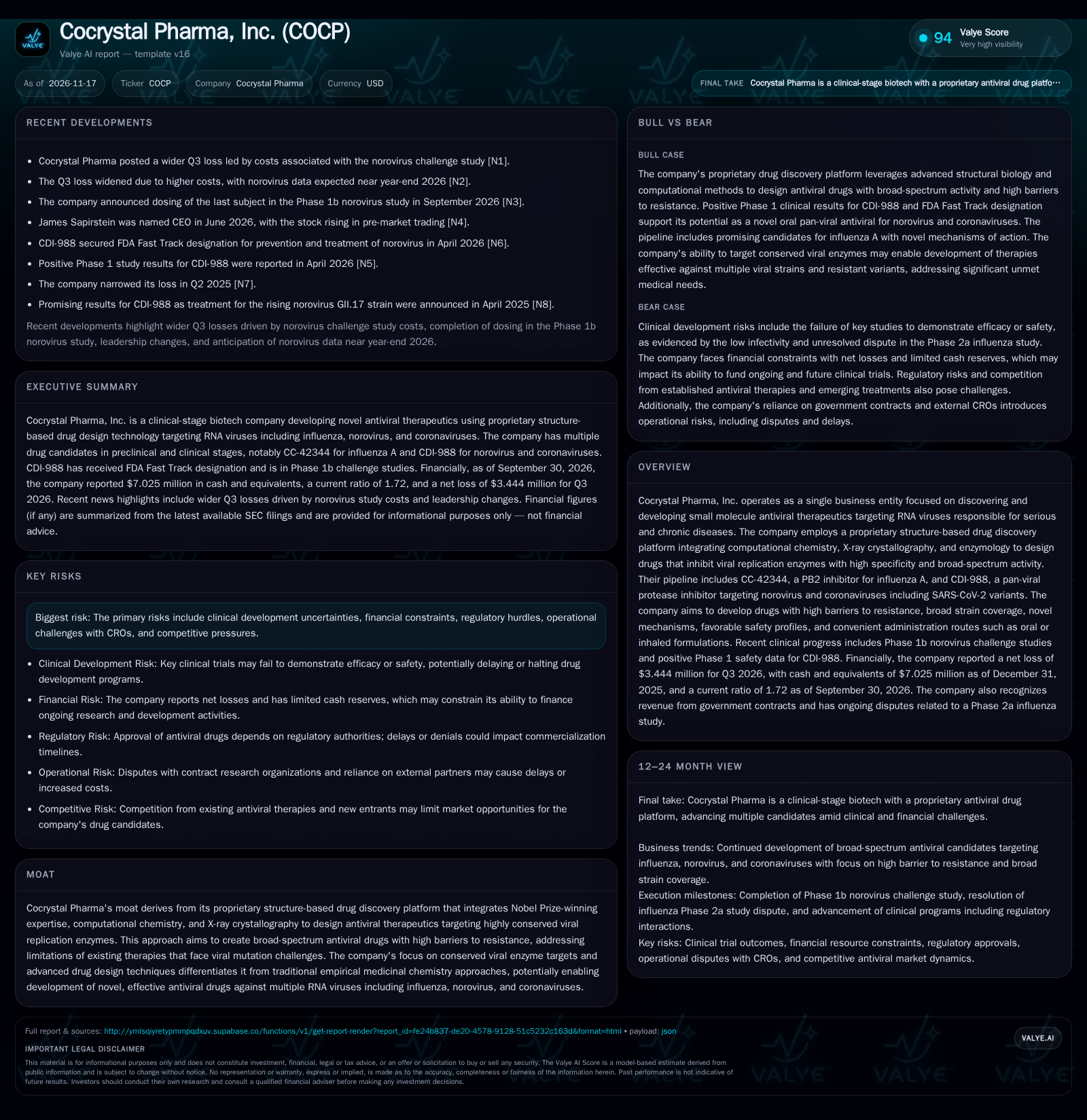
Cocrystal Pharma is a clinical-stage biotech leveraging structure-based drug design to develop antivirals for influenza, norovirus, and coronaviruses. Recent milestones include completing dosing in a Phase 1b norovirus study and securing FDA Fast Track for CDI-988, but Q3 losses widened due to trial costs and cash remains limited. Near-term value hinges on upcoming clinical data and the company’s ability to resolve operational disputes and secure further funding.[N1] [N2] [N3] [N6] [S2]
Cocrystal Pharma stands at a pivotal junction as it pursues broad-spectrum antivirals for major global health threats. While recent clinical milestones, such as the completion of Phase 1b dosing for its norovirus candidate and FDA Fast Track status, signal technical progress, the company’s widening losses and unresolved operational challenges highlight the fragility of its current position. With key data due and a narrowed funding window, Cocrystal’s near-term trajectory will be defined by clinical outcomes, dispute resolutions, and its ability to secure additional capital for continued development.[N1] [N2] [N3] [N6] [S2]
Recent Milestones and Setbacks Define the Clinical and Financial Landscape
Cocrystal Pharma’s Q3 2026 net loss widened to $3.444 million, primarily due to increased costs from its norovirus challenge study, while cash and equivalents stood at $7.025 million as of December 31, 2025.[N1] [S2] The company completed dosing in its Phase 1b norovirus study in September 2026, with key data readouts expected near year-end.[N2] [N3] CDI-988, its oral protease inhibitor for norovirus and coronaviruses, secured FDA Fast Track designation in April 2026 and reported positive Phase 1 safety results.[N5] [N6] However, progress on the influenza A program (CC-42344) remains stalled due to a dispute with a contract research organization following inconclusive Phase 2a study results, with arbitration ongoing.[S2] The company completed a $5 million equity raise in July 2026, but ongoing net losses highlight a narrowing cash runway and the need for further funding.[S2]
The interplay between clinical progress and financial health is critical for Cocrystal, as the timing of data readouts directly influences investor confidence and funding availability. In clinical-stage biotechs, the period following trial completion but before data dissemination often heightens uncertainty, which can exacerbate cash management challenges. This dynamic underscores the importance of efficient trial execution and transparent communication strategies to maintain stakeholder trust. Additionally, the unresolved arbitration with the CRO not only delays the influenza program but also introduces operational risk that can reverberate through budgeting and resource allocation decisions, potentially constraining the company's ability to pivot or accelerate other pipeline initiatives.
How Cocrystal’s Platform Could Unlock Value—If Development Hurdles Are Cleared
Cocrystal’s business model is that of a classic clinical-stage biotech: value is realized through successful advancement of proprietary drug candidates, leading to potential out-licensing, strategic partnerships, or eventual commercialization. Its structure-based drug design platform targets conserved viral enzymes, aiming for broad-spectrum efficacy and high resistance barriers—a desirable profile for pandemic-prone RNA viruses. The main economic levers are successful clinical trial outcomes and regulatory milestones, which could unlock non-dilutive funding, partnership payments, or licensing deals.
At present, nearly all expenses are R&D, with minimal revenue recognized from government SBIR grants ($435,000 over nine months in 2026), and no product sales.[S2] Fixed costs are relatively contained for a single-program biotech, but the variable costs of clinical trials are significant, as reflected in the Q3 loss spike.[N1] The $5 million equity raise in July 2026 provides a temporary buffer, but given the cash burn rate, further fundraising will likely be required absent a major partnering event or clinical success.[S2] If a candidate advances to late-stage trials or attracts licensing interest, Cocrystal could see a step change in its funding mix and operational leverage.
The platform's reliance on structure-based drug design confers potential efficiency gains in lead optimization and candidate selection, which, if realized, could shorten development timelines and reduce costly late-stage failures. However, these benefits depend heavily on the robustness of the underlying computational models and the translatability of in vitro binding affinities to clinical efficacy. Moreover, the economic model is sensitive to clinical trial design choices; for instance, adaptive trial designs or biomarker-driven patient selection could improve success probabilities and cost-effectiveness but require upfront investment and regulatory alignment. The conditional nature of funding inflows—often tied to milestone achievements—means that any delays or setbacks could disproportionately impact liquidity, necessitating contingency planning and diversified financing strategies.
Platform Differentiation Faces Entrenched Rivals and Rapidly Evolving Threats
Cocrystal’s competitive edge rests on its structure-based drug design platform, which integrates computational chemistry and X-ray crystallography to target highly conserved viral replication enzymes. This approach aims to deliver antivirals with broad strain coverage and high resistance barriers—attributes especially valuable in influenza, norovirus, and coronavirus markets where viral mutation can rapidly undermine existing therapies.
However, the antiviral landscape is highly competitive, with established pharmaceutical players and several well-funded biotechs pursuing similar broad-spectrum or next-generation antivirals. For influenza, entrenched therapies (such as neuraminidase inhibitors or baloxavir) dominate, and any new entrant must demonstrate clear efficacy, resistance advantage, or improved administration. The norovirus space is less crowded but still attracts significant interest, especially for oral therapies with pandemic potential. If Cocrystal’s candidates can show strong clinical efficacy, safety, and resistance profiles, the platform could attract licensing or acquisition interest, but absent such data, differentiation remains theoretical.
While Cocrystal’s platform targets conserved viral enzymes to mitigate resistance development, the rapid evolution of RNA viruses poses an ongoing challenge that could erode long-term efficacy and market exclusivity. Competitors with larger pipelines and broader therapeutic portfolios may also leverage combination therapies or platform synergies to outpace single-agent approaches. Furthermore, regulatory expectations for antiviral approval increasingly emphasize not only efficacy but also real-world effectiveness and resistance monitoring, which could raise development complexity and costs. Therefore, Cocrystal’s ability to demonstrate meaningful clinical differentiation and durability of response will be pivotal in securing competitive positioning and justifying premium valuations or partnership terms.
Breakout Potential Hinges on Positive Norovirus Data and Strategic Partnerships
If the upcoming Phase 1b norovirus challenge study demonstrates a meaningful reduction in clinical symptoms and viral shedding, Cocrystal could rapidly advance CDI-988 into Phase 2 or attract licensing interest from larger pharma partners.[N2] [N3] The FDA Fast Track designation may expedite regulatory interactions, and positive data would validate the platform’s ability to generate broad-spectrum, resistance-robust antivirals—a differentiator in a market hungry for pandemic preparedness.
Confirmation of this upside would come from: (a) statistically significant efficacy signals in the Phase 1b norovirus data, (b) announcements of licensing deals or partnership agreements, and (c) non-dilutive funding tied to clinical progress. Additional upside could emerge if the influenza program dispute is resolved and CC-42344 reenters clinical development. Falsification would be signaled by negative or inconclusive clinical results, lack of partner interest despite positive data, or inability to secure additional funding without further dilution.
Development Continues Amid Funding Pressures and Operational Uncertainty
This scenario would be confirmed by steady but incremental clinical progress, such as initiation of Phase 2 studies or extension of government funding, but without transformative licensing deals. Falsification would occur if the company runs into acute cash shortages, triggers major layoffs or program halts, or fails to resolve operational disputes—resulting in stalled pipeline progress.
Clinical or Operational Setbacks Could Force Strategic Retrenchment
If the Phase 1b norovirus data are negative, inconclusive, or delayed, Cocrystal could face urgent funding challenges, with limited ability to raise capital on acceptable terms given its widened losses and unresolved influenza program. Operational setbacks—such as protracted disputes with CROs or regulatory delays—could further erode confidence and trigger program pauses or staff reductions.
Downside confirmation would include: (a) public disclosure of negative clinical trial results or trial discontinuation, (b) failure to raise new capital or raising at highly dilutive terms, (c) visible pipeline contraction, or (d) extended delays in resolving the influenza CRO dispute. A lack of new partnerships, licensing interest, or government grants would compound these pressures, increasing the risk of strategic alternatives or asset sales.
Milestones That Will Shape Cocrystal’s Clinical and Strategic Trajectory
Top-line results from the Phase 1b norovirus challenge study at Emory University—especially efficacy endpoints such as reduction in clinical symptoms and viral shedding.
Resolution or escalation of the dispute and arbitration with the CRO over the influenza Phase 2a study; a clear path forward for CC-42344 would be a positive signal.
Updates on potential licensing, partnership, or non-dilutive funding deals for CDI-988 or other pipeline assets.
Cash burn rate and runway projections following the recent $5 million equity raise; updated guidance on funding needs would help clarify dilution risk.
FDA or other regulatory interactions for both CDI-988 and CC-42344, including feedback on Fast Track status or trial design.
Progress on government grant applications or extensions, as non-dilutive funding is a critical buffer.
Leadership and R&D team stability under new CEO James Sapirstein, and any changes to strategic focus or operational priorities.
Disclaimer: This is research-only, informational analysis and not investment advice. It may include AI-generated interpretation and general industry context. Always verify important details using primary sources.

Comments