
Concentra Group Expands Occupational Health Leadership Through Innovation and Scale
Concentra leverages its extensive U.S. network, technological innovation, and diverse services to sustain growth and strengthen market leadership in occupational health.
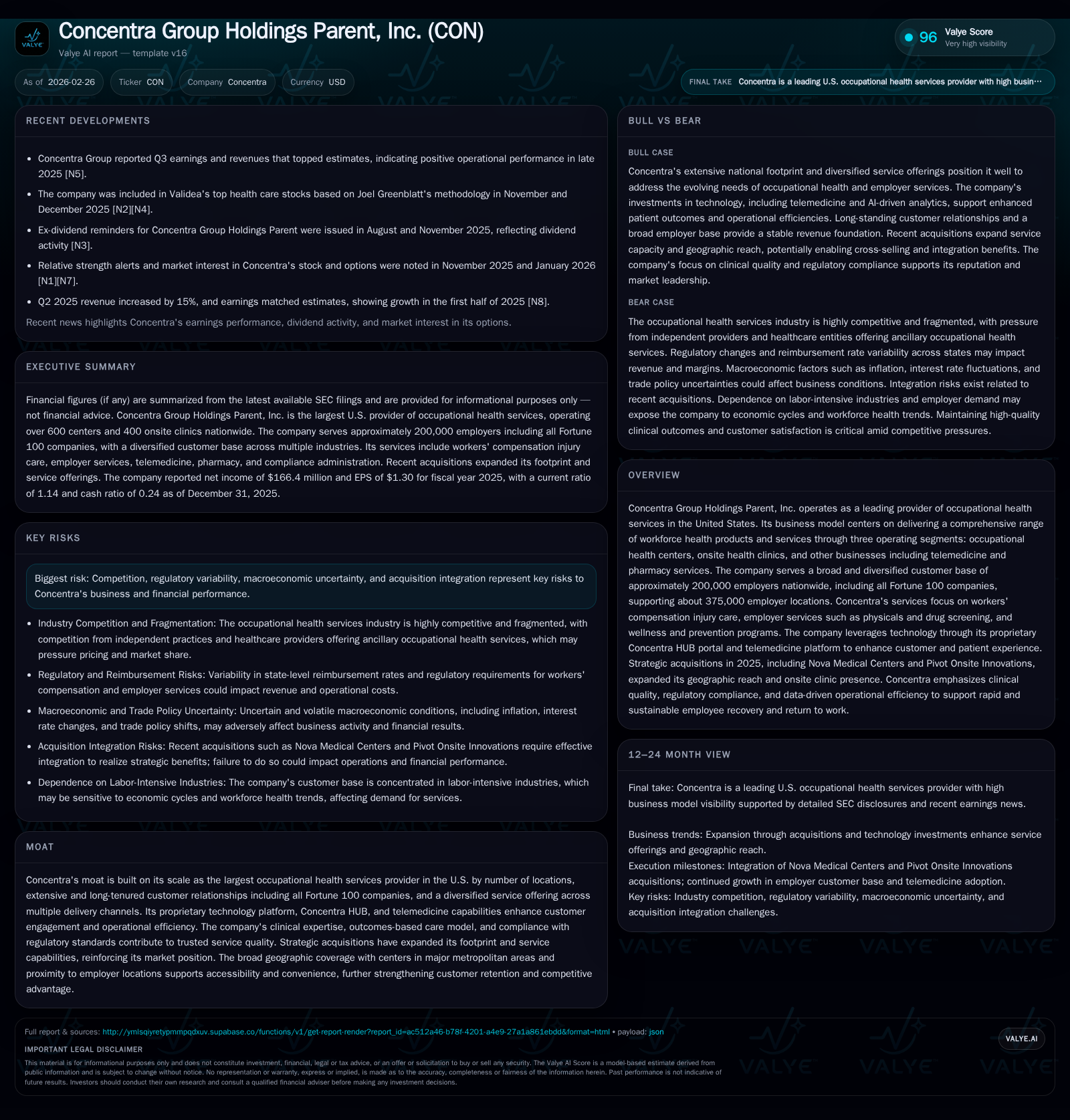
As the largest occupational health services provider in the U.S., Concentra Group Holdings Parent, Inc. has demonstrated steady financial and operational growth driven by its expansive clinic footprint and diversified service mix. Recent acquisitions and ongoing enhancements to its telemedicine platform underpin future growth prospects, complemented by deep, long-tenured relationships with a broad employer base including all Fortune 100 companies. While regulatory complexity and integration risks linger, the company’s disciplined capital allocation balances reinvestments with shareholder returns.
Track Record of Steady Growth and Operational Strength
Concentra Group Holdings Parent, Inc. is the largest occupational health services provider in the United States by number of locations. The company’s financial results demonstrate steady growth coupled with operational discipline. In fiscal year 2025, operating income rose approximately 9.6% to $334 million from $305 million in 2024 [F1], underscoring effective leverage as patient volumes increased alongside expanded center count.
Net income remained stable at around $166 million between those years [F1], signaling moderate margin pressure or reinvestments supporting growth initiatives. Operating cash flow grew modestly by 1.7%, reaching roughly $279 million in 2025 [F1], demonstrating resilient cash generation amid ongoing capital expenditures.
The company serves approximately 53,000 patients daily across its network—a figure reflecting both organic demand growth and capacity expansion through acquisitions [S6][S11]. The ability to capture volume gains without proportional cost increases points to operational efficiencies enabled by scale.
Historical performance (annual)
| FY | Net ($mm) | CFO ($mm) | OpInc ($mm) | Capex ($mm) | Net YoY |
|---|---|---|---|---|---|
| 2025 | 166 | 279 | 334 | 82 | -0.1% |
| 2024 | 167 | 275 | 305 | 64 |
Source: SEC companyfacts cache [F1].
Capital returns and efficiency (annual)
| FY | Div ($mm) | Buybacks ($mm) | FCF ($mm) |
|---|---|---|---|
| 2025 | 8 | 22 | 197 |
| 2024 | 8 | 15 | 210 |
Source: SEC companyfacts cache [F1].
Source: Company filings [F1]
Operating Segments Fueling Market Dominance
Concentra operates three primary segments: Occupational Health Centers (OHC), Onsite Health Clinics (OHCs), and Other Businesses encompassing telemedicine and pharmacy solutions [S4][S14]. For the year ending December 31, 2025, roughly 93% of revenue was generated by OHCs which focus on workers' compensation injury care alongside employer services such as physical examinations and drug screening [S14][S16].
Onsite health clinics represent about 5% of revenue with over 411 permanent locations embedded within employer worksites nationwide—strategically positioned to lower barriers to care [S14][S21]. Other businesses constitute approximately 2% of revenue but are gaining relevance driven by investments in Concentra Telemed and pharmacy services that enhance omnichannel delivery.
This diversified portfolio reduces client concentration risk while enabling scalable expansion across new geographies and adjacent service lines. Across all channels, Concentra serves more than 200,000 employers including all Fortune 100 companies — highlighting broad market penetration [S5][S6].
Innovation via Telemedicine and Technology Platforms
A key competitive differentiator is Concentra’s proprietary technology infrastructure anchored by the Concentra HUB — a customer portal providing self-service access for employers, insurers, and third-party administrators around the clock [S9]. Approximately two-thirds of employer customers actively use this platform.
Concentra Telemed offers virtual visits for work-related injuries with a centralized clinical team available nonstop [S7][S21]. Since launching in recent years, Telemed has expanded substantially addressing unmet behavioral health needs within workers’ compensation—a sector marked by provider shortages.
The company employs sophisticated data interoperability practices enabling seamless information exchange among partners to boost efficiency and optimize clinical outcomes such as reduced claim duration and return-to-work rates [S7][S9]. Artificial intelligence tools support predictive modeling targeting patient noncompliance risk forecasting and automated chart reviews — reflecting advanced clinical frameworks customary in scaled occupational health organizations.
Customer Base Breadth and Industry Diversification
Concentra’s customer portfolio includes nearly 200,000 employers spanning manufacturing, staffing agencies, retail, healthcare providers, food services/restaurants, government agencies, transportation/logistics to construction and wholesale trade—no single industry accounts for more than a tenth of revenues [S6]. This wide industrial spread ensures resilience against sector-specific slowdowns.
Revenue contribution from the largest employer customer is under three percent while the top thousand clients collectively account for about thirty-seven percent of occupational health center revenues [S5]. Retention is strong with ninety-eight percent of top hundred customers partnering for over a decade [S9], underscoring durable long-term relationships driven by trusted clinical expertise, personalized engagement models featuring local management collaboration for tailored workforce health improvements.
Financial Resilience: Capital Allocation and Shareholder Returns
Capital stewardship balances reinvestment with shareholder value measures.
Return on equity reached approximately forty-two percent in fiscal year 2025 calculated as net income over equity ($166 million/$393 million) indicating high capital efficiency despite capital intensity demands [F1]. Free cash flow after capital expenditure was strong near $197 million reflecting solid liquidity even as capex rose significantly—28% higher than prior year reflecting investments into center expansions plus technology platforms [F1].
Share repurchases accelerated with $22 million spent on retiring shares versus $15 million prior year under a board-approved program extending through end-2027 [S13][S22]. Dividends remained modest but stable near $8 million supporting consistent distributions aligned with earnings trends.
Liquidity remained solid featuring a current ratio above one (approximately 1.14) confirming sound short-term balance sheet positioning alongside manageable long-term debt refinanced favorably during recent periods reducing interest costs [F1][S12][S25].
Growth Opportunities Amid Adjacencies and Expansion Plans
Beyond core occupational health services, Concentra is positioning itself to capture emerging workforce health needs through strategic investments:
- Expanding behavioral health offerings via telemedicine platforms designed specifically for workers’ compensation cases where traditional providers fall short [S4].
- Pursuing horizontal integrations such as workplace safety consulting and vertical moves into specialty care aimed at broadening the occupational healthcare spectrum delivered directly or via partnerships [S4].
- Scaling onsite clinic footprint further to harness rising direct-to-employer primary care demand including modalities focused on chronic condition management augmented by behavioral interventions launched recently [S21].
- Continuously enhancing digital assets like Concentra HUB to capture higher engagement driving visit volumes organically while offering data-driven insight tools for employers.
These illustrate a multi-pronged strategy leveraging horizontal expansion across related service segments alongside vertical integration within occupational healthcare to increase wallet share per customer.
Navigating Challenges and Regulatory Dynamics
Competitive pressures arise from a highly fragmented landscape populated by independent practices specializing solely in occupational health alongside ancillary healthcare providers offering related services at scale but outside dedicated workers' comp niches [S10][S11]. This intensifies the need for continuous innovation combined with network density advantages held firmly by Concentra.
Regulatory variability across states introduces reimbursement complexity as workers’ compensation fee schedules differ materially requiring adaptive pricing strategies—historically yielding approximately +3% annual reimbursement rate increases balancing inflationary cost pressures yet posing potential headwinds if policy shifts unfavorably materialize [S27].
Macroeconomic uncertainty tied to labor market fluctuations impacts injury incidence affecting volume; geopolitical tensions or tariff changes could indirectly affect broader economic conditions relevant for employment levels especially in manufacturing sectors representing large portions of client bases [S2].
Integration risks from recent sizable acquisitions remain pertinent; these encompass cultural alignment challenges along with system harmonization which could impact near-term margins despite expected long-term accretion given management experience executing over two hundred transactions historically [S16][S25]. Cybersecurity threats requiring ongoing vigilance represent another operational risk vector given sensitive healthcare data handled extensively across platforms [S26].
Key Metrics to Monitor for Future Performance
Based on latest disclosures ([N1],[S3]), stakeholders should track:
- Patient visit growth trends across physical centers versus telemedicine channels to gauge transition toward omnichannel delivery models.
- Telemedicine adoption rates measured by patient usage levels and claims processed remotely indicating scalability of remote care solutions.
- Clinical outcomes statistics including total claim cost reductions compared with benchmarks plus average days away from work post-injury reflecting quality adjustments protecting competitive positioning.
- Integration success markers post recent acquisitions quantified through retention rates of acquired customers/employees plus realization of targeted synergies indicated through sequential margin improvement or EBITDA accretion metrics publicly communicated.
- Uptake of Concentra HUB functionalities correlating with higher self-service engagement contributing to administrative efficiency gains. Monitoring these will illuminate how well Concentra navigates evolving market dynamics while bridging traditional care models with innovative digital strategies.
Disclaimer: This report is based solely on publicly available company filings and news disclosures as cited; it does not constitute investment advice or recommendations.
Disclaimer: This is research-only, informational analysis and not investment advice. It may include AI-generated interpretation and general industry context. Always verify important details using primary sources.

Comments