
Chesapeake Utilities Corp Expands Regulated Footprint Amid Rising Capex and Flat Free Cash Flow
Chesapeake Utilities balances regulated energy growth with elevated capital expenditures, testing its cash flow profile.
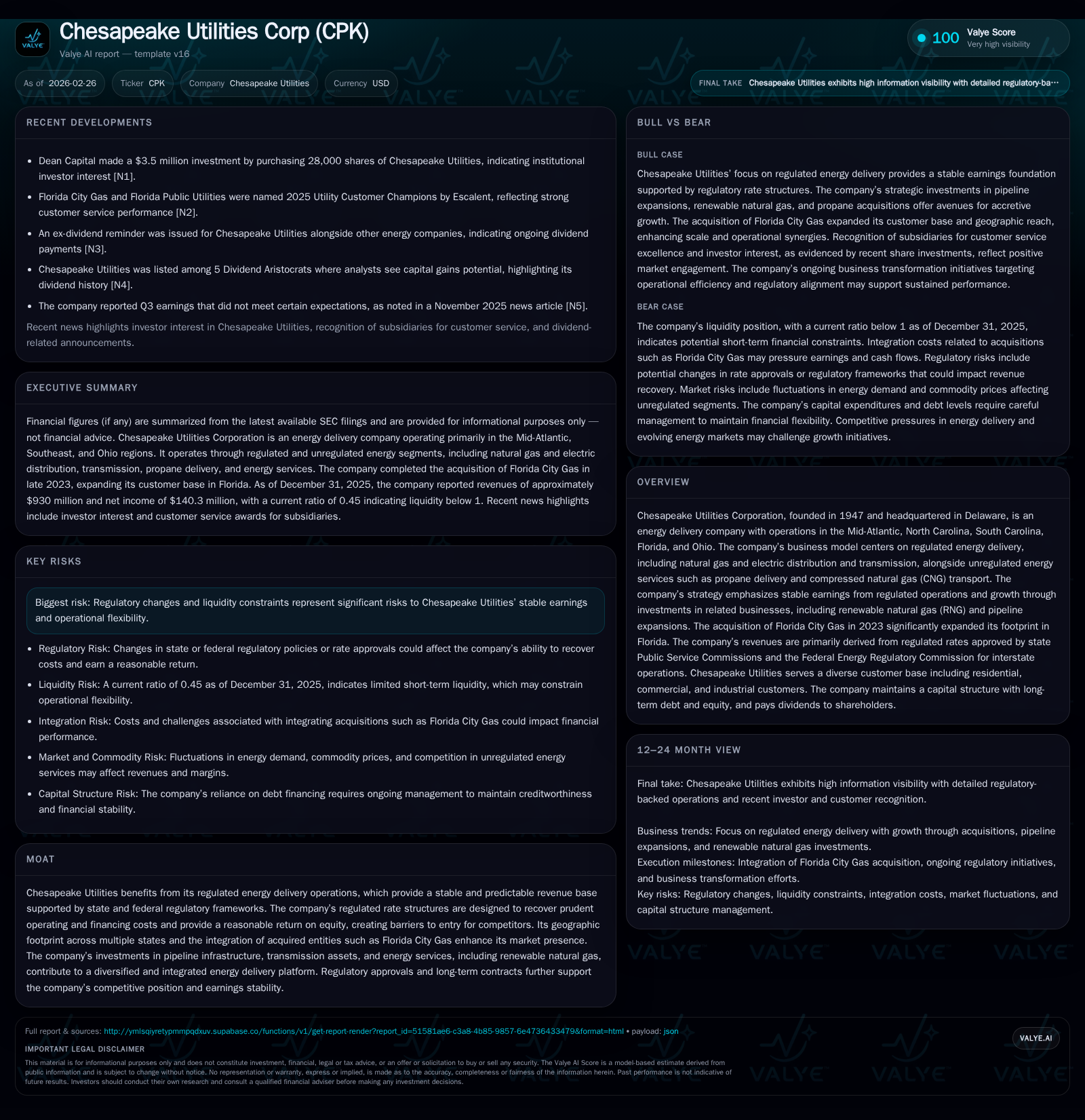
Chesapeake Utilities Corporation delivered steady top-line and net income growth in 2025, fueled by continued investments in regulated energy delivery and the Florida City Gas acquisition. The company’s core strategy hinges on stable returns from regulated natural gas and electric distribution, supplemented by growth in non-regulated energy services such as propane and compressed natural gas transport. Despite robust revenue increases, free cash flow remained negative due to sharply higher capital spending aimed at infrastructure expansion. Chesapeake maintains financial flexibility through a diversified debt maturity schedule but faces potential constraints from its current ratio below one. Monitoring regulatory developments and execution on pipeline expansions will be critical for sustaining earnings momentum and improving cash flow generation.
Company Overview
Founded in 1947 and based in Delaware, Chesapeake Utilities Corporation (CPK) operates across multiple states including the Mid-Atlantic, North Carolina, South Carolina, Florida, and Ohio. It is fundamentally an energy delivery company that integrates regulated natural gas and electric distribution & transmission with unregulated businesses such as propane delivery and compressed natural gas (CNG) transport. The firm's business model emphasizes generating stable earnings from rate-regulated operations overseen by state Public Service Commissions (PSCs) and the Federal Energy Regulatory Commission (FERC). This foundation underpins its growth via strategic acquisitions and investments in adjacent energy services.
A transformational move was the 2023 acquisition of Florida City Gas for approximately $922.8 million in cash,[S25] significantly expanding Chesapeake's footprint into one of the fastest-growing utility markets in Florida.[N3] This broadened geographic exposure supports scale economies and brand presence.
Historical Financial Performance
Chesapeake has displayed consistent top-line expansion over the past four years with a compound growth pattern driven both organically through regulated rate base increases and via acquisitions. Between FY2022 and FY2025, revenues advanced from approximately $681 million to $930 million,[F1] representing a three-year CAGR near 10%. The most significant jump was recorded in 2025 where revenues grew 18.1% over prior year,[F1] attributable largely to the consolidation of Florida City Gas as well as rate base growth across regulated operations.
Operating income expanded correspondingly from about $143 million in FY2022 to roughly $256 million in FY2025,[F1] a compound rise signaling improved operating leverage. Net income also increased steadily, registering an 18.3% gain in the latest fiscal year to $140.3 million,[F1] reflective of disciplined expense control during rising costs.
However, while operating cash flows increased substantially from $159 million in FY2022 to approximately $234 million in FY2025,[F1] free cash flow turned negative given accelerated capital spending needs that outpaced operating cash generation.[F1]
Historical performance (annual)
| FY | Rev ($mm) | Net ($mm) | CFO ($mm) | OpInc ($mm) | Rev YoY | Net YoY |
|---|---|---|---|---|---|---|
| 2025 | 930 | 140 | 234 | 256 | +18.1% | +18.3% |
| 2024 | 787 | 119 | 239 | 228 | +17.4% | +36.0% |
| 2023 | 671 | 87 | 203 | 151 | -1.5% | -2.9% |
| 2022 | 681 | 90 | 159 | 143 |
Source: SEC companyfacts cache [F1].
Capital returns and efficiency (annual)
| FY | Div ($mm) | FCF ($mm) | ROE% |
|---|---|---|---|
| 2025 | 61 | -215 | 8.8 |
| 2024 | 54 | -116 | 8.5 |
| 2023 | 40 | 15 | 7.0 |
| 2022 | 35 | 31 | 10.8 |
Source: SEC companyfacts cache [F1].
Note: Dividends paid reflect amounts declared during each fiscal year.[F1]
Segment Composition and Industry Positioning
Chesapeake’s operations are segmented into:
- Regulated Energy: This core segment encompasses natural gas distribution and transmission along with electric distribution operations primarily in Delaware, Maryland, Pennsylvania/non-Florida Mid-Atlantic states, Ohio, and Florida post-acquisition.[S26]
- Unregulated Energy: Includes propane retail/delivery services, mobile CNG transportation via Marlin Gas Services, LNG/RNG initiatives linked to methane capture technologies.[S25]
The regulatory framework under state PSCs and FERC supports cost recovery mechanisms that stabilize cash flows by allowing recovery of prudent costs plus stipulated returns on equity (ROE). The regulated business benefits from natural monopolies within service territories restricting competitive threats.
Chesapeake leverages this moat alongside strategic investment into sustainable fuels such as renewable natural gas (RNG), which align with evolving regulatory mandates for decarbonization.[S25]
Capital Allocation and Returns Profile
Chesapeake demonstrates a conservative capital return policy anchored around dividend distributions which rose to $60.7 million in FY2025 from $54.2 million the prior year.[F1][S9][S18]
The company did not engage in share repurchase activities during FY2025,[F1] focusing likely on funding capital projects through equity issuance or debt facilities.[S9]
Financial metrics estimate an ROE near 8.8% for FY2025 derived from net income relative to common equity (~$1.6 billion), consistent with regulated utility targets but somewhat below higher-growth peers.[F1]
Cash flows reflect solid operational performance but are currently pressured due to heavy capex spend (about $448 million vs ~$234 million CFO), producing an approximate negative free cash flow of around $215 million for the year.[F1]
This divergence points toward the reinvestment phase following strategic acquisitions and organic growth capex.
Liquidity and Balance Sheet Considerations
The balance sheet has expanded along with business scale; equity reached nearly $1.6 billion at year-end FY2025,[F1] buttressed by retained earnings accumulation.
Debt financing is well diversified across maturities spanning near-term obligations like notes maturing late-2026 through long-dated bonds due into the late-2030s/early-2040s, aiding interest rate risk management.
Current liabilities stand at about $530 million against current assets of roughly $237 million resulting in a current ratio of approximately 0.45,[F1] suggesting potential short-term liquidity tightness that may require management attention via working capital optimization or liquidity reserves.
Future Growth Prospects
Explicit guidance remains absent; however, Chesapeake's strategic outline details clear growth catalysts:[S25]
- Pipeline expansions targeting new interstate/intrastate projects enhancing transmission capacity.
- Growing Marlin Gas Services’ footprint into LNG/RNG transport services aligning with renewable energy trends.
- Targeted propane acquisitions intended to consolidate regional presence under a unified brand.
- Investment in sustainable energy resources including methane capture technologies demonstrating ESG convergence.
- Geographic expansion focused on high-growth states like Florida through recent acquisitions (e.g., Florida City Gas).[N3][S25]
These programs should underpin both earnings accretion beyond regulatory lag adjustments as rate bases expand organically plus incremental contributions from ancillary energy services.
An internal milestone worth monitoring is progress on regulatory approvals related to pipeline expansions which will materially impact medium-term earnings profile.
Risks And Considerations
Regulatory changes remain a perennial risk impacting allowed returns or cost recovery frameworks leading to earnings volatility.[S25] Liquidity constraints highlighted by suboptimal current ratios might pressure operational flexibility if capex investment pacing accelerates further without commensurate cash inflows.[F1] Energy commodity price volatility indirectly affects non-regulated segments like propane or CNG transport operating margins. Integration risks tied to sizeable inorganic expansions including retention of customer satisfaction levels post-acquisition affect reputation and future contract renewals.[N3] Climate policy shifts could require additional technology investments or impact asset stranding risk scenarios especially for fossil fuel-related infrastructure segments.
Summary And What To Watch For Next
Chesapeake Utilities Corporation stands as a robust regional energy delivery company balancing regulated earnings stability with measured growth strategies centered on infrastructure upgrades and renewables integration. The recent acquisition-fueled revenue step-up underscores successful execution though it strains free cash flow given surging capital needs. Capital allocation appears disciplined with modest dividend increases offsetting lack of buybacks reflecting reinvestment priorities amid industry transformation. Debt maturity diversification provides financial stability yet latent liquidity tightness warrants vigilance given working capital dynamics. Upcoming focus areas include pipeline project approvals/regulatory developments in expanding service territories plus progression of RNG/methane capture deployments poised to shape future earnings trajectory. Investors should monitor quarterly updates for detailed capex ramp pacing alongside management commentary addressing balance sheet funding strategies.
Disclaimer: This analysis is intended solely for informational purposes based on disclosed data as of February 26, 2026, without offering investment recommendations or price targets.
Disclaimer: This is research-only, informational analysis and not investment advice. It may include AI-generated interpretation and general industry context. Always verify important details using primary sources.

Comments