
Pop Culture Group: Revenue Scale Meets Persistent Losses and Governance Uncertainty
Despite generating over $121 million in annual revenue, Pop Culture Group Co., Ltd faces ongoing net losses, shareholder-approved corporate migration, and public scrutiny over capital allocation—all against a backdrop of limited business model transparency.
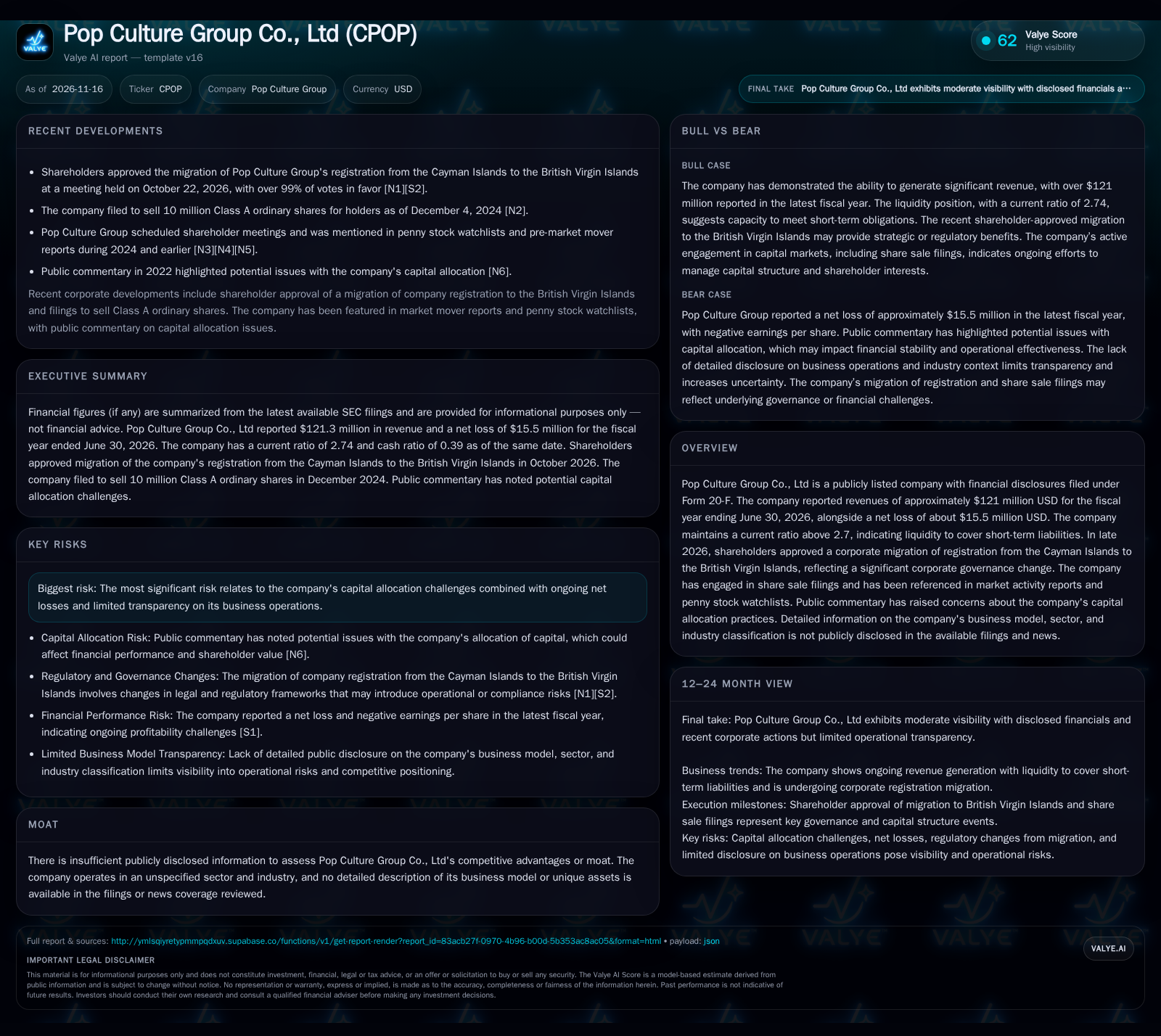
Pop Culture Group reported $121 million in annual revenue but posted a net loss of $15.5 million for the fiscal year ending June 2026. Shareholders overwhelmingly approved a migration of company registration from the Cayman Islands to the British Virgin Islands in October 2026. The company has filed to sell 10 million Class A ordinary shares and reported liquidity-ratio trends above 2.7. However, persistent losses, public concerns over capital allocation, and a lack of operational disclosure cloud the outlook and raise questions about the sustainability of its business economics and governance.
Pop Culture Group Co., Ltd stands out as a revenue-generating entity with over $121 million in sales for the most recent fiscal year, but continues to operate at a net loss and faces substantial scrutiny over its capital allocation practices. The recent shareholder approval to migrate the company’s registration from the Cayman Islands to the British Virgin Islands marks a significant governance shift, while ongoing share sale activity and limited business model transparency contribute to an uncertain investment case. The core question is whether the company’s current capital structure and governance changes can address persistent profitability challenges in the absence of clear operational disclosure.
Recent Revenue, Losses, and Governance Actions Shape the Operating Backdrop
Pop Culture Group Co., Ltd reported $121 million in revenue alongside a net loss of $15.5 million for the fiscal year ending June 30, 2026, highlighting a persistent gap between topline scale and profitability [S1]. The company reported cash and liquidity metrics for the period; these figures do not by themselves establish operating runway, investment capacity, financial flexibility, or financing capacity. In October 2026, shareholders overwhelmingly approved a migration of corporate registration from the Cayman Islands to the British Virgin Islands, representing a notable shift in legal and regulatory framework [N1] [S2]. Additionally, the company filed to sell 10 million Class A ordinary shares for holders as of December 2024, underscoring ongoing engagement with capital markets [N2]. Public commentary and news coverage have raised concerns about capital allocation, with limited transparency into how operating cash is being deployed or invested [N6]. These facts collectively underscore a business at a governance and financial crossroads, with scale but unresolved strategic and operational risks.
Examining the Underlying Economics: Revenue Scale, Losses, and Capital Structure
The disclosed $121 million annual revenue base suggests Pop Culture Group has achieved a meaningful scale, but the $15.5 million net loss signals that costs—whether from operations, overhead, or financing—consistently outstrip income [S1]. Without detailed segment or cost breakdowns, it is unclear whether losses stem from low gross margins, high fixed costs, or inefficient capital deployment.
The decision to file for a sale of 10 million Class A ordinary shares in late 2024 suggests the company is either raising capital for operational needs, restructuring, or providing liquidity for existing holders [N2]. Such dilution, in the context of ongoing losses, may be necessary to sustain operations but raises questions about long-term shareholder value if not accompanied by a credible plan toward profitability. Capital allocation concerns flagged by public commentary further imply that investments or expenditures may not be generating adequate returns [N6]. In the absence of business model details, it is difficult to assess whether the company’s economics could benefit from operating leverage, margin expansion, or improved capital efficiency.
Competitive Positioning Remains Opaque Amid Minimal Disclosure
Pop Culture Group’s competitive positioning is difficult to assess due to the lack of public information on its sector, product lines, or target customers. Without clarity on whether the company operates in entertainment, events, media, or another industry, it is impossible to benchmark its revenue scale, cost structure, or market share against peers. If the company is in a highly fragmented or commoditized segment, persistent losses could reflect pricing pressures or lack of differentiation. Alternatively, if it participates in a niche with high switching costs or brand value, the current losses may be the result of aggressive investment in growth or market capture.
The migration from the Cayman Islands to the British Virgin Islands could be motivated by regulatory or tax considerations, but may also be a response to competitive or structural pressures. Without operational details, it is unclear whether the company possesses any defensible assets—such as proprietary content, distribution channels, or technology—that could support sustainable margins or customer retention. The absence of disclosed partnerships, recurring revenue models, or ecosystem integration further clouds the competitive narrative.
How Improved Capital Allocation and Strategic Clarity Could Unlock Value
An upside scenario for Pop Culture Group would require a clear shift toward disciplined capital allocation, cost control, and business model transparency. If management can demonstrate that recent governance changes (including the migration to the British Virgin Islands) reduce regulatory friction or unlock new operational efficiencies, and if capital raised through share sales is deployed into high-return projects, the company could pivot to profitability. Evidence that would support this scenario includes improved gross or operating margins, declining quarterly losses, or detailed disclosures clarifying how capital is being invested to drive sustainable growth.
A favorable outcome may also emerge if the company reveals a scalable, high-margin business segment or a defensible position within a growing market. Signals such as new strategic partnerships, customer wins, or recurring revenue contracts would further bolster the case for operating leverage and margin expansion. Ultimately, a credible turnaround would be confirmed by positive free cash flow, transparency around investment priorities, and evidence that management is addressing shareholder and governance concerns.
Sustained Revenue Offset by Ongoing Losses and Unresolved Transparency Gaps
The most plausible near-term scenario is that Pop Culture Group continues to generate substantial revenue but struggles to translate topline growth into profitability, primarily due to unresolved cost structure or capital allocation challenges. Unless the company provides greater transparency into its business model, cost drivers, and capital deployment, investor uncertainty is likely to persist.
If management fails to articulate a clear path to profitability or address concerns over capital allocation, public skepticism and governance questions will continue to weigh on the valuation and limit access to favorable financing. Confirmation of this scenario would come from continued net losses, absence of margin improvement, lack of detailed disclosures, and capital raises that do not materially improve the company’s financial trajectory.
Dilution, Governance Uncertainty, and Persistent Losses Erode Stakeholder Value
In a downside scenario, Pop Culture Group’s capital allocation practices fail to improve, and ongoing net losses deplete available liquidity, potentially leading to further dilutive share offerings or distress. The migration to the British Virgin Islands could introduce new regulatory or compliance risks without delivering tangible operational benefits, further unsettling investors or creditors. If the company’s business model is structurally unprofitable or exposed to adverse market dynamics, the absence of corrective action may accelerate value erosion.
Regulatory scrutiny, shareholder activism, or inability to access capital markets on reasonable terms could intensify downside pressures and threaten the company’s viability as a going concern.
Milestones and Disclosures That Will Clarify Pop Culture Group’s Trajectory
Quarterly trends in gross and operating margins, if disclosed, to determine whether the company is progressing toward profitability.
Updates on capital allocation policy and specific uses of proceeds from share sales or other financing activities.
Detailed business model disclosures—including sector, primary business lines, and geographic footprint—that would allow comparison to peers.
Evidence of recurring revenue streams, customer retention rates, or multi-year contracts that could underpin more stable cash flows.
Impact of the corporate migration to the British Virgin Islands on regulatory costs, tax rates, or operational flexibility.
Changes in current and cash ratios over time to assess the sustainability of liquidity and working capital management.
Announcements of new partnerships, strategic investments, or business development wins that signal momentum or competitive differentiation.
Management commentary or investor communication addressing capital allocation concerns raised in public commentary and news coverage.
Disclaimer: This is research-only, informational analysis and not investment advice. It may include AI-generated interpretation and general industry context. Always verify important details using primary sources.

Comments