
Crown PropTech Acquisitions Extends Business Combination Deadline Amid Liquidity Concerns
The SPAC delays its merger timeline into late 2026 while managing severe working capital constraints and limited operating activity.
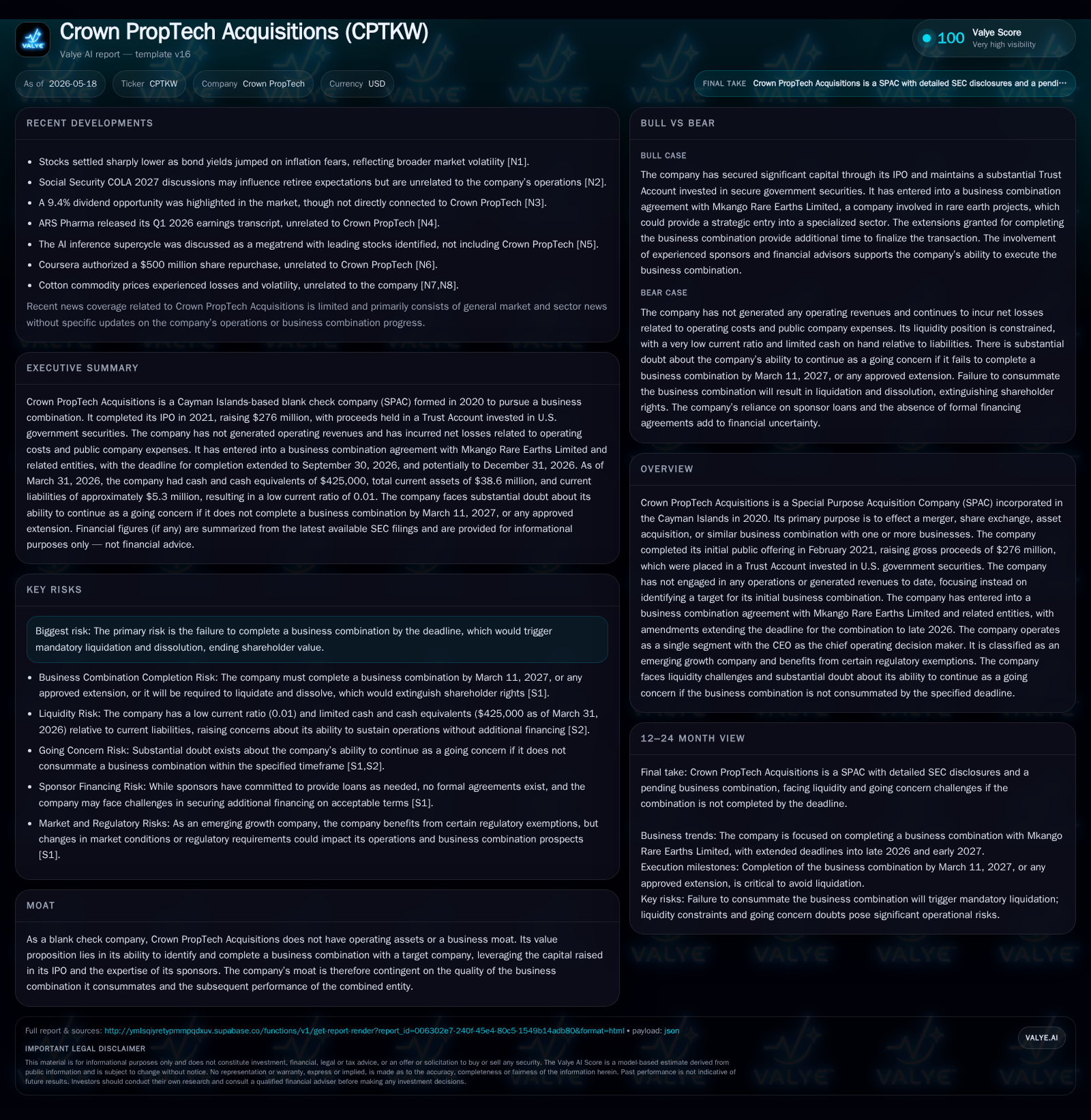
Crown PropTech Acquisitions, a Cayman Islands-incorporated blank check company, announced in its latest 10-Q filing dated May 18, 2026, that it has extended its deadline to complete a business combination until March 11, 2027. The company remains without operating revenues and continues to rely on its sponsors’ financial support to sustain operations amid very limited liquidity — cash on hand stands at just $425 as of March 31, 2026. Its value and future hinge entirely on successfully consummating a merger with Mkango Rare Earths Limited or an alternate target. The delay extends the time available for due diligence and regulatory approvals but also heightens financial and execution risks for shareholders.
Recent Operating Update
Crown PropTech Acquisitions filed its latest quarterly report (10-Q) on May 18, 2026 [S2], revealing material updates to its merger timeline and liquidity position. The company entered into an amended business combination agreement with Mkango Rare Earths Limited extending the outside deadline for consummation from late 2026 until March 11, 2027 under Cayman Islands law [S3]. This extension includes an automatic push to December 31, 2026 if SEC proxy/registration effectiveness is delayed beyond mid-August.
Concurrently, sponsor-backed non-redemption agreements were executed preventing approximately 461,146 Class A public shareholders from redeeming their shares during shareholder votes [S3]. These moves suggest management’s effort to stabilize the shareholder base during precarious cash positions.
Financially, Crown PropTech disclosed it holds a paltry $425 cash outside its trust account with current liabilities exceeding $5 million primarily due to accrued expenses and loans from related parties [S2][F1]. The trust account holds $5.7 million in U.S. government securities designated for the eventual business combination or redemptions but these funds remain restricted pending completion of the combination [S2][F1]. Management highlighted substantial doubt about going concern given operating losses and reliance on sponsors for further financing [S4][S5].
Business Model
Crown PropTech operates as a Special Purpose Acquisition Company (SPAC), incorporated in the Cayman Islands in September 2020 strictly for effecting one or more business combinations with private operating companies [S1]. It raised gross proceeds of approximately $276 million through its IPO in February 2021 which were placed into an interest-bearing trust account invested mainly in short-term U.S. government securities [S1].
The SPAC itself conducts no operational activities currently and generates no revenues other than nominal interest income from trust investments [S1][S2]. Its sole economic purpose is sourcing, negotiating, and completing a qualifying merger or acquisition that converts it from a blank check enterprise into an operating company. Until such an event completes — which historically can take several years — Crown PropTech incurs ongoing administrative costs (legal, accounting, compliance) funded by sponsor contributions and loans.
Revenue mechanics are straightforward: revenue generation depends entirely on consummating a business combination with a suitable target firm. Post-combination revenues hinge exclusively on the acquired company's operations.
The strategic strength of Crown PropTech's offering lies in the sponsors’ ability to source actionable deals within proptech or related sectors and secure shareholder approval amid increasing market scrutiny of SPACs post-2021 hype cycles. However, absent an accomplished transaction, the SPAC’s value proposition remains unrealized.
Industry Structure and Competitive Position
By design, crown PropTech operates at the intersection of public markets' capital access and private equity deal origination within technology-oriented real estate sectors (implied by its name though unexecuted operationally). It faces competitive challenges common among SPACs — increasingly crowded search fields where timing, deal quality, regulatory reviews, and investor sentiment dictate outcomes.
Unlike traditional industry players manufacturing or servicing tangible products or direct software providers serving end customers, CPTKW’s competitive position depends on financial acumen, sponsor credibility, diligence capabilities, and timing paradoxes relative to peer SPACs targeting similar sectors.
Peer SPACs often compete not only for attractive target companies but also for investor confidence amid fluctuating regulatory landscapes led by SEC scrutiny over disclosures and accounting treatments [S2]. The rising cost of capital and elevated shareholder activism have pressured many SPAC entities into executing deals swiftly yet judiciously.
Growth Drivers
Growth catalysts for Crown PropTech emerge post-business combination rather than through internal expansion:
- Extended Deadline: Pushed merger completion deadline through early 2027 allows prolonged due diligence cycles particularly important given Mkango Rare Earths Limited is engaged during periods of macroeconomic uncertainty [S3].
- Non-Redemption Agreements: Shareholder commitments not to redeem reduce cash outflows upon merger completion allowing better deal financing flexibility [S3].
- Sponsor Financial Support: Continued sponsor loan availability enables operational continuity during extended search phases despite very limited liquid assets [S4].
- Market Volatility: While geopolitical disruption introduces risks, it can also create opportunistic valuations that skilled sponsors may exploit.
Successful navigation of regulatory filings (proxy statements), shareholder vote approval processes, and securing deal financing without dilution remain critical upcoming milestones.
Risks and Watchpoints
Key constraints clearly shape Crown PropTech’s near-term outlook:
- Liquidity Crisis: With unrestricted cash nearly depleted ($425) and substantial working capital shortfalls over $5 million [F1], maintaining minimal operations hinges on sporadic sponsor loans without firm contractual backing [S4].
- Failure to Complete Business Combination: The existential risk is non-consummation by mandated deadlines triggering automatic liquidation which would erase shareholder equity completely [S1][S4].
- Geopolitical Impact: Ongoing global conflicts heighten market volatility potentially affecting target valuations or capital availability [S2].
- Regulatory Delays: SEC review timelines could compress remaining execution windows jeopardizing injection of trust account funds post-merger proxy clearance [S3].
- Market Sentiment Toward SPACs: Persistently cautious capital markets pose investor redemption risks despite executed non-redemption agreements.
- Sponsor Dependency: Heavy reliance on sponsors’ goodwill for loans exposes the company to sudden funding withdrawal risks.
Monitoring developments around Mkango Rare Earths’ proxy statement progress will be vital alongside diligence reports confirming transaction feasibility.
What To Watch Next
Investors should focus attention on:
- Completion status of SEC proxy statement effectiveness anticipated by August 14, 2026 for merger voting timelines under amended schedule [S3].
- Shareholder meeting outcomes particularly regarding redemption votes and approval of proposed transaction structures.
- Sponsor loan extensions or formal financing arrangements evidencing ongoing financial runway beyond minimal cash reserves [S4].
- Regulatory signals or macroeconomic events influencing capital market stability relevant for finalizing complex mineral resource acquisitions referenced by Mkango Rare Earths linkage.
- Any public disclosures around alternative targets if current negotiations falter given last extension expires March 11, 2027.
Financial Profile Brief
The financial positioning as of Q1 2026 underscores significant strains:
- Cash & equivalents stand at a mere $425 outside restrictive Trust Account funds earmarked for transaction use only [F1][S2].
- Current liabilities notably exceed current assets resulting in an extremely low current ratio (~0.01) signaling near insolvency conditions absent external funding [F1].
- Total debt approximated at roughly $800K (net debt level) reflects modest borrowing primarily related to sponsor loans rather than market issuance [F1].
- Operating losses accumulate from ongoing administrative costs at over $3 million annually without offsetting operating income given absence of business operations yet incurred legal/compliance expenses persistently weigh results negatively [F1][S2].
Sponsors' commitment to incur some costs via loans has preserved SPR progress albeit without long-term assurances; eventual business combination closure will trigger transition from loss-making shell entity to standalone operating metrics based on acquired firm performance.
This analysis is based solely on publicly available regulatory filings including the latest quarterly report dated May 18, 2026 and does not constitute investment advice.
Financial position in context
As of 2026-03-31, companyfacts shows $425 in cash and equivalents [F1]. Current assets of $38604 and current liabilities of $5mm imply a current ratio near 0.01x for 2026-03-31 [F1].
Disclaimer: This is research-only, informational analysis and not investment advice. It may include AI-generated interpretation and general industry context. Always verify important details using primary sources.

Comments