
Crown Reserve Acquisition Corp. I’s Strategic Progress and Execution Risks in Business Combination with Carvix
Crown Reserve Acquisition Corp. I advances its planned merger with Carvix, navigating key regulatory milestones and execution challenges ahead of a September 2026 deadline.
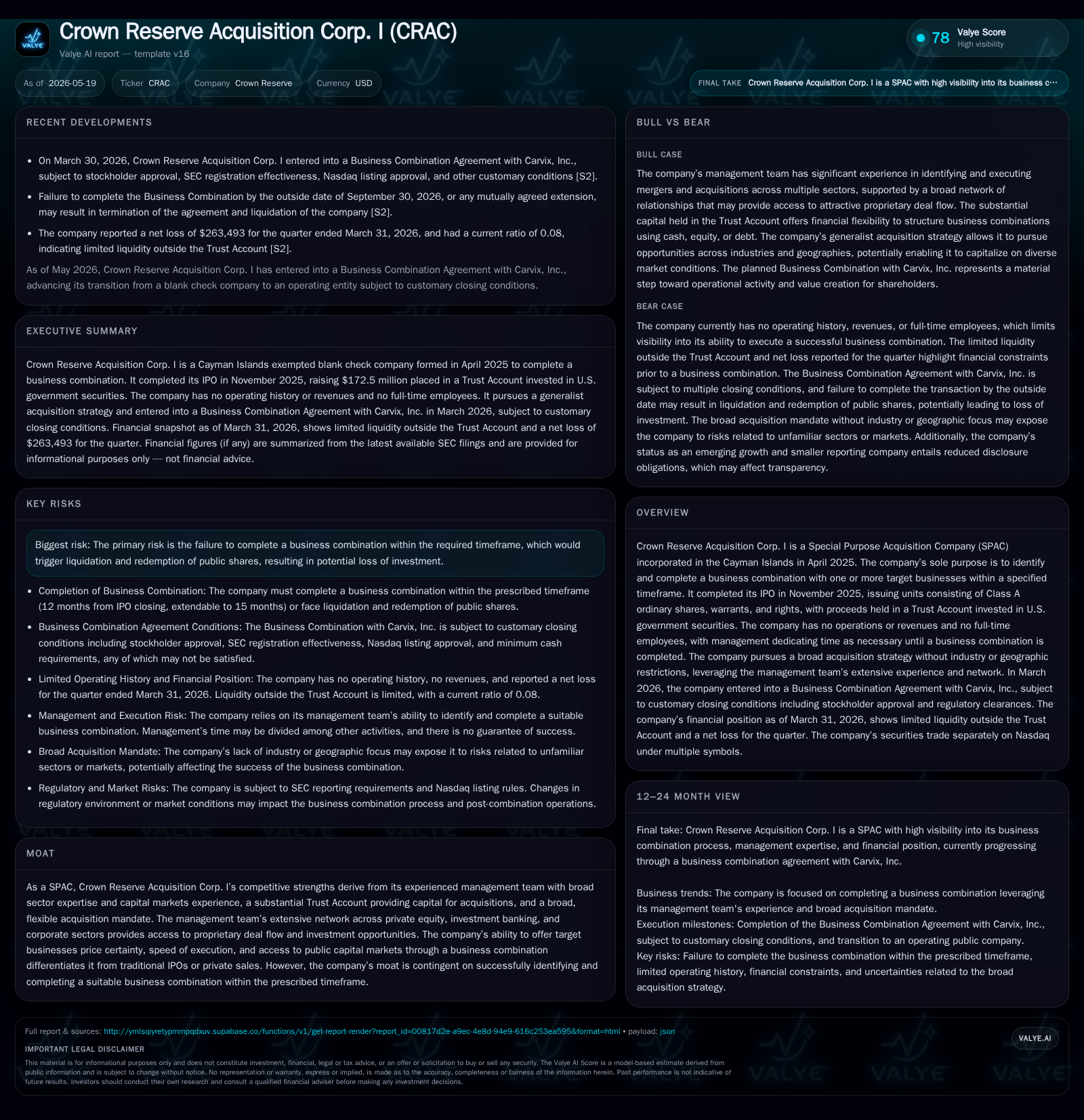
Crown Reserve Acquisition Corp. I’s latest quarterly filing details significant progress on its March 2026 Business Combination Agreement with Carvix, setting critical conditions including stockholder approvals, SEC registration effectiveness, and Nasdaq listing approvals. The SPAC’s trust account structure provides downside protection for public investors, while the proposed domestication to Delaware signals governance shifts post-merger. Key risks include meeting the September 30, 2026 Outside Date, managing redemption impacts on cash availability, and regulatory clearances. Monitoring approval votes, regulatory reviews, and redemption trends will be essential to assess the transaction’s completion prospects.
Latest Quarterly Update: Progress Toward Business Combination with Carvix
Crown Reserve Acquisition Corp. I (CRAC) filed its latest quarterly report on May 15, 2026 [S2], highlighting the execution of a Business Combination Agreement (BCA) with Carvix, Inc. on March 30, 2026 [S3]. This agreement marks CRAC's transition from fundraising to actively pursuing transaction consummation with multiple customary closing conditions to satisfy. These include obtaining requisite stockholder approvals from both CRAC and Carvix shareholders, SEC declaration of effectiveness for the associated Registration Statement on Form S-4, and Nasdaq's approval for listing shares issued in connection with the merger.
An important structural change involves CRAC’s domestication from a Cayman Islands exempted company to a Delaware corporation prior to closing [S2]. This shift will modify governing law and shareholder rights post-merger. The combined board will consist predominantly of members nominated by Carvix along with independent directors mutually agreed upon by both parties [S3].
The BCA sets an Outside Date of September 30, 2026 for closing completion; failure to meet this deadline permits termination absent mutual consent [S3]. Additionally, an exclusivity clause limits CRAC's ability to pursue alternative business combinations during this period, focusing management resources exclusively on this transaction.
SPAC Structure and Capital Overview
Incorporated in April 2025 as a Cayman Islands exempted company [S1], Crown Reserve Acquisition Corp. I is a Special Purpose Acquisition Company formed solely to complete one or more business combinations within specified timeframes after its November 2025 IPO. The IPO raised gross proceeds of $172.5 million through issuance of Units priced at $10 each; each Unit includes one Class A ordinary share, half of one redeemable warrant exercisable at $11.50 per share, plus rights convertible into fractional shares upon combination completion [S1].
Proceeds are held in an interest-bearing Trust Account invested exclusively in U.S. government securities providing principal protection for public investors until either the business combination closes or liquidation occurs [S1]. The Sponsor holds founder shares aligned via lock-up agreements and warrants designed to incentivize post-combination value creation [S1].
This structure offers downside protection typical of SPACs but depends entirely on successful completion of a qualifying business combination within deadlines without generating operating revenues prior.
Competitive Positioning and Industry Context
CRAC’s management team brings extensive experience spanning technology, financial services, healthcare technology, and consumer sectors aimed at identifying companies at inflection points suitable for acquisition [S1]. Led by CEO Prashant Patel with considerable corporate development expertise, the team leverages broad relationships across private equity firms, investment banks, family offices, and corporate executives for proprietary deal sourcing [S1].
Compared with peers launching amid heightened regulatory scrutiny in late 2025 market conditions—particularly around target diligence disclosures—CRAC’s broad sector mandate provides flexibility but also exposes it to elevated completion risk relative to specialized competitors.
SEC demands for timely audited financial statements of target businesses may impose challenges on deal timetables [S1]. CRAC’s management depth aids navigation of these complexities but execution risk remains inherent.
Growth Drivers Anchored by Carvix Transaction
The definitive agreement with Carvix crystallizes CRAC's pathway toward value creation by facilitating Carvix’s transition into a publicly traded company supported by enhanced capital market access [S3]. Completion enables Carvix to fund organic growth initiatives or strategic acquisitions while potentially strengthening its balance sheet.
Public ownership via CRAC’s vehicle offers operational benefits including greater visibility among customers and partners as well as ability to incentivize employees through equity-linked compensation aligned with public market norms [S3]. Trust Account-backed proceeds provide near-term financing stability assuming redemptions do not substantially reduce cash available at closing.
Post-merger governance arrangements aim for continuity through integration of existing Carvix leadership alongside independent directors fostering execution of growth strategies [S3]. Key performance indicators will likely focus on capital deployment efficiency enabled by new equity inflows balanced against dilution risks from warrant conversions embedded in initial units.
Risks Impacting Completion Prospects and Post-Combination Performance
The primary risk is failing to satisfy all closing conditions by the September 30 Outside Date resulting in potential termination of the BCA unless extended by mutual consent [S2], [S3]. Failure would trigger liquidation provisions mandating return of remaining funds net obligations—a binary outcome eliminating anticipated growth leverage.
Public shareholders’ redemption rights allow dissenting investors to redeem shares for cash prior to closing which could materially reduce minimum cash required at close creating funding shortfalls [S2]. Regulatory reviews including Hart-Scott-Rodino Act antitrust clearances or delayed SEC effectiveness declarations could also prolong timelines beyond planned windows jeopardizing deal viability [S3].
The domestication changes governing law from Cayman Islands statutes pre-close to Delaware corporate law post-close introducing potential subtle shifts in shareholder protections and governance dynamics [S2]. Additionally, absence of full-time employees coupled with exclusivity covenants may strain management focus limiting alternative opportunities during deal pendency.
Upcoming Milestones Critical for Closing Assessment
Investors should monitor scheduled shareholder votes determining approval of the combination proposals integral under Nasdaq listing rules and Cayman jurisdictional requirements. Vote outcomes serve as key sentiment gauges potentially influencing redemption volumes despite sponsor voting commitments supporting deal passage [S2], [S3].
Timely SEC clearance of the S-4 Registration Statement is necessary before proxy solicitation commences; any delays increase uncertainty around final timing [S3]. Nasdaq’s formal listing approval—including treatment of earnout shares tied to performance hurdles embedded in warrants—is another decisive factor.
Obtaining written consents from Carvix stockholders constitutes an essential contractual precondition confirming internal target party support prior to consummation [S3]. Redemption trends relative to expectations inform available cash assumptions underpinning Minimum Cash Amount conditions crucial for completion feasibility.
Financial Position Snapshot Pre-Combination
Reflecting its status as a newly formed SPAC with no ongoing operations pending acquisition closure, CRAC reported current assets of approximately $273.6 thousand against current liabilities near $3.43 million as of March 31, 2026 — yielding a current ratio around 0.08 indicative of transactional obligations rather than operational liquidity constraints [F1], [S2].
The Trust Account holds approximately $172.5 million invested in low-risk U.S. government securities representing principal collateral backing public investors’ redeemable shares ensuring downside protection per SPAC structure disclosed in filings [S1], [F1]. Operating losses remain minimal consistent with absence of revenue-generating activities but reflect costs related to transaction pursuit.
Warrant liabilities initially valued near $1.77 million at IPO fluctuate based on market factors; exercise prices set at $11.50 introduce potential dilution contingent on share price performance impacting holder incentives post-merger [S1], [F1]. Transaction costs anticipated upon closing will modestly reduce liquid reserves but are factored into Minimum Cash Amount calculations preserving investor protections.
This analysis synthesizes factual information exclusively from Crown Reserve Acquisition Corp. I’s recent SEC filings without speculative extrapolation beyond documented disclosures. It aims to clarify company strategy evolution through its critical business combination phase within SPAC operational frameworks without investment research views or valuation judgments.
Disclaimer: This is research-only, informational analysis and not investment advice. It may include AI-generated interpretation and general industry context. Always verify important details using primary sources.

Comments