
Salesforce, Inc. (CRM) Deep-Dive Equity Analysis — August 2026
Salesforce’s integrated AI platform and expanded data capabilities position it for growth amid intensifying competition and operational risks. Its subscription model and ecosystem create leverage but face important execution and regulatory challenges.
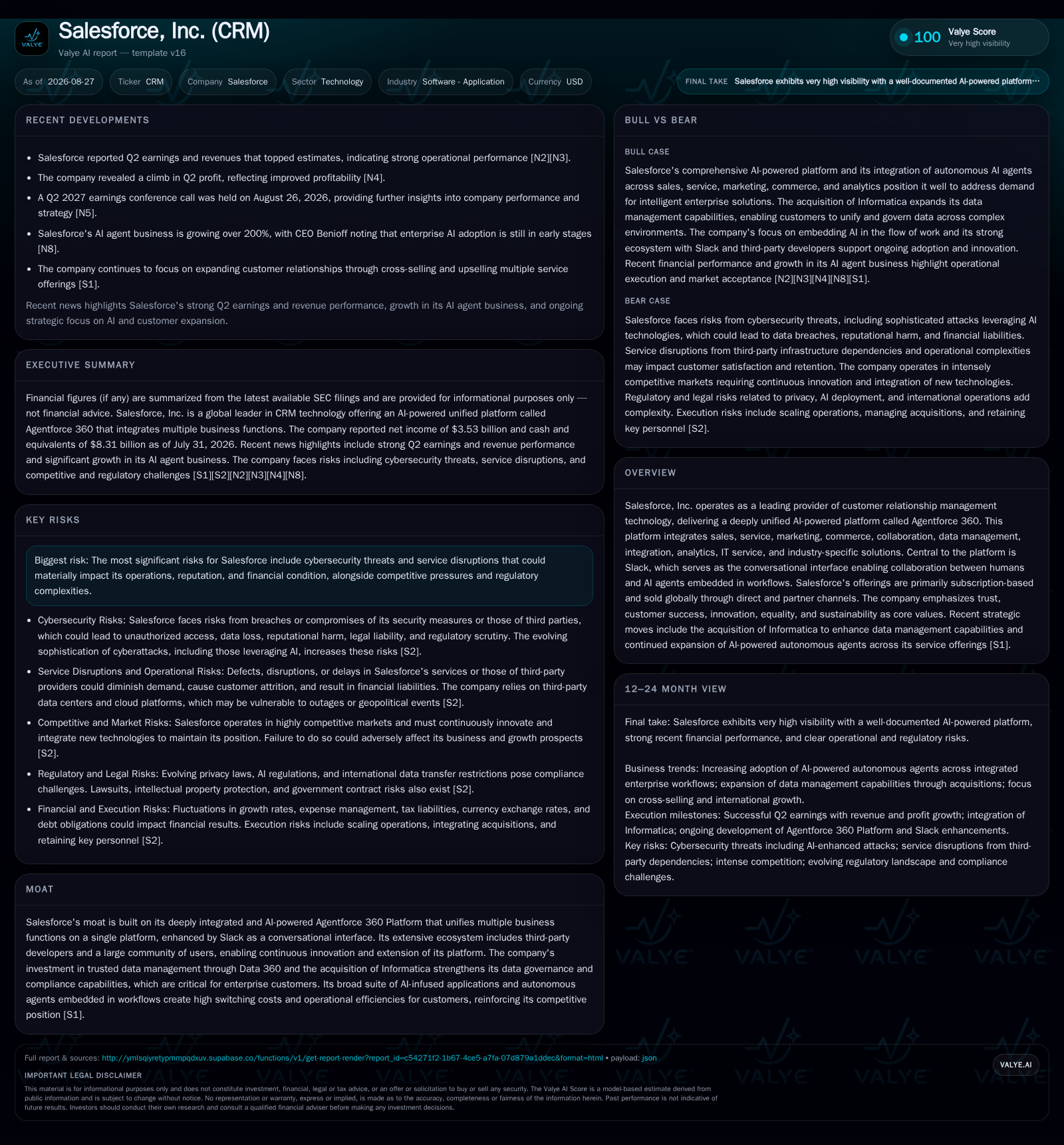
Salesforce offers a uniquely unified AI-powered CRM platform integrating sales, service, marketing, commerce, collaboration, and data management. Its business model centers on subscription revenues with embedded AI agents and a strong partner ecosystem. Recent acquisitions enhance data governance and multi-cloud integration, supporting differentiated product breadth. The company’s moat rests on platform integration, AI workflows, and Slack collaboration, but cybersecurity, infrastructure dependencies, competitive innovation, and regulatory risks pose material threats. The bull case hinges on accelerating AI adoption and cross-selling; the bear case on execution lapses and external shocks. Near-term focus includes AI agent growth, acquisition integration, and operational risk mitigation.
Salesforce Inc., a recognized leader in customer relationship management software, continues to evolve its value proposition through a deeply integrated AI-driven platform named Agentforce 360. This platform unites sales, marketing, service, commerce, collaboration, and data management on a subscription basis, leveraging autonomous AI agents embedded in workflows. Its recent acquisition of Informatica significantly bolsters data governance across complex IT environments, addressing a critical enterprise need. The company reported strong Q2 2026 financial results, propelled by rapid growth in AI agent adoption. However, Salesforce must navigate substantial cybersecurity threats, competitive pressures, and regulatory complexities while executing on ambitious cross-selling and international expansion strategies.
Latest Operating Snapshot
Salesforce reported Q2 2026 earnings and revenues that exceeded analyst expectations, underscoring operational momentum and market acceptance of its AI-infused platform [N2][N3]. Notably, net income for the quarter reached $3.53 billion, reflecting improved profitability and effective cost management [S2][N4]. The company’s AI agent business segment is expanding rapidly, growing over 200%, which CEO Benioff attributes to early-stage enterprise adoption of AI technologies and the platform’s ability to embed autonomous agents in daily workflows [N8].
Strategically, Salesforce’s acquisition of Informatica in fiscal 2026 expanded its data management capabilities, enabling customers to unify and govern data across hybrid and multi-cloud environments—a key competitive lever given growing enterprise complexity [S1]. Slack continues to serve as the primary conversational interface, enhancing collaborative interactions between human users and AI agents and thereby increasing platform stickiness [S1]. However, the balance sheet shows a current ratio below 1.0 (0.84), indicating working capital constraints that require careful management despite strong cash reserves of $8.31 billion [S2].
Business Model and Unit Economics
Salesforce primarily generates revenue through subscription sales of its Agentforce 360 platform, which bundles multiple AI-powered enterprise applications—sales, service, marketing, commerce, integration, and analytics—into a unified offering [S1]. This subscription model implies recurring revenues, providing revenue visibility and potential operating leverage as fixed costs in platform development and cloud infrastructure can be spread over a growing user base. Pricing likely combines volume-based tiers, feature packages, and seat licenses, with upselling opportunities across integrated modules driving average contract value expansion.
The acquisition of Informatica could enhance data management breadth, potentially increasing the platform’s attractiveness for large enterprises requiring complex data governance and compliance. However, capital intensity remains material: investments in AI research, infrastructure partnerships, and acquisitions require continuous resource allocation. Operating leverage may emerge as AI agent adoption scales, reducing customer support costs and increasing workflow automation, but this depends on successful integration and customer retention. Slack’s role as a conversational interface also contributes to stickiness, increasing switching costs and expanding usage depth.
Moat, Competition and Counterforces
Salesforce’s moat is anchored in the comprehensive integration of multiple enterprise functions within the AI-powered Agentforce 360 platform, combined with Slack’s conversational interface. This combination creates switching frictions through embedded autonomous agents that optimize workflows and data governance features that align with stringent compliance needs. The acquisition of Informatica strengthens Salesforce’s data management capabilities, a critical differentiator amid multi-cloud complexities. Additionally, the extensive ecosystem of third-party developers and partners fosters innovation and network effects.
Nonetheless, Salesforce faces competitive pressures from established CRM providers, cloud giants, and emerging AI-native startups. Competitors could erode pricing power or replicate autonomous agent capabilities. Cybersecurity risks and service reliability are significant counterforces: customers’ sensitivity to data breaches or outages could impair trust and retention. Regulatory risks around AI deployment and data privacy may impose compliance costs or constrain product features. The platform’s complexity also requires effective operational execution to maintain integration quality and user experience.
Bull Case
In the bull scenario, Salesforce capitalizes on accelerating enterprise AI adoption, leveraging its early lead in embedding autonomous AI agents across sales, service, marketing, and commerce workflows. The integrated Agentforce 360 platform, combined with Slack’s human-AI collaboration interface, drives increased customer productivity and operational efficiency, leading to higher continued-adoption indicators and expanded wallet share through cross-selling. The Informatica acquisition enables Salesforce to address growing data governance demands, particularly in regulated industries, strengthening its competitive position.
Confirming evidence includes sustained >200% growth in AI agent business, strong Q2 earnings beats, and increasing international penetration. Successful integration of Informatica and continued expansion of third-party developer ecosystem would further validate this path. A falsification test would be a slowdown in AI adoption or failure to integrate data management capabilities, leading to customer churn or stagnant contract values despite new sales efforts.
Base Case
The base case envisions steady growth driven by incremental AI adoption and prudent expansion of Salesforce’s platform. Subscription revenues increase at a moderate pace, with cross-selling and upselling offsetting some churn. The Informatica acquisition is successfully integrated but delivers gradual rather than transformative impacts on data governance capabilities. Slack maintains its role as the collaboration interface but faces competitive pressure from other communication platforms.
Operational execution risks are managed adequately, and regulatory compliance costs rise but remain manageable. Cybersecurity incidents are controlled without material customer impact. Competitive dynamics remain intense, limiting pricing power but not eroding core customer relationships. This scenario implies continued investment in innovation and infrastructure with somewhat balanced fixed and variable cost structures, sustaining profitability growth but at a tempered rate compared to the bull case.
Bear Case
In a downside scenario, Salesforce faces material cybersecurity breaches or service disruptions due to third-party infrastructure failures, causing loss of customer trust and increased attrition. Regulatory challenges around AI ethics, privacy, or data sovereignty impose costly compliance burdens and restrict platform functionality, reducing competitive differentiation. Additionally, failure to integrate Informatica or keep pace with competitors’ AI innovations results in stagnating or declining AI agent adoption.
Financially, this translates into slowed subscription growth, margin compression, and impaired operational leverage. Execution risks including talent loss, acquisition integration failures, or product complexity exacerbate difficulties. A key falsification would be continued strong AI agent growth and customer retention despite external pressures; conversely, evidence of customer defections or regulatory penalties would confirm risk materialization.
What Matters Next
Critical near-term KPIs include the growth rate and customer penetration of AI-powered autonomous agents across Salesforce’s service lines, which indicate market acceptance and platform value. Progress in integrating Informatica’s data management capabilities, measured by new customer wins or product adoption metrics, will reveal acquisition success.
Customer retention and net dollar retention rates are essential to assess cross-selling effectiveness and platform stickiness amid competition. Monitoring service reliability metrics and cybersecurity incident reports will provide insights into operational risk management. Regulatory developments around AI and data privacy, especially in key international markets, could materially influence Salesforce’s go-to-market strategies and product roadmap. Lastly, updates on Slack’s user engagement and third-party developer ecosystem growth will shed light on network effects and switching costs.
Disclaimer: This is research-only, informational analysis and not investment advice. It may include AI-generated interpretation and general industry context. Always verify important details using primary sources.

Comments