
Crisp Momentum Strengthens Capital Structure to Support Microdrama Platform Expansion
Recent loan settlement and share repurchase clear legacy financial complexity, enabling focus on scalable growth in the emerging global microdrama market.
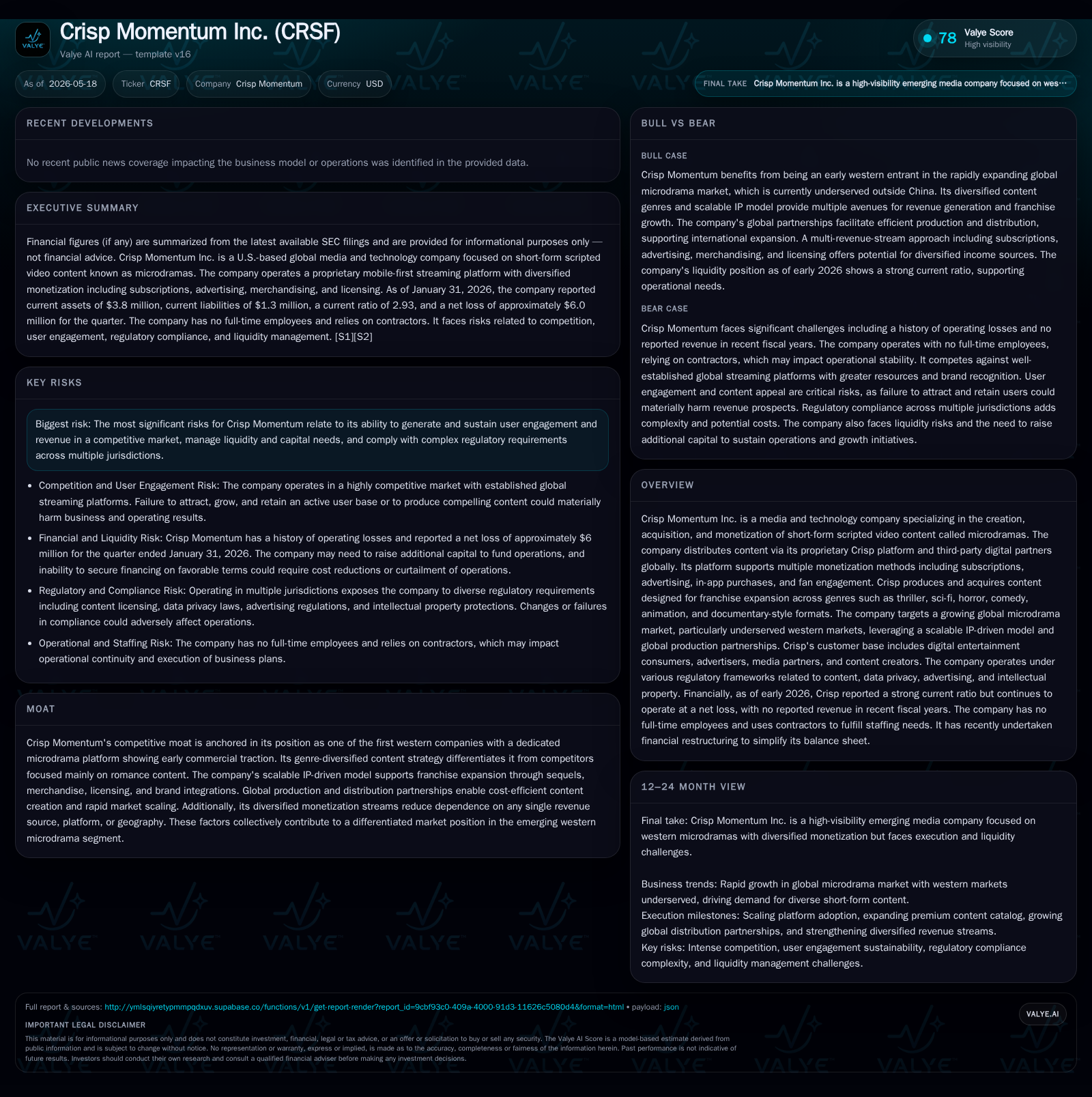
In April 2026, Crisp Momentum finalized a Loan Settlement and Share Repurchase Agreement with Banji Step K.K., extinguishing a $2.9 million loan receivable and related accrued interest through issuance of treasury shares, as disclosed in the May quarter 10-Q. This transaction simplifies Crisp’s capital structure and reduces counterparty risk, supporting operational scalability amid ongoing efforts to grow its proprietary Crisp microdrama platform. A pioneer among western microdrama providers, Crisp leverages a diverse genre lineup and IP-driven franchise model across subscriptions, advertising, and fan-engagement monetization streams. The company targets rapid global expansion in an underpenetrated western market while navigating risks tied to competitive dynamics, capital constraints, and regulatory complexities.
Recent Quarterly Operating Update: Loan Settlement and Financial Simplification
The most consequential event reported in Crisp Momentum’s May 2026 quarterly report ([S2]) is the April 20 Loan Settlement and Share Repurchase Agreement with Banji Step K.K. ([S3]). This transaction extinguished all outstanding obligations under a $2.9 million convertible loan agreement originally extended by Crisp to Banji in September 2025.
In lieu of repayment in cash or asset transfers (the latter partially incomplete from earlier November 2025 agreements), Banji delivered 80 million shares of Crisp’s common stock back to the company as treasury shares. The net effect is elimination of a significant loan receivable balance previously encumbering the balance sheet plus accrued interests. Mutual releases accompany the settlement to fully discharge any remaining contractual liabilities between the parties.
This resolution clears legacy financial encumbrances that had introduced complexity and counterparty risk. With the shares held as treasury stock (unless retired later at management’s discretion), Crisp improves flexibility over capital allocation decisions without diluting existing shareholders further.
Moreover, the company maintains adequate near-term liquidity post-settlement with a current ratio approximating 2.93 ([F1]). This improvement supports operational resilience in scaling the Crisp platform and content development initiatives without immediate refinancing concerns.
Business Model and Product Offering: Proprietary Platform and Franchise-Driven Content
Crisp Momentum operates a mobile-first streaming platform delivering short-form scripted video content known as "microdramas" or Duanju ([S1], [S8]). These videos typically range from 1–2 minutes per episode arranged in multi-episode arcs designed for binge consumption aligned with evolving consumer attention spans.
The Crisp platform supports multiple monetization methods: subscription fees granting ad-free or premium access; advertising-supported segments; in-app purchases for exclusive fan content; branded entertainment including product placement; and merchandising/collectibles tied to popular franchises.
Content covers multiple genres—thriller, sci-fi, horror, comedy, animation and documentary-style formats—differentiating Crisp from niche competitors predominantly anchored in romance microdramas (). Production is globally sourced via partnerships spanning Asia, Europe and North America enabling optimized costs and accelerated release cadences.
Importantly, the company’s IP-driven approach emphasizes franchise-building with opportunities for sequels, spin-offs, cross-media licensing and brand integrations that create ancillary revenue beyond direct streaming revenues.
Competitive Environment and Industry Positioning: Early Entrant with Diversified Content
Crisp Momentum emerges as one of the first western media companies with a dedicated microdrama platform showing early commercial traction ([S13], ). In an industry where peers often concentrate content narrowly by genre or geography, Crisp’s strategy to build diversified genre content libraries offers differentiation.
Their global production partnerships address common capacity constraints facing short-form video startups while enabling regional localization—a critical factor given differing cultural preferences in storytelling formats. Additionally, multi-revenue stream monetization reduces exposure to volatility on any single platform or geographic market.
This positioning carries moat potential if scalability continues alongside strengthening recurring revenue streams backed by proprietary franchise IP assets.
Growth Drivers: Global Market Expansion, Monetization Diversification, and Franchise IP
Several structural drivers underpin Crisp’s growth outlook. First is expanding global demand for mobile-native short-form scripted video content. While China leads with an estimated $6.9 billion microdrama market serving hundreds of millions daily users ([S16]), Western markets remain nascent but rapidly growing—underserved relative to increasing smartphone penetration and shifting consumption behaviors.
Unit economics support disciplined growth through fast production/testing cycles that enable rapid pruning of underperforming titles while scaling successful properties ([S1]). Incremental additions of premium content drive retention effects benefiting subscription renewals and ARPU increases via fan-engagement features.
Franchise-ready IP opens ancillary revenue avenues such as merchandise sales and licensed brand integrations augmenting core subscription/advertising revenues (). Digital distribution partnerships worldwide accelerate reach allowing faster user base scale-up critical for network effects.
Risks and Constraints: User Engagement, Market Competition, and Capital Management
Despite promising structural trends, Crisp faces considerable execution risks. Maintaining sustained user engagement is imperative amid rapidly evolving audience tastes in a crowded digital entertainment landscape ([S27], ). Failure to develop compelling new content could impair monetization strategies reliant on active subscriber bases.
Financially, prior auditor concerns about going concern status underscore historic capital constraints ([S17], [S20]). While recent settlement transactions simplify obligations reducing refinancing risks short-term, ongoing capital discipline remains essential as operating losses persist during scale-up phases.
Regulatory risks also loom large due to multi-jurisdictional operations requiring compliance with diverse content classification laws, data privacy frameworks (GDPR-type regimes), advertising disclosures and other jurisdiction-specific media regulations ([S25]).
Finally, dependence on third-party digital platforms for distribution embeds exposure to algorithm changes or policy shifts that could materially impact growth trajectories.
Key Milestones to Monitor: User Metrics, Content Pipeline, and Financial Health
Critical indicators to watch include monthly active users (MAU) on the Crisp proprietary platform along with subscriber count trends reflecting adoption speed as a proxy for product-market fit ([S2], [S1]).
Track record of new microdrama launches by frequency will indicate health of the content pipeline vital for continuous user engagement given short consumption windows per episode.
Upcoming quarterly guidance updates around recurring revenue breakdowns encompassing subscriptions versus ads versus in-app sales will signal monetization scalability beyond top-line gains.
From a financial perspective sustainable improvement in operating cash flow metrics combined with maintenance of strong liquidity ratios post recent settlements will inform runway sufficiency amid strategic expansion phases ([F1], [S2], [S3]).
Financial Profile: Balance Sheet Strengthening and Capital Structure Outlook
While detailed latest-period income figures are not disclosed in the recent filings beyond prior year-end results showing operating losses near $8 million ([F1]), balance sheet developments are notable.
Total debt approximated $530 thousand as of January-end 2026 with net debt near $477 thousand after adjusting for liquid assets ([F1]). Post-April settlement elimination of the $2.9 million loan receivable from Banji further strengthens balance sheet quality by removing non-cash encumbrances reducing perceived credit risk ([S3], [S2]).
Holding significant shares as treasury stock provides future optionality whether for recaps or retirements without immediate dilution effects.
Overall capital structure improvements complement strategic emphasis on disciplined unit economics within scalable IP-led content strategies designed for long-term value capture despite early-stage operating loss profiles.
Disclaimer: This analysis is based solely on publicly available information from recent SEC filings dated up to May 15th, 2026 ([S1]-[S3]) supplemented by corporate numeric data ([F1]) provided therein. It reflects factual reporting without investment research views.
Disclaimer: This is research-only, informational analysis and not investment advice. It may include AI-generated interpretation and general industry context. Always verify important details using primary sources.

Comments