
CSX CORP Leverages Network Depth Amid Capital Investment and Regulatory Pressures
CSX’s latest quarterly filing reveals robust balance sheet growth driven by strategic capital expenditures and delivers insight into operating leverage amid regulatory and labor challenges.
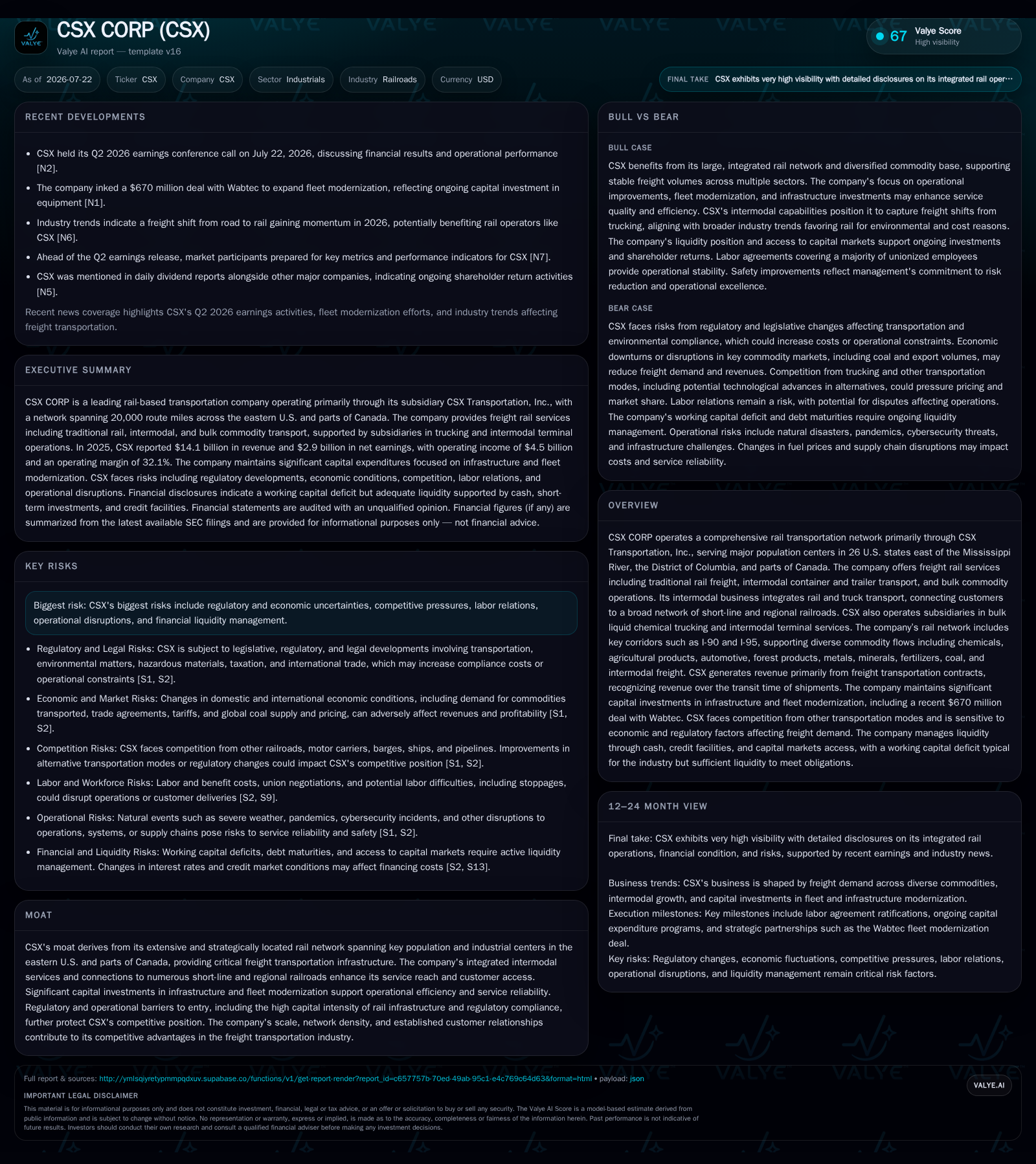
In Q2 2026, CSX advanced its capital investment program, increasing net property by $135 million while boosting liquidity with a $715 million rise in cash and short-term investments. The rail operator’s business model balances freight volume-driven revenue streams—anchored in bulk commodity transport and expanding intermodal services—with ongoing operational efficiency efforts evidenced by key KPIs such as carloads hauled and operating ratio. CSX's competitive moat arises from its dense, strategically located rail network servicing major eastern U.S. corridors but faces headwinds from regulatory compliance costs, labor negotiations, and modal competition from trucking. Its investment-grade financial strength supports continued capital allocation toward network modernization amid these constraints.
Q2 2026 Capital Spend Unlocks Capacity but Raises Working Capital Needs
CSX CORP’s second quarter 2026 filings reveal a tangible expansion in fixed assets alongside deliberate liquidity management during a complex financial backdrop. Total assets rose by approximately $1 billion since year-end, primarily driven by a $715 million increase in cash and short-term investments alongside a $135 million net property increase aligned with ongoing capital expenditures targeting rail infrastructure enhancements [S2]. This capital injection underscores the company’s commitment to sustaining and modernizing its dense rail network—a necessity in the capital-intensive railroad sector where continuous investment in track quality, rolling stock modernization, and terminal capacity is critical to preserving operational reliability.
The company’s working capital position reflects current assets of $3.4 billion against current liabilities of $4.15 billion as of June 30, 2026, resulting in a current ratio near 0.82x [F1]. The increase in current liabilities includes a strategic reclassification of approximately $1 billion in long-term debt to current liabilities plus an uptick in income and other taxes payable [S2]. While a negative working capital position raises common liquidity concerns elsewhere, CSX’s extensive access to revolving credit facilities, commercial paper programs, and shelf registration capabilities cushions short-term funding needs effectively [S2]. This balance between hefty capital spending to bolster network density and the resulting short-term liquidity pressure reflects the classic trade-off faced within freight rail operators’ financial strategies.
Multimodal Freight Volumes Drive Revenue during Commodity Mix Shifts
Revenue generation at CSX centers on hauling both bulk commodities (chemicals, agricultural products, metals) and intermodal containers integrating rail-truck freight solutions. These streams are monetized through volumetric fees often adjusted for haul distance and commodity characteristics—critical factors influencing average revenue per carload figures [S1]. Despite some headwinds noted in merchandise tonnage reduction circa 2% year-over-year as per broader annual disclosures [S1], intermodal volume growth of around 4% signals rising customer preference for multimodal logistics pathways benefiting from CSX’s integrated terminal services.
This shift towards intermodal freight amplifies CSX's exposure to broader supply chain trends such as e-commerce proliferation and port activity cycles where modal cost-efficiency becomes a decisive factor in shipper routing decisions. Consequently, revenue sensitivity not only tracks volume fluctuations but also commodity mix changes that can sway pricing power materially depending on market conditions for segments like coal versus chemicals [S1]
Operating Efficiency Insights Through Key KPIs: Carloads, Train Velocity, Margins
Operational performance metrics continue to serve as bellwethers for CSX's margin sustainability amid evolving cost pressures. The company monitors carloads hauled alongside revenue ton-miles to gauge freight volume traction. While comprehensive Q2-specific volume data is pending detailed release [N2], historical trends point toward stable performance with intermodal carload increases partially offsetting merchandise softness [S1].
Operating ratio remains a pivotal metric illustrating how effectively CSX converts revenues into operating income after deducting expenses [S1]. Increasing fuel surcharges driven by variable fuel costs alongside labor expense inflation challenge margin improvement initiatives despite productivity gains such as improved train velocities—a proxy for line-haul operational efficiency
These dynamics echo industry-wide themes where railroad operators strive to optimize capacity utilization amidst fixed infrastructure constraints while managing variable input costs. Innovations in locomotive technology targeting fuel efficiency also contribute incrementally to margin expansion prospects.
Competitive Rail Industry Dynamics: Peer Benchmarking and Trucking Pressure
Within the Class I railroad peer set—including Union Pacific and Norfolk Southern—CSX distinguishes itself through network concentration focused on East Coast industrial corridors such as I-90 and I-95 [S1]. This strategic density facilitates competitive advantages in service frequency and last-mile access but also consolidates exposure to regulatory complexities related to urban congestion zones impacting hazardous material transport.
Competitive pressure from trucking firms particularly challenges CSX’s intermodal transport segment where door-to-door flexibility of trucking exerts price discipline on rail alternatives. Peers similarly face this modality contest but vary according to geographic footprint influence on customer choices. Nonetheless, CSX's growing intermodal volumes suggest incremental market share capture potential facilitated by integrated terminal services coupling rail efficiency with truck reach.
Labor Agreements Update Reflects Stability Amid Union Negotiations
Labor relations remain a critical continuity risk for CSX operations given approximately 75% of the roughly 22,000 workforce are union members governed under national rail labor agreements negotiated under the Railway Labor Act [S2]. The vast majority of union contracts effective January 1, 2025 have been ratified covering key unions representing most employees. However, negotiations persist with certain groups as agreements do not expire automatically but continue until amended or replaced.
This partial stability provides near-term operational assurance yet maintains an underlying uncertainty over potential labor disputes that could disrupt freight handling capacity or elevate operating expense trajectories due to wage pressures. Such dynamics often factor prominently into the company's overall operating ratio sensitivity analysis.
Growth Catalysts in Intermodal Transport and Infrastructure Investment
Longer term growth prospects hinge significantly on expanding intermodal freight services interpreted as a diversification away from cyclically sensitive bulk commodity segments. Enhancements in rolling stock fuel efficiency through fleet modernization alongside targeted terminal infrastructure upgrades aim to amplify throughput capacity accommodating rising container volumes [S1]
Broader macro tailwinds from industrial production growth coupled with shifting environmental policies favoring lower carbon footprint logistics modes support structural demand improvements for rail freight vis-à-vis trucking alternatives. Continued investment signifies management’s alignment with these secular trends amplifying CSX’s ability to capture diversified traffic lanes underpinning future revenue resilience.
Risk Matrix: Regulatory Constraints, Operational Disruptions, Cybersecurity Challenges
CSX confronts multifaceted risks spanning tight regulatory oversight on hazardous materials transport under common carrier mandates, fluctuating compliance cost burdens arising from evolving federal rules (TSA, EPA), litigation exposures including fuel surcharge antitrust claims in appellate stages [S14]. Additionally, vulnerability persists regarding environmental liabilities linked to real estate holdings necessitating costly remediation efforts [S18].
Operationally, the heavy reliance on information technology makes cybersecurity threats particularly consequential—potential system breaches can severely disrupt safe train movements or jeopardize proprietary data [S1]. Weather events ranging from hurricanes to floods also present recurrent disruption risks with cascading impact on service reliability essential for customer retention.
Upcoming Catalysts to Watch: Volume Guidance, Contract Renewals, Network Deployments
Future performance milestones crystallize around forthcoming earnings releases expected to clarify volume trajectories across commodity segments including intermodal containers [N2]. Major contract renewals remain focal points influencing pricing strategies directly affecting average revenue per carload metrics.
Network deployments delivering expanded throughput at key terminals or enhanced asset utilization triggered by recent capital expenditures will serve as execution barometers confirming management’s strategy efficacy improving capacity without proportionate cost escalations.
Financial Profile Discussion: Liquidity Strength Offsets Working Capital Drag
CSX maintains robust liquidity buffers reflected in increased cash plus short-term investments totaling an uplift of $715 million over year-end totals [S2]. The company’s total debt outstanding approximates $17.16 billion as of mid-2026 with net debt exceeding $15 billion after accounting for cash holdings [F1]. Despite working capital deficits principally due to reclassified debt maturing within one year amounting to approximately $1 billion alongside tax liability timing effects, the company retains ample access to committed credit lines facilitating adequate coverage of obligations as they fall due [S2]. Shareholder returns through dividends ($520 million paid) and share repurchases ($506 million executed) further underscore confidence in sustainable free cash flow generation enabling prudent capital allocation amidst sustained investment cycles [S2].
This analysis leverages publicly available filings up to July 22, 2026. It synthesizes operating data contextualized within structural industry characteristics without offering investment advice or price forecasts. Readers should consult primary documents for detailed quantitative information or direct company communications for forward-looking statements beyond historic evidence cited here.
Disclaimer: This is research-only, informational analysis and not investment advice. It may include AI-generated interpretation and general industry context. Always verify important details using primary sources.

Comments