
Citrine Global Advances Modular Drone Production Amid Liquidity Challenges
The company pushes forward its innovative modular UAV manufacturing while managing significant liquidity constraints.
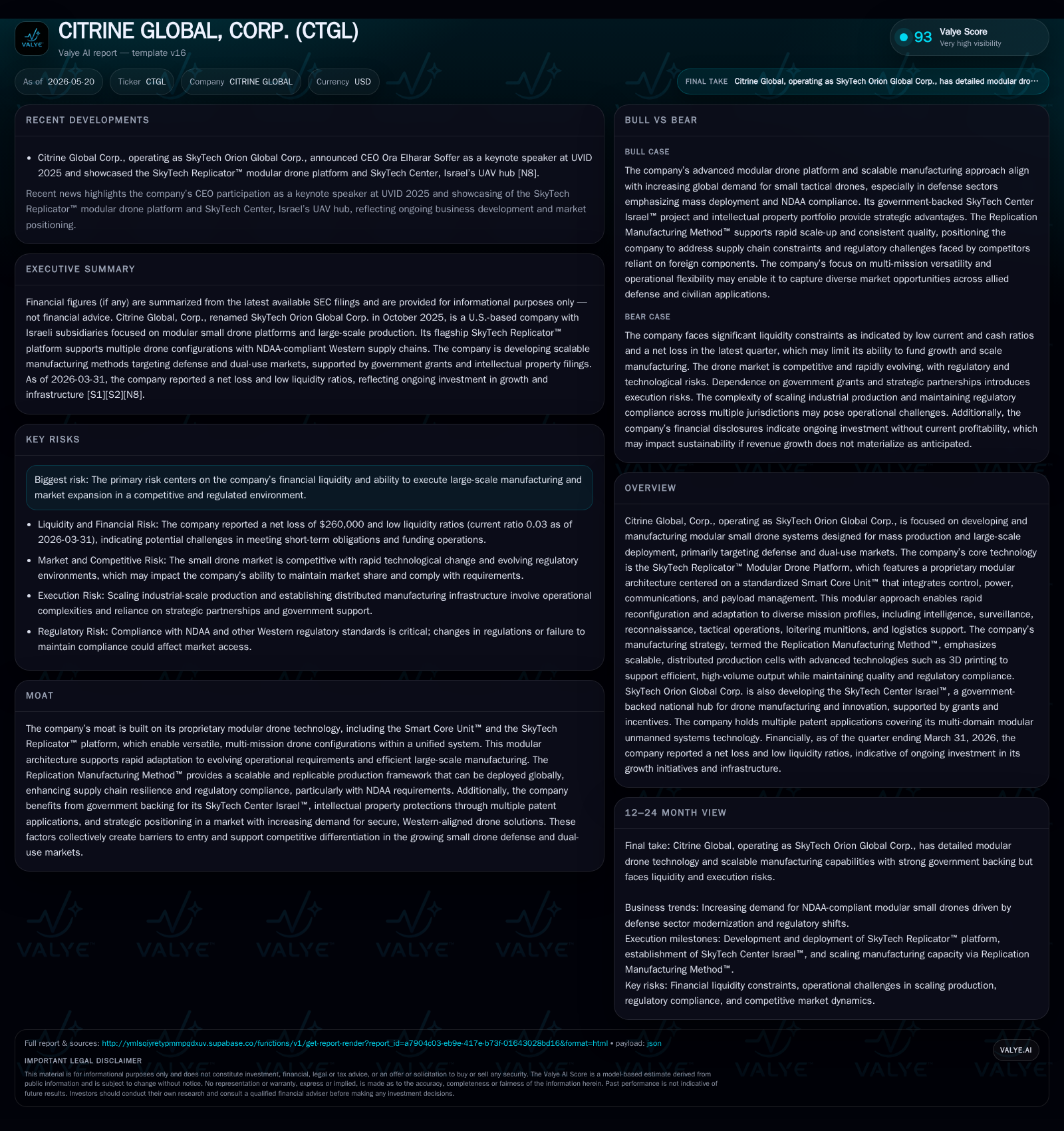
In its latest quarter, Citrine Global, operating as SkyTech Orion Global Corp., advances the establishment of its SkyTech Innovation and Production Center in Israel, anchored by a strategic government grant supporting defense-grade drone production. The company’s core value proposition lies in its modular SkyTech Replicator™ platform, which promises scalable and versatile drone solutions tailored to defense and dual-use markets. Despite technological progress and supportive regulatory positioning, Citrine Global faces substantial liquidity pressures marked by a working capital deficit and reliance on personal guarantees for credit facilities. Execution risk remains tied to the ability to scale large-volume manufacturing efficiently amid competitive and regulatory complexities.
Latest Operational Update: Insights from Q1 2026 Filing
Citrine Global’s latest quarterly report dated May 20, 2026 [S2] reinforces its commitment to advancing the SkyTech Innovation and Production Center located in Yeruham, Israel. Backed by an approximately $4 million government grant awarded by the Israeli Ministry of Economy and Industry early last year [S1], this grant reimburses about 37.5% of eligible expenditures tied to establishing the center’s infrastructure—assembly lines, R&D labs, testing facilities—dedicated primarily to defense-grade UAV manufacturing.
This milestone reflects tangible progress towards fulfilling the company’s strategic objective of transitioning from development to mass-production-capable operations. Importantly, recent shareholder restructuring increased CTGL Citrine Global Israel Ltd.’s ownership stake in its major subsidiary SkyTech Orion Ltd. to nearly 70%, with management backing in the form of personal guarantees on loans provided by key executives such as CEO Ora Elharar Soffer [S1]. These guarantees underscore the tight financial conditions faced during this scale-up phase.
Despite these developments, Citrine Global has yet to record revenue streams from product sales as it remains firmly in the pre-commercial phase [S5]. Its balance sheet at March 31, 2026 shows cash reserves are constrained at roughly $3,000 with total debt estimated at $725,000 [F1].
Recent filings reveal ongoing efforts towards corporate governance strengthening including new director appointments and anti-dilution protections for principal shareholders indicative of attempts to align interests during this complex growth phase [S14]. An updated corporate presentation released April 27 further clarifies strategic initiatives underway including upcoming public market transition plans [S3].
Citrine Global’s Business Model and Modular Drone Technology
At its core, Citrine Global operates under the SkyTech Orion Global Corp. brand focused on end-to-end solutions in modular small drone systems engineered for both defense and dual-use applications [S1]. The cornerstone product is their proprietary SkyTech Replicator™ Modular Drone Platform that emphasizes a standardized Smart Core Unit™ architecture integrating control systems, power management, communications interfaces, and payload handling.
This modularization enables diversified mission capability—including surveillance, reconnaissance, tactical strike loitering munitions, and logistics support—on a common platform skeleton that accelerates time-to-market and lowers lifecycle costs via economies of scale [S1]. Unlike conventional drones tethered to fixed airframes or proprietary electronics suites requiring bespoke manufacture per variant, Citrine’s platform allows rapid reconfiguration through plug-and-play payload modules adapting swiftly to evolving operational needs.
Manufacturing strategy centers around the Replication Manufacturing Method™, deploying distributed production cells equipped with cutting-edge additive manufacturing technologies such as industrial-grade 3D printers designed to optimize unit cost structures under volume scale regimes [S1]. This approach not only facilitates flexibility in spatially dispersed manufacturing hubs but also mitigates supply chain risks endemic to foreign-controlled component restrictions prevalent in sensitive defense supply chains.
Revenue generation prospects derive predominantly from governmental defense contracts where buyers value secure Western-aligned sourcing compliant with stringent NDAA stipulations; this regulatory compliance coupled with IP protections shelter Citrine’s moat [S1]. While contract awards are pending commercialization milestones achievement, pre-contract investments reflect strong confidence from regional authorities illustrated by grant funding programs supporting capacity expansions [S21].
Competitive Positioning within Defense-Grade UAV Industry
The defense small UAV industry landscape is characterized by rapid technology cycles, rigorous reliability requirements, cost efficiency demands under high-scale production models, regulatory scrutiny concerning export controls, and accelerating adoption across allied military forces [S13]. Within this context, Citrine Global’s competitive edge lies primarily in its modular architecture that consolidates diverse capabilities into a flexible platform with streamlined electronic interfaces that reduce integration complexity—a notable differentiator compared to single-mission-centric offerings prevalent among many competitors
Complementing this is their replication-focused scalable manufacturing method designed not merely for low-volume bespoke builds but for serial production across geographically distributed cells leveraging digital fabrication technologies—increasing responsiveness while balancing global supply chain independence critical under geopolitical tensions affecting component sourcing [S1]. Intellectual property protections evidenced through multiple patent filings further fortify entry barriers.
Growth Drivers: Modular Design, Scalable Production, and Market Demand
Driving growth internally is Citrine’s platform adaptability which shortens R&D cycles by decomposing system complexity into modular components that can be independently upgraded or customized without redesigning entire systems—a critical advantage given accelerating pace of tactical doctrine evolution demanding multi-role flexibility [S1]. Industrial capacity expansion at the Yeruham facility backed by government grants enables scaling beyond prototyping toward serial unit output levels anticipated for formal contract delivery phases [S21].
Externally observable growth tailwinds include increasing recognition worldwide of tactical small drones as pivotal battlefield assets across ISR (intelligence-surveillance-reconnaissance) missions alongside emerging loitering munition utility. This demand trajectory is reinforced by regulatory imperatives favoring domestically produced secure drone platforms given export control regimes limiting access to foreign-origin tech deemed sensitive or potentially adversarial controlled.
Furthermore, broader western defense alliances emphasize complementarity among indigenous drone providers satisfying interoperability standards—a space Citrine aims to occupy via its modular architecture compatible with diverse mission packages. The holistic focus on compliance reduces customer switching costs tied both to procurement policy adherence (NDAA-alignment) and established trusted vendor relationships.
Key Risks and Execution Challenges: Liquidity and Scaling Constraints
Citrine's primary risk axis revolves around significant liquidity pressure concomitant with an extended pre-revenue operational stage. As of March quarter-end 2026 balance sheet metrics demonstrate current liabilities surpassing current assets by a wide margin, coupled with net debt close to $722K despite modest total debt of $725K [F1]. This imbalance implies a pressing working capital deficiency impeding sustaining operations absent external funding or turnaround in revenue inflows.
Supporting these obligations are personal guarantees signed by top executives including CEO Ora Elharar Soffer who additionally owns nearly one-third stake in SkyTech Orion Ltd., revealing concentrated execution risk exposure linked both financially and reputationally should refinancing or capital raises fail [S1]. The reliance on a credit facility provided by S.R. Accord Ltd., extended through late 2027 but utilized incrementally since March 2023 further illustrates operational funding fragility necessitating cautious cash flow management [S7].
Additional execution challenges stem from converting highly technical modular designs conceptually proven into reliable mass-produced units conforming fully with evolving certification requirements—this involves overcoming typical industrialization bottlenecks such as quality consistency at higher throughput rates amidst tight regulatory compliance landscapes for defense products [S13]. Competitive bidding environments among established defense contractors require not only meeting technical specs but also demonstrating scalable supply capabilities without cost overruns which pose pronounced risk factors.
What Investors Should Watch Next: Milestones and Demand Signals
Key near-term inflection points will revolve around observable progress on completing construction phases at the Yeruham Innovation Center including commissioning assembly lines plus R&D/test labs expected over next quarters as detailed in internal roadmaps released with prior presentations [S3][S21]. Early contract awards or memoranda of understanding with allied defense agencies will provide measurable validation of market traction while initial revenue recognition will mark critical transition beyond development costs absorption phases.
Monitoring increments in operating cash flow improvements or successful refinancing activities aiming at alleviating working capital constraints will be pivotal indicators regarding financial sustainability beyond existing short-term borrowing arrangements supported by personal guarantees. Regulatory certification advances ensuring readiness for domestic/U.S./European procurement eligibility also represent potential demand accelerators aiding pipeline visibility.
Equity compensation plan expansions approved in January suggest human capital retention strategies essential during growth scaling periods; investor focus should encompass how effectively these incentives translate into talent recruitment critical for commercializing advanced UAV technologies within tight timelines [S14][S21]
Current Financial Position: Navigating Liquidity Pressures
As per latest available financial snapshot ending March 31st, 2026, Citrine Global holds approximately $3,000 in cash equivalents against total reported debt near $725,000 resulting in net debt around $722K reflecting minimal liquid buffer amid ongoing development expenditures [F1]
Credit facilities extended through March-September 2027 were secured against collateral including roughly 125k sq ft industrial land parcel allocated for their Israeli manufacturing hub reflecting steady asset backing but also indicating dependent capital structure heavily reliant on continuous lender confidence accompanied by CEO personal guarantees underpinning facilities [S7][S16]. The absence of revenue leaves continued burn financed mainly through these short term borrowings supplemented by equity issuance reserved for compensatory purposes limiting runway extension under status quo liquidity conditions.
Management acknowledges losses inherent during early-stage industrial buildup while pursuing scalable contract wins; however without noticeable cash flow inflections or material funding events forthcoming constraining factors remain formidable requiring stakeholder vigilance on refinancing or partnership developments beyond currently disclosed disclosures.
This analysis profiles Citrine Global's strategic focus on developing innovative modular drone solutions within robust regulatory contexts while contending with acute financial constraints typifying early-stage aerospace technology ventures targeting sensitive defense sectors. It highlights both structural business strengths anchored in proprietary technology platforms and manufacturing methodology alongside significant execution risks chiefly arising from liquidity pressures affecting operational momentum amid transitioning toward commercial scale production.
No investment research views are offered herein; this report serves exclusively as an informational industry analysis grounded strictly upon publicly filed SEC documentation up through May 20th, 2026.
Disclaimer: This is research-only, informational analysis and not investment advice. It may include AI-generated interpretation and general industry context. Always verify important details using primary sources.

Comments