
Cousins Properties Inc: Navigating the Sun Belt Office Real Estate Landscape with Lifestyle Focus
A detailed analysis of Cousins Properties' strategy, operations, financials, and sector outlook within the evolving office real estate markets of the U.S. Sun Belt.
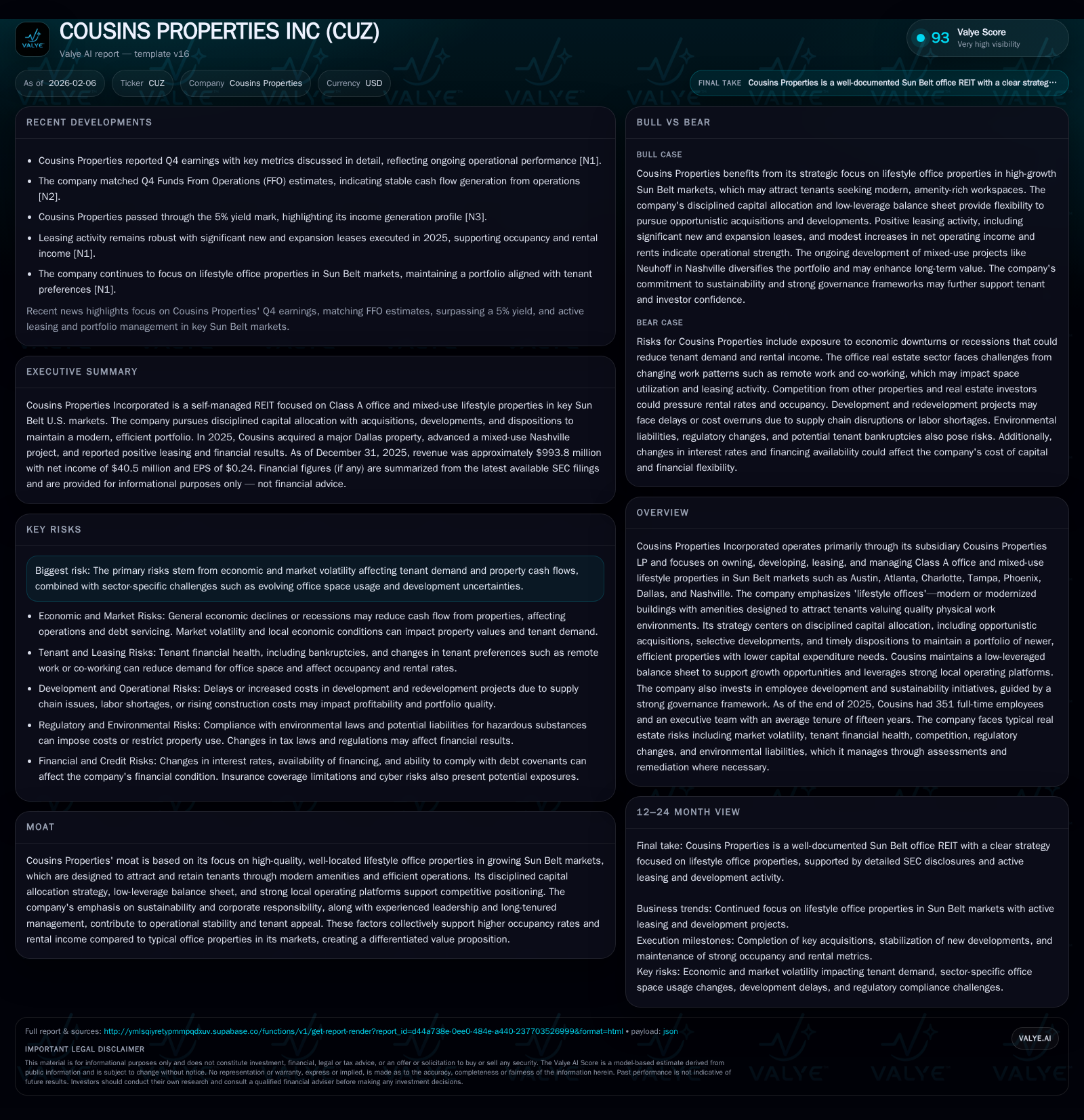
Cousins Properties Inc (CUZ) specializes in Class A lifestyle office properties across key Sun Belt markets, leveraging a disciplined capital allocation approach to maintain a modern, efficient portfolio. Despite a slight occupancy dip in 2025, the company demonstrated stable operating cash flows and moderate growth through acquisitions and leasing activity. Risks remain rooted in macroeconomic factors and changing office space utilization trends. However, Cousins’ focus on amenities, sustainability, and local platforms supports differentiation in an evolving office REIT sector.
Company Overview and Market Positioning
Cousins Properties Incorporated (NYSE: CUZ) operates principally through its subsidiary Cousins Properties LP (CPLP), focusing on owning, developing, leasing, managing primarily Class A office properties alongside opportunistic mixed-use developments. Their geographic emphasis on key Sun Belt metropolitan areas—Austin, Atlanta, Charlotte, Tampa, Phoenix, Dallas, and Nashville—positions the firm within dynamic high-growth regions benefiting from demographic expansion and corporate relocations.
The company uniquely brands its properties as "lifestyle offices," reflecting modernized or newly developed buildings equipped with amenities tailored to tenants who prioritize physical workspace quality as part of employee recruitment and retention strategies. Though not an industry-standard classification, this approach highlights Cousins’ commitment to differentiating its assets by integrating a holistic occupancy experience that transcends pure real estate functionality.
Strategic Framework
Cousins leverages a disciplined capital allocation framework that blends opportunistic acquisitions with selective developments while actively disposing of non-core or older assets. This strategy targets maintaining a portfolio composed mainly of newer or comprehensively upgraded buildings requiring lower ongoing capital expenditure. Such operational prudence supports a sustainable cash flow profile while preserving growth optionality.
Local operating platforms enhance market responsiveness—a critical element given the diverse urban landscapes within their Sun Belt footprint. These decentralized capabilities facilitate nuanced understanding of market demands and expedite leasing processes.
Simultaneously, Cousins underscores sustainability initiatives and invests in employee development as integral components of its value creation model. These commitments aim to bolster operational efficiency, tenant satisfaction, and long-term portfolio resilience.
Financial Performance Highlights
For the year ended December 31, 2025, Cousins reported total revenues of approximately $993.8 million alongside a net income of $40.5 million [F1]. Operating cash flow demonstrated slight improvement over the prior year with net cash provided by operating activities increasing by roughly $2 million to $402.3 million [S1]. This was supported by improved economic occupancy due in part to the end of rent abatements across key properties such as Domain 9 (Austin), Promenade Central (Charlotte), and Buckhead Plaza (Atlanta), plus accretive acquisitions including Vantage South End and Sail Tower in late 2024 followed by The Link in mid-2025.
Capital expenditures for 2025 increased modestly to around $267 million from $252 million the previous year. Higher leasing costs—comprising commissions and tenant improvements—accounted largely for this increment as strong leasing momentum required buildout support to meet tenant-specific configurations [S1]. Meanwhile, expenditures on projects under development decreased materially owing to full stabilization of Domain 9.
Financing activities saw a notable reduction in proceeds compared to the prior year due primarily to decreased securities offerings ($500 million in gross proceeds versus $1.4 billion in 2024) alongside increased debt repayments [S1]. These moves reflect a conservative balance sheet management philosophy aimed at retaining financial flexibility.
Leasing Activity and Portfolio Metrics
Portfolio-wide office leasing executed approximately 2.125 million net leased square feet during 2025 across 167 transactions with an average lease term extending to about 8.5 years—a lengthening evident relative to previous periods [S1]. Net effective rents averaged $25.86 per square foot after accounting for free rent concessions, commissioning fees, and tenant improvement amortization costs. These metrics represent a slight downward adjustment from previous years but still indicate healthy leasing fundamentals considering broader headwinds.
Occupancy stood at about 90.7% at year-end 2025 down marginally from 91.6% twelve months prior—a reflection perhaps of ongoing sector-wide pressures including shifting workplace preferences towards hybrid or remote modalities [S1]. Yet Cousins reports above-market occupancy levels attributable partly to the lifestyle positioning.
Second-generation leased space experienced rent escalations on a straight-line basis rising by more than 21%, illustrating successful rent roll-forward on renewal transactions despite higher concession environments.
Competitive Advantages / Moat Analysis
Cousins’ moat stems chiefly from its deliberate focus on high-quality lifestyle offices that appeal to tenants seeking vibrant workplace environments rather than purely functional space alternatives—themselves increasingly commoditized in secondary markets. This is coupled with strategic geographic targeting of fast-growing Sun Belt metros benefiting from favorable migration patterns and pro-business climates.
Management’s experience and tenure contribute operational stability while underwriting consistent leasing success despite industry headwinds like oversupply risks or changing demand profiles driven by remote work adoption [S1].
Additionally, maintaining relatively low leverage affords resilience against interest rate shocks or capital access constraints prevalent within commercial real estate cycles.
Its commitment to sustainability further enhances attractiveness among tenant segments placing rising value on ESG credentials—not only mitigating regulatory risk but also supporting longer-term asset desirability.
Risks to Consider
Key risks faced include:
- Economic Volatility: Broader national or regional recessions could impair tenant ability to fulfill lease obligations or reduce demand for premium office space.
- Structural Shifts in Office Use: Persistent shifts towards hybrid/remote models might reduce overall space requirements; potential impacts on lease renewals or rental rate growth remain uncertain.
- Development Risks: Construction delays or cost overruns stemming from labor shortages or supply chain bottlenecks could hamper timelines/cost assumptions.
- Capital Market Conditions: Fluctuations affecting debt availability or equity issuance can constrain future acquisitions/developments crucial for growth.
- Regulatory/Climate Factors: Changes in tax laws or environmental regulations could increase operating costs; severe weather events pose physical risk exposure despite insurance coverage limits.
- Tenant Credit Risk: Insolvency or bankruptcy events among major tenants could result in unexpected vacancy or collection shortfalls.
These risks are inherent within commercial property ownership but appear mitigated somewhat by diversification across multiple dynamic markets alongside disciplined underwrite standards [S1,S2].
Industry Context Analysis
The U.S. office REIT sector continues experiencing transformative pressures amid evolving post-pandemic work patterns that challenge traditional demand paradigms globally. While many coastal gateway cities face oversupply issues exacerbated by cautious re-leasing climates post-COVID disruptions, key Sun Belt metros like those targeted by Cousins benefit comparatively from population growth driven by corporate relocation incentives and lower tax burdens.
Simultaneously rising interest rates have elevated capital costs industry-wide necessitating refined capital deployment strategies emphasizing yield sustainability over volume growth—principles well aligned with Cousins’ current policies.
Segment innovations such as lifestyle offices help offset commoditization risks by enhancing tenant retention through amenity-rich environments fostering community and productivity—concepts increasingly valued as companies seek competitive recruitment advantages [N8].
Recent News Reflections
Cousins’ Q4 earnings reported February 5th did not reveal any material surprises relative to consensus estimates; funds from operations (FFO) matched expectations signaling steady operational performance despite broader uncertainties [N1,N2]. The company's dividend yield surpassed the notable 5% mark recently evidencing attractive income prospects relative to peers amid cautious investor sentiment towards office REITs [N3].
Analyst upgrades tracked upwards tied largely to confidence in portfolio quality and sustained demand for their property niche [N9]. Peer comparisons emphasize improved relative valuations but underscore lingering concerns surrounding future fundamentals linked directly to office utilization evolution over coming years [N6,N7,N13].
Outlook Summary
Looking ahead into 2026 and beyond, Cousins Properties seems poised to capitalize on demographic-driven demand increases within its core markets while navigating sectoral shifts cautiously but proactively via curated asset mix refurbishment initiatives paired with disciplined capital stewardship.
Continued emphasis on sustainability practices not only mitigates regulatory risks but aligns with increasingly ESG-conscious stakeholders ranging from tenants to investors alike.
Nevertheless, vigilance towards macroeconomic volatility remains essential with particular focus on tenant health and lease pipeline stability as indicators shaping longer-term cash flow trajectories.
This analysis is based on information available through February 6th, 2026 as sourced from company filings (10-K/10-Q), recent news coverage on Nasdaq.com, and validated numeric data from SEC XBRL compilations. It aims solely to provide an informed perspective on Cousins Properties Inc’s business operations without constituting investment advice or solicitation.
Disclaimer: This is research-only, informational analysis and not investment advice. It may include AI-generated interpretation and general industry context. Always verify important details using primary sources.

Comments