
Cadrenal Therapeutics: Strategic Review and Clinical Setbacks Define a Precarious Inflection Point
With its lead asset missing a key Phase 2 endpoint and cash reserves projected to run dry within a year, Cadrenal Therapeutics faces a critical juncture. The company’s pursuit of strategic alternatives and ongoing regulatory engagement may shape the future of its novel 12-LOX and anticoagulation pipeline, but the path to value creation is fraught with scientific, financial, and operational risks.
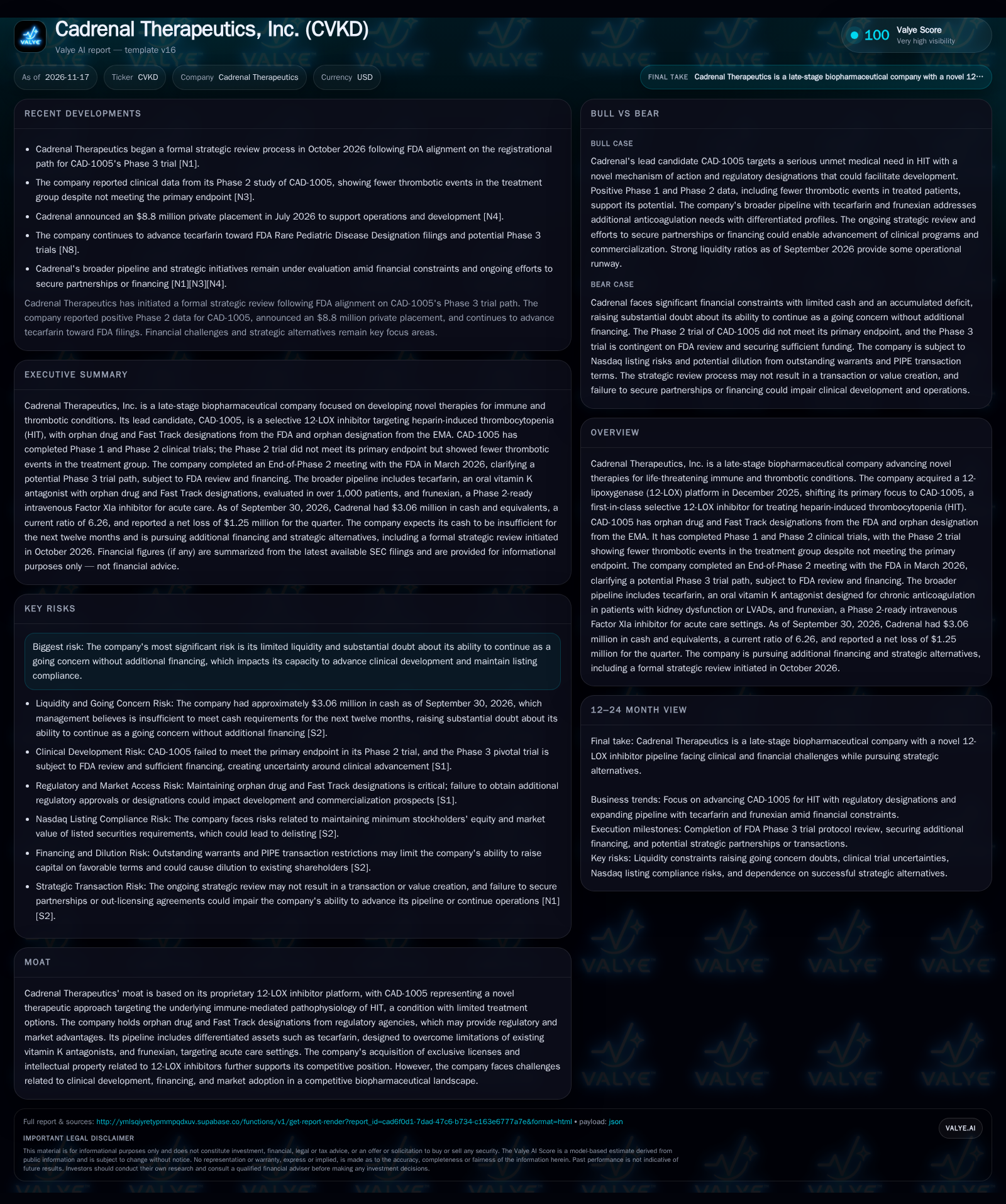
Cadrenal Therapeutics’ lead candidate, CAD-1005, did not meet its Phase 2 primary endpoint, and the company expects its cash to be insufficient for the next twelve months. Management has initiated a strategic review to explore partnerships, asset sales, or other transactions, but continued development of its pipeline depends on securing additional financing and regulatory alignment. The outcome of these efforts will likely determine whether Cadrenal can advance its programs or faces further operational contraction.
Cadrenal Therapeutics sits at a pivotal crossroads as scientific promise collides with operational and financial headwinds. Its lead drug, CAD-1005—a selective 12-LOX inhibitor for the high-need indication of heparin-induced thrombocytopenia—did not achieve its Phase 2 primary endpoint, though signs of reduced thrombotic events may hint at a differentiated therapeutic profile. With less than a year of cash runway and a strategic review underway, the company’s next steps will be decisive: securing a partner, asset sale, or financing could allow further clinical progress, while failure to do so may force contraction or a sale under duress. Investors and stakeholders must weigh the potential upside of novel pipeline assets against the acute risks of dilution, delisting, and clinical uncertainty.
Recent Clinical and Financial Developments Set the Stage for Urgent Strategic Action
The company reported cash and liquidity metrics for the period; these figures do not by themselves establish operating runway, investment capacity, financial flexibility, or financing capacity. [S1] [S2] Despite the clinical setback, the trial data revealed a lower rate of thrombotic events in treated patients, suggesting a possible benefit worth further exploration [N3]. In response to its financial constraints and uncertain development path, Cadrenal’s board initiated a formal strategic review in October 2026 to explore licensing, asset sales, partnerships, or mergers [N1] [S2]. The outcomes of this review and the company’s ability to secure additional financing or a strategic transaction will be critical determinants of its future.
Pipeline-Driven Value and the Challenge of Capital-Intensive Clinical Development
Cadrenal’s business model is anchored in the high-risk, high-reward economics typical of late-stage biopharma: significant upfront R&D and clinical trial costs, offset by the potential for outsized returns if a novel therapy achieves regulatory approval and commercial adoption. With CAD-1005 targeting HIT—a rare but severe immune complication of heparin therapy—market exclusivity via orphan drug and Fast Track designations could enable premium pricing and limited competition if efficacy and safety are demonstrated [S1]. However, the company’s current burn rate, negative earnings, and accumulated deficit of $46 million underscore its dependence on external capital to sustain operations and advance trials [S2]. Without sufficient cash flow from approved products or lucrative licensing deals, Cadrenal must either attract new investment or out-license assets to larger partners. The economics of its pipeline hinge on successfully navigating costly late-stage trials and then capturing sufficient share in specialized, often hospital-based markets. Fixed costs are dominated by R&D and regulatory expenses, while variable costs would rise with commercialization, including manufacturing, pharmacovigilance, and sales.
Novel Mechanism Offers Differentiation, but Clinical and Commercial Hurdles Remain
Cadrenal’s competitive position is rooted in its proprietary 12-LOX inhibitor platform, which addresses an unmet need in HIT—a space with limited direct competitors and a high barrier to entry due to disease complexity and small patient populations. Orphan drug status and Fast Track designations for CAD-1005 and tecarfarin provide potential regulatory and market access advantages [S1]. However, the failure to meet primary endpoints in Phase 2 raises questions about clinical differentiation and ultimate approvability. Established anticoagulant therapies (e.g., argatroban, bivalirudin) are entrenched in hospital protocols, while emerging anticoagulation technologies and biosimilars continue to evolve. The pipeline’s value proposition relies on demonstrating superior efficacy, safety, or convenience. Furthermore, capital constraints may limit Cadrenal’s ability to compete for attention and resources versus better-funded biotech and pharma peers, especially in the absence of a large commercial infrastructure or established relationships with hospital systems.
Strategic Partnership or Licensing Catalyzes Pipeline Advancement and Unlocks Shareholder Value
A favorable scenario for Cadrenal involves securing a partnership or out-licensing deal for CAD-1005 or other pipeline assets, providing both nondilutive funding and external validation. If a partner with clinical, regulatory, and commercial expertise joins to co-develop or commercialize CAD-1005, Cadrenal could accelerate Phase 3 trials and gain access to broader networks and resources. Evidence supporting this scenario would include a major transaction announcement, upfront milestone payments, or new financing from institutional investors. On the clinical front, positive regulatory feedback or publication of post-hoc analyses demonstrating a clear reduction in thrombotic events—even absent primary endpoint success—could reignite interest in the 12-LOX platform. Confirmation would come from progress updates on Phase 3 trial initiation, new collaborations, or public disclosures of improved financial runway. Falsification of this scenario would be indicated by prolonged strategic review with no transactions, inability to attract partners, or regulatory setbacks that stall development.
Operational Retrenchment and Asset Monetization Amid Ongoing Uncertainty
The most plausible near-term outcome is that Cadrenal continues to operate in a capital-constrained mode while seeking to monetize assets or secure incremental financing. The strategic review may yield a small partnership, option-based licensing deal, or bridge financing, allowing minimal progress in pipeline development—particularly for CAD-1005 and tecarfarin. However, major out-licensing or M&A transactions may be elusive given the mixed clinical data and uncertain market opportunity. The company may prioritize cost containment, delay new trials, and focus on maintaining Nasdaq compliance to preserve optionality. Evidence for this scenario would include announcements of modest financings, restructuring efforts, or updates indicating slow but continued progress. Falsification would be seen if Cadrenal rapidly secures a transformative partnership or, conversely, is forced into bankruptcy or delisting due to lack of options.
Inability to Secure Funding or Transactions Forces Clinical Halt and Strategic Contraction
If Cadrenal fails to secure additional funding, partnerships, or asset sales during its strategic review, the company faces the risk of halting pipeline development and potentially entering a distressed sale or liquidation process. Deteriorating liquidity, missed regulatory milestones, or loss of orphan/Fast Track status could further reduce asset value and bargaining leverage. Nasdaq delisting due to non-compliance would increase operational challenges and restrict access to capital markets. Confirmation of this scenario would come from public disclosures of failed financing attempts, workforce reductions, clinical trial suspensions, or formal bankruptcy proceedings. A continued net loss without offsetting inflows, alongside mounting dilution from warrants or PIPEs, would exacerbate shareholder value destruction.
Milestones and External Catalysts That Will Shape Cadrenal’s Trajectory
Announcements of new partnerships, licensing deals, or asset sales—especially with upfront or milestone payments—would directly impact Cadrenal’s ability to fund development and signal external validation.
Updates on the initiation, design, or enrollment of a Phase 3 trial for CAD-1005 or tecarfarin, if disclosed, would provide insight into pipeline momentum and regulatory alignment.
SEC filings or press releases detailing additional financings, PIPE transactions, or warrant exercises, along with accompanying dilution and runway implications, would help test the near-term viability thesis.
Public statements or filings regarding Nasdaq listing compliance—including notices of deficiency, remediation plans, or delisting risks—would clarify operational constraints and capital market access.
Clinical data releases, including post-hoc analyses or secondary endpoint outcomes for CAD-1005, would inform whether the asset retains strategic or out-licensing appeal.
Board or management commentary on the progress and timing of the strategic review process, including any concrete transaction proposals, would illuminate the likelihood of a value-creating outcome.
Disclosure of changes in burn rate, headcount, or operational priorities would signal whether Cadrenal is retrenching or preparing for a major transition.
Disclaimer: This is research-only, informational analysis and not investment advice. It may include AI-generated interpretation and general industry context. Always verify important details using primary sources.

Comments