
CVS Health's Integrated Healthcare Model and Tech Innovations Amid Regulatory Headwinds
CVS Health leverages its vast integrated ecosystem and AI investments to sustain growth in a complex, regulated healthcare environment.
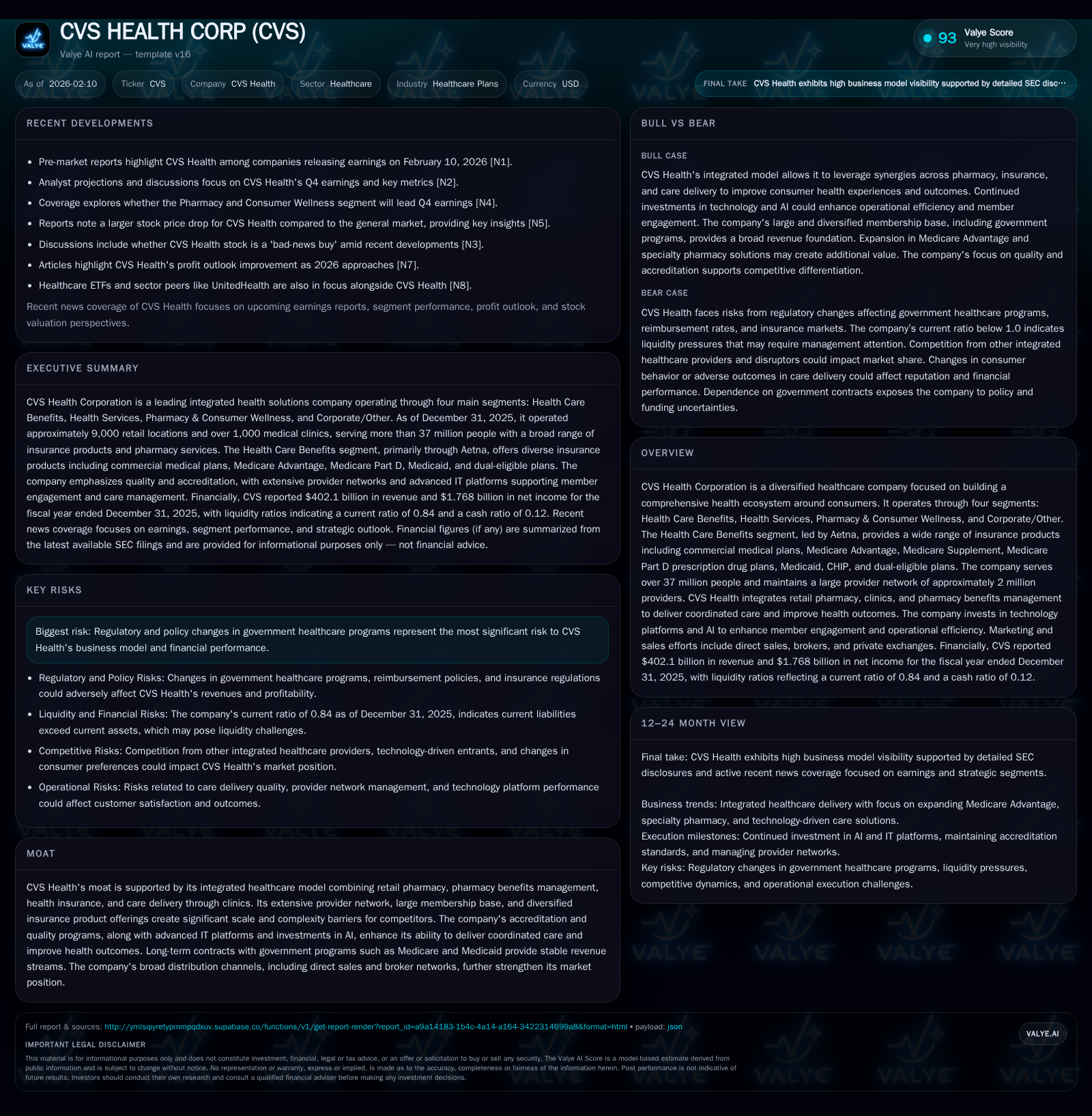
CVS Health Corporation operates a uniquely integrated healthcare model encompassing insurance (Aetna), retail pharmacy, clinics, and pharmacy benefits management. Serving over 37 million members via diversified insurance plans and a provider network of roughly 2 million healthcare professionals, CVS is positioned to deliver coordinated care that enhances patient outcomes while controlling costs. Its aggressive investment in AI and technology platforms furthers operational efficiencies and member engagement. However, persistent regulatory uncertainty around government healthcare programs represents a core risk to its substantial Health Care Benefits segment revenue streams.
Building an Integrated Healthcare Ecosystem: CVS’s Key Differentiator
CVS Health Corporation exemplifies an ambitious vision of an interconnected healthcare system designed from the ground up around consumer convenience and coordinated care. As of late 2025, it manages a complex constellation of services spanning health insurance through Aetna (Health Care Benefits), retail pharmacies, primary care clinics (Health Services), pharmacy benefits management (PBM), and consumer wellness products. This ecosystem serves over 37 million insured members and interfaces daily with nearly 2 million healthcare providers [S1][F1].
Unlike standalone insurers or pharmacy chains, CVS’s model captures value at multiple touchpoints—insurance underwriting, pharmacy dispensing, clinical care provision, and benefits administration—creating synergistic feedback loops. For example, integrating data from its retail pharmacies and in-house clinics feeds into Aetna’s risk models facilitating smarter care pathways. This vertical integration acts as a formidable barrier for competitors who lack the scale or infrastructure to match such breadth.
The company’s strategic emphasis on simplifying healthcare experiences while improving outcomes is buttressed by its investments in technology platforms that support consumer engagement and provide actionable analytics for cost control [valye_report_excerpt]. This multi-pronged approach not only builds consumer loyalty but enhances negotiation clout with providers and suppliers by presenting aggregated patient data.
Segment Deep Dive: How Each Business Arm Contributes to Growth and Risk
CVS organizes its operations into four reportable segments:
Health Care Benefits: Anchored by Aetna operations serving approximately 37 million members through diversified insurance products—including commercial medical plans, Medicare Advantage, Medicare Supplement plans, standalone Medicare Part D PDPs, Medicaid services, CHIP coverage, and dual-eligible populations [S1][valye_report_excerpt]. This segment is the largest by revenue contribution with broad geographic reach across group employer markets and government-sponsored enrollments.
Health Services: Comprises more than 1,000 walk-in clinics offering primary care accessible directly at retail locations or standalone settings. These clinics enhance onsite care access feeding back into the overall managed care framework by reducing unnecessary emergency visits or hospitalizations.
Pharmacy & Consumer Wellness: Encompasses about 9,000 retail pharmacies plus specialty pharmacy solutions. It integrates prescription fulfillment with wellness products targeting consumer health outside of traditional insurance coverage. Recent analyst commentary suggests this segment may drive near-term earnings strength due to stable foot traffic and expanded health service offerings beyond purely pharmaceutical sales [N3].
Corporate/Other: Includes administrative functions and various smaller initiatives supporting core businesses.
Importantly, while the Health Care Benefits segment carries considerable revenue weight through Aetna’s diverse product portfolio servicing government programs (Medicare/Medicaid), it is also highly exposed to regulatory fluctuations affecting reimbursement rates—a key risk factor [valye_report_excerpt][S1]. Conversely, Pharmacy & Consumer Wellness offers somewhat more stable demand dynamics but faces competitive pressures from other retail chains.
Financial Performance Spotlight: Revenue, Margins, and Cash Position
Fiscal year ending December 2025 showed CVS generating robust revenues totaling approximately $402 billion [F1]. Despite this scale, net income was about $1.77 billion translating into a slim margin near 0.4%. These tight margins reflect inherent characteristics within healthcare plan operations where competitive pricing pressures coexist with claims cost variability.
Liquidity metrics highlight areas for scrutiny. Current assets stood near $74.7 billion versus current liabilities at $88.7 billion rendering a current ratio of roughly 0.84 [F1]. This sub-1 ratio indicates short-term obligations exceed readily available assets which could signal potential working capital constraints under stress scenarios or require reliance on cash flow generation from operations.
This financial profile aligns with industry norms where insurance entities often manage significant reserves alongside complex cash flow timings linked to claims payments. Nevertheless, investors should monitor evolving balance sheet composition and debt maturities as cost inflation or adverse claim trends emerge [N10][N2].
Innovation in Action: Leveraging AI and Technology to Enhance Care
CVS places strategic priority on advancing technology capabilities as a major competitive lever. The company uses AI-powered platforms both for internal operational efficiency—such as automating benefit adjudications—and enhancing member experiences through personalized outreach.
These tools enable predictive modeling to foresee patient risks proactively allowing interventions that could reduce costly acute events later on [valye_report_excerpt][S1]. Such innovation is expected to deepen integration benefits across the multiple segments by delivering tailored treatment regimens informed by comprehensive data sets.
Management's leadership team includes a Chief Experience and Technology Officer (CETO) overseeing these initiatives alongside cybersecurity functions reporting directly to top executives which underscores how technology governance forms a pillar within broader enterprise risk oversight [S1].
Navigating the Regulatory Landscape and Government Program Dependencies
The Company faces considerable exposure to regulatory shifts impacting Medicaid, Medicare Advantage plans, Part D drug formularies, reimbursement formulae changes, and other government-sponsored programs that undergird much of its Health Care Benefits segment revenues [S1][valye_report_excerpt].
Governance frameworks actively focus on these risks with senior management bringing material regulatory developments directly before the Board’s Audit Committee which conducts biannual cybersecurity reviews plus routine updates on emerging threats or policy impacts [S1]. Cybersecurity risk itself constitutes a significant operational vulnerability given underlying health data sensitivity.
Any abrupt government policy changes—such as cuts to payment rates or modifications in eligibility criteria—could materially affect enrollment volumes or margins adding uncertainty despite stable long-term contracts currently in place [S2]. Vigilance remains necessary given ongoing debates regarding Medicare reform nationally.
Competitive Moat: Provider Networks, Scale, and Consumer Trust
A foundational advantage lies in CVS’s extensive provider network comprising approximately two million providers across providers participating in its plans either directly or through affiliated healthcare systems [valye_report_excerpt]. This sprawling footprint conveys unmatched scale for negotiating contracting terms and implementing quality oversight programs.
Combined with roughly 87 million pharmacy benefit management members serviced mainly through PBM solutions—a figure that continues expanding—CVS commands significant bargaining power vis-à-vis pharmaceutical manufacturers coupled with consumer trust anchored by consistent accreditation efforts [S1]. The company’s focus on safety standards and quality programs further solidifies consumer confidence particularly among older demographics who rely heavily on Medicare-related offerings.
This combination renders it challenging for new entrants or standalone players lacking comprehensive capabilities to replicate value propositions effectively without scaling similar breadth.
Market Sentiment and Recent Earnings Reactions: Analyzing the Noise
Recent Q4 earnings reports revealed mixed market responses reflecting diverging investor sentiment [N1][N2][N4]. On one hand analysts lauded CVS for beating consensus earnings estimates driven notably by strength in Pharmacy & Consumer Wellness segments supporting improved bottom-line performance [N3][N10].
Conversely shares suffered declines as headline fears about regulatory uncertainties clouded longer-term outlooks fuelled by ongoing debates around pricing reforms in Medicare Advantage [N13][N12]. Some market participants framed this as a "bad-news buy" opportunity banking on CVS’s durable business model despite short-term volatility [N12][N14].
Overall investor discourse underscores a delicate balancing act between recognizing execution excellence demonstrated through innovation-led growth strategies while staying vigilant toward external policy-driven headwinds that could erode profitability intermittently.
Long-Term Value Creation Amid Short-Term Volatility
Positioning itself as America’s trusted health care partner remains CVS’s overarching ambition driving strategic priorities centered on consumer-centricity supported by technological innovation [valye_report_excerpt]. The company’s integrated model—combining insurance underwriting breadth through Aetna alongside retail pharmacies plus direct clinical services—forms a defensible fortress against both competitive encroachments and disruptive market entrants.
Longer term shareholders potentially benefit from scalable synergies realized from aligned platforms enabling better health outcomes alongside cost efficiencies reinforced through AI adoption. The regulatory landscape undoubtedly adds complexity but also marks CVS as a key stakeholder capable of influencing evolving norms given its size and federal program ties.
For investors calibrated to withstand episodic noise induced by potential reimbursement shifts or margin compression events analysis concludes CVS holds considerable promise balanced against prudent caution necessitated by sector-specific risks [N14].
Disclaimer: This analysis is intended solely for informational purposes based on publicly available data as of early 2026 without offering any investment advice or recommendations.
Disclaimer: This is research-only, informational analysis and not investment advice. It may include AI-generated interpretation and general industry context. Always verify important details using primary sources.

Comments