
Cyngn Inc.'s Evolution in Industrial Autonomy: Latest 10-Q Insights and Market Position
Cyngn's May 2026 quarterly report highlights operational scaling progress amid increasing costs, underscoring its strategic focus on modular autonomy software integrated with OEM partnerships.
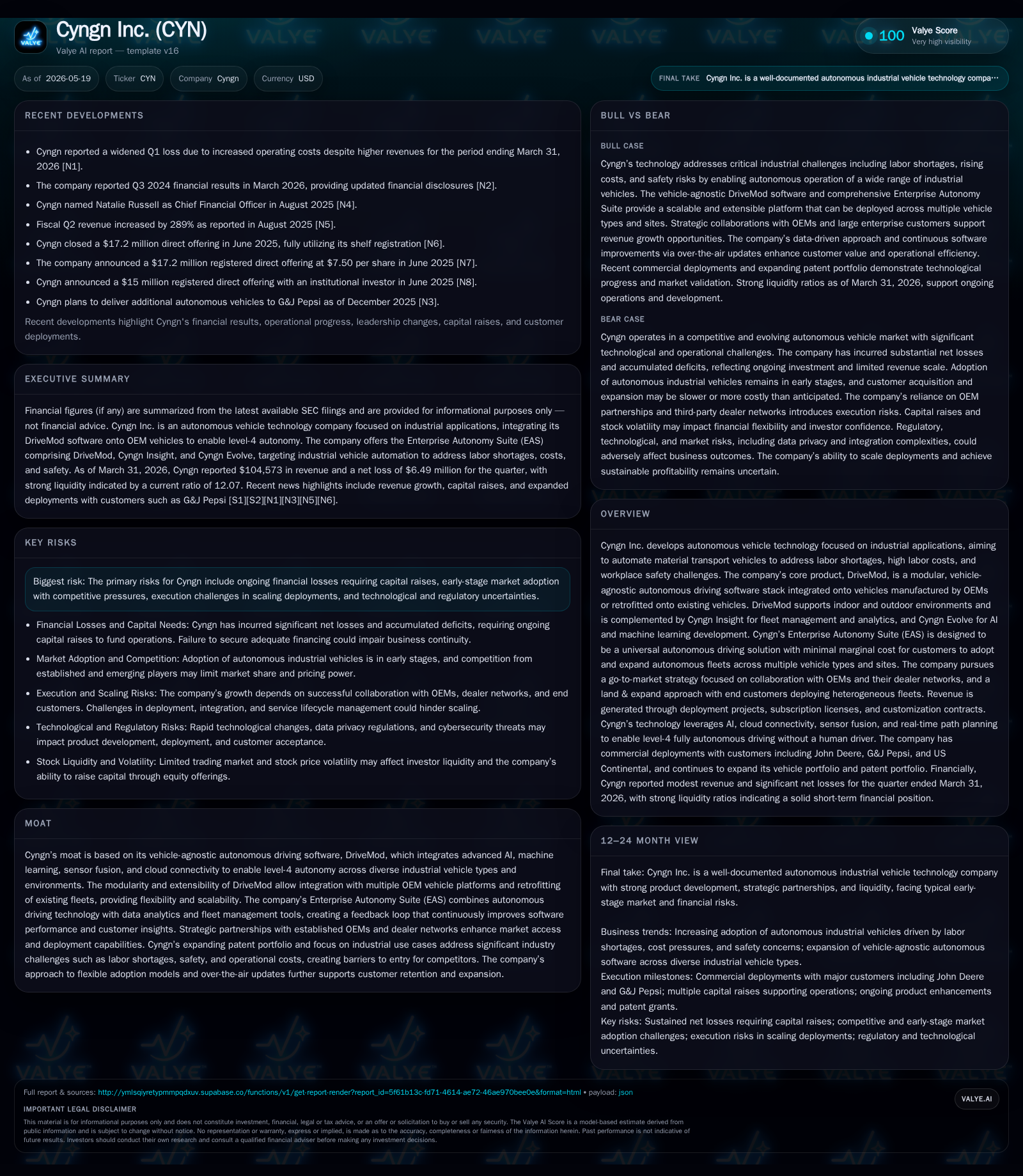
In its recent 10-Q filing for Q1 2026, Cyngn Inc. detailed ongoing expansion efforts of its autonomous industrial vehicle platform, DriveMod, complemented by analytics and AI tools under its Enterprise Autonomy Suite (EAS). Despite rising revenues linked to new deployments, escalating operating expenses have widened net losses as the company invests heavily in scaling commercialization. Cyngn’s business model leverages modular, vehicle-agnostic software that integrates across multiple industrial vehicle types and OEM platforms, enabling flexible retrofit or embedded solutions. The firm operates within a nascent yet evolving market landscape characterized by high barriers to entry and regulatory uncertainty, with growth driven by OEM collaborations, fleet expansion, and value-added data services. Key risks remain centered on financial sustainability, technological reliability in edge cases, and the timing of broader market adoption.
Latest Quarterly Operating Update: Progress and Challenges
Cyngn’s Q1 2026 10-Q filing dated May 14 reveals a mixed but forward-moving operational picture. The company reported revenue gains reflecting increased scaled deployments of its DriveMod autonomous vehicle system particularly in material handling applications. However, this revenue growth accompanies a marked jump in operating expenses tied to expanded commercial deployment efforts and technology development investments. Net losses consequently widened, signaling ongoing margin pressure as Cyngn accelerates its transition from prototype to production-stage operations. Importantly, no new risk factor changes were disclosed relative to the prior year-end filing [S2][N1]. This dynamic aligns with early-stage commercialization curves common among enterprise autonomy providers where upfront scaling costs precede sustainable profitability.
Business Model and Product Suite Composition
At the heart of Cyngn’s strategy lies DriveMod—a modular autonomous driving software stack designed to be vehicle agnostic. DriveMod supports both indoor and outdoor operational design domains (ODDs), integrating seamlessly onto industrial vehicles either at OEM assembly or via retrofit kits. This flexibility addresses one of the key adoption barriers faced by traditional rigid automation solutions that require all-or-nothing fleet investments [S1][S6].
Complementing DriveMod is Cyngn Insight, a configurable cloud-based fleet management platform that aggregates telematics and operational data into actionable analytics for customers. Additionally, Cyngn Evolve functions as an internal AI/ML development ecosystem facilitating continuous algorithm training using both real-world and synthetic datasets derived from deployed fleets. Together these components form the Enterprise Autonomy Suite (EAS), which provides not only autonomous control but also ongoing data-driven optimization and remote monitoring capabilities enhancing customer value over time [S6][S11].
Revenue streams come principally from deployment fees—covering site mapping, integration labor, hardware installation—and recurring EAS licensing subscriptions [S6]. Customization via Non-Recurring Engineering (NRE) contracts also generates project-specific revenues as DriveMod expands support to new vehicle types or maneuvers often tailored per OEM or end-customer requirements
Competitive Landscape and Industry Structural Dynamics
Cyngn operates within an emergent sector focusing on automation of industrial vehicles predominantly used for material transport in manufacturing, distribution centers, agriculture, mining, and yard operations—markets where labor shortages, safety pressures, and cost inflation compel automation adoption.
Instead of competing with adjacent hardware or enabling technology vendors, Cyngn positions itself as a collaborative technology partner relying heavily on OEM alliances like BYD (forklifts) and Motrec (tuggers). Its leveraging of established dealer networks facilitates broader market penetration without incurring direct sales channel development costs [S13]. This partnership-centric approach aligns with industry value chains where vehicle manufacturers control critical hardware platforms while autonomy firms provide software overlays.
A notable structural advantage lies in EAS’s modularity and extensibility—enabling cyclical expansion within existing customer fleets across sites and vehicle classes without substantial incremental capital expense. Regulatory exposure is moderated given deployments occur mostly on private property under existing workplace safety frameworks rather than public roads; nonetheless evolving standards from OSHA or ISO bodies require active compliance efforts [S26].
Growth Drivers in Enterprise Autonomy Suite Expansion
Key growth vectors center on increasing volume penetration through land-and-expand strategies at large enterprise customers who operate heterogeneous industrial vehicle fleets across multiple sites. After initial deployment success, Cyngn aims to upsell expanded autonomy features alongside enhanced data analytic packages via Cyngn Insight subscriptions.
Broadening DriveMod’s functionality—for instance adding complex maneuvers or supporting additional vehicle models—opens doors for NRE-driven revenues while deepening strategic ties with OEM partners enhances exclusivity prospects. Expanding industry 5.0 paradigms featuring AI-human collaboration in smart factories further boosts demand for sophisticated autonomy combined with actionable data insights [S5][S6].
Commercially released products such as the Stockchaser tow tractor endorsing a 6,000-lb towing capacity (since early 2023) and the MT160 Tugger rated at 12,000 lbs towing capacity commercially released in 2024 represent tangible milestones evidencing product portfolio diversification [S12]
Operational Risks and Market Adoption Constraints
Primary hurdles include continued net losses necessitating future capital raises aligned with scaling ambitions. Technologically, achieving consistent high-reliability performance required for widespread industrial AV deployment remains challenging due to limited control over OEM mechanical subsystems like braking or steering which are critical for safe operation [S1].
Software robustness against rare edge-case scenarios also requires ongoing refinement given the complexities encountered even in controlled environments. Furthermore, customers face significant payback timing considerations; many industrial automation adopters are risk-averse towards large-scale upfront investments because ROI horizons can extend over multiple years leading to cautious phased adoption rather than wholesale fleet automation [S7][S24].
Regulatory uncertainty around autonomous industrial vehicle standards globally introduces additional execution complexity requiring constant monitoring and active participation in standards development.
Key Milestones and Near-Term Watchpoints
Near-term execution indicators to monitor include scaling production deployments notably with marquee customers such as John Deere alongside further expansion at US Continental among others. Progression securing additional license agreements particularly targeting companies reliant on material handling vehicles will serve as demand signals.
Tracking forthcoming patent grants following recent portfolio expansions will reflect intellectual property moat strengthening efforts essential for sustained competitive differentiation. Continuous rollout of DriveMod enhancements broadening maneuvering capabilities coupled with deeper integration within dealer service networks are pivotal execution milestones likely driving uptake velocity over the coming quarters [S5][S6].
Financial Profile and Liquidity Status
As of March 31, 2026, Cyngn held approximately $5.1 million in cash and equivalents against current liabilities near $4.1 million resulting in a robust current ratio around 12 indicating strong short-term liquidity capacity supportive of ongoing operational scaling efforts [F1][S2]. Total debt remained elevated referencing prior metrics approximating $32.6 million against net debt near $27.5 million due to cash offsets
Despite higher revenues reflective of expanding commercial deployments through Q1 2026, operating expenses outpaced top-line growth causing net losses to widen further compared with prior periods consistent with an investment-heavy commercialization phase demanding careful cash management going forward. Capital raising ability underpins financial resilience amid ongoing net burn characteristic of early-stage autonomous systems ventures.
This analysis synthesizes publicly available SEC filings along with recent news disclosures to provide an integrated operating perspective of Cyngn Inc.’s business transformation within industrial autonomous vehicle markets. It does not constitute investment advice but serves to elucidate company positioning, strategic progressions, market dynamics, risks, and financial context relevant for industry stakeholders seeking domain-informed insights.
Financial position in context
As of 2026-03-31, companyfacts shows $5mm in cash and equivalents [F1]. Current assets of $50mm and current liabilities of $4mm imply a current ratio near 12.07x for 2026-03-31 [F1].
Disclaimer: This is research-only, informational analysis and not investment advice. It may include AI-generated interpretation and general industry context. Always verify important details using primary sources.

Comments