
Cypherpunk Technologies: Dual-Track Strategy Blends Digital Asset Volatility with Biotech Upside
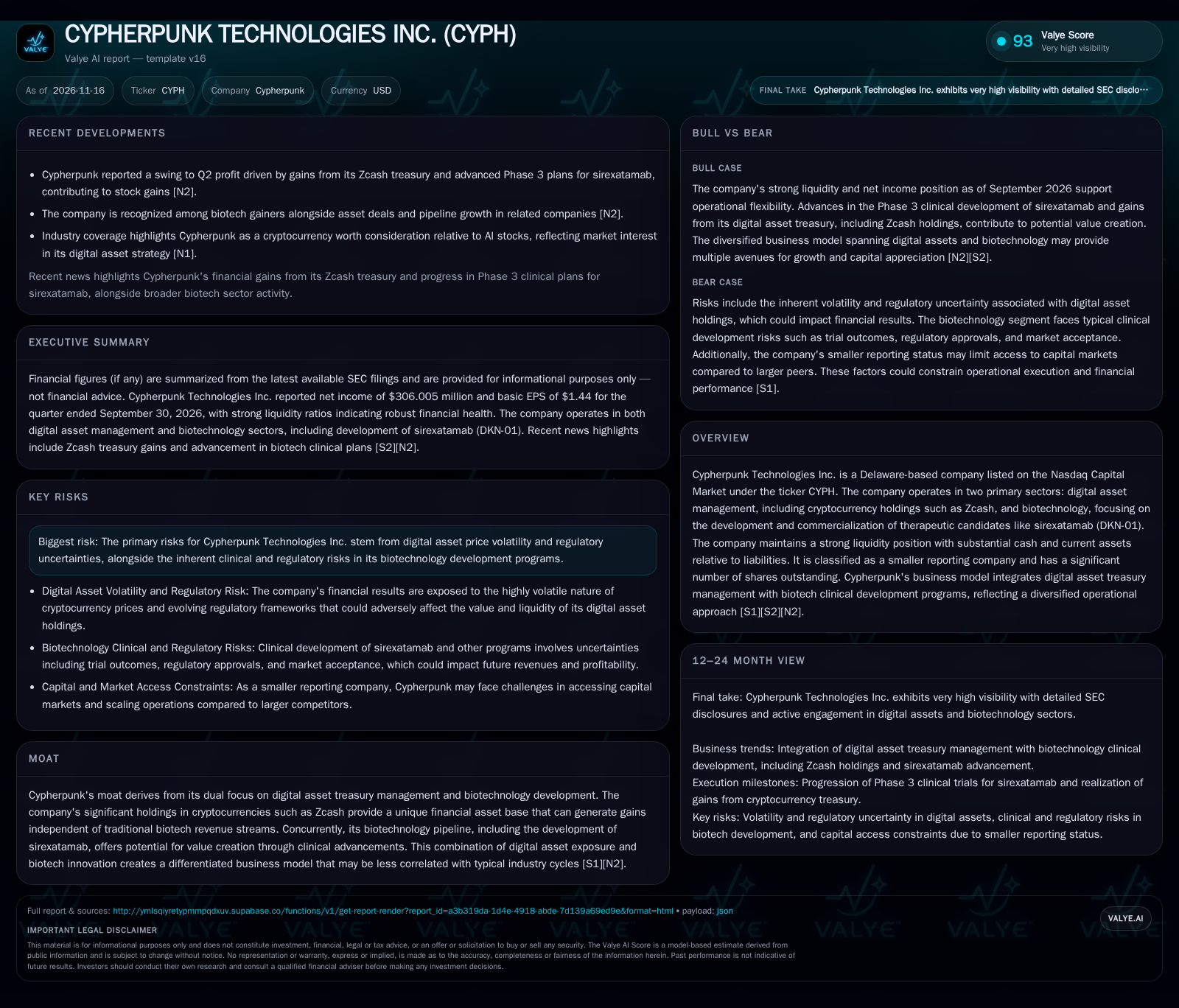
Cypherpunk Technologies maintains a uniquely diversified business model, combining digital asset management—including cryptocurrency holdings—and the development of biotechnology assets like sirexatamab. Recent financials show substantial current assets and net income, but the company’s future trajectory hinges on navigating clinical and regulatory hurdles in biotech and managing exposure to crypto market swings.
Cypherpunk Technologies reported liquidity position and net income as of Q3 2026, reflecting robust digital asset gains and ongoing biotech development. Its business model is unusual in combining cryptocurrency treasury management with clinical-stage biotech, offering both diversification and complexity. The company’s outlook will depend on continued digital asset performance, successful biotech advancement, and its ability to mitigate sector-specific risks.
Cypherpunk Technologies Inc. stands out for its rare hybrid approach: simultaneously managing a sizable digital asset treasury and advancing clinical-stage biotechnology programs. However, its future value creation depends on two highly volatile arenas—digital assets and biotech clinical development—each with their own unique risk and reward profiles. Investors and analysts must grapple with the interplay between these sectors, where success in one could buffer setbacks in the other, but failure in both would be deeply damaging.
Why Cypherpunk’s Latest Financials Matter for Its Unique Diversification Bet
As of September 30, 2026, Cypherpunk Technologies reported $55.988 million in cash and cash equivalents and $526.442 million in current assets, far exceeding its $2.385 million in current liabilities. This produces an reported current ratio of over 220, highlighting a balance sheet with reported liquidity position [S2]. In the same quarter, the company posted net income of $306.005 million and basic earnings per share of $1.44 [S2]. These results were achieved amid continued focus on both digital asset management—including Zcash holdings—and the development of biotechnology programs such as sirexatamab (DKN-01) [S1] [N2].
These facts are material because they demonstrate Cypherpunk’s current financial strength, largely fueled by digital asset gains, while also supporting ongoing investment in its biotech pipeline. However, the sustainability of this position is contingent on continued positive crypto price trends and successful biotech execution—both of which historically exhibit high volatility and risk.
The company reported cash and liquidity metrics for the period; these figures do not by themselves establish operating runway, investment capacity, financial flexibility, or financing capacity. Digital asset valuations can be highly sensitive to market sentiment and regulatory developments, potentially inflating asset values in favorable conditions but risking rapid depreciation. Therefore, understanding the proportion of liquid versus illiquid or volatile assets within current assets is critical to assessing the true financial resilience and operational runway of the company.
Dissecting Cypherpunk’s Revenue Streams: Crypto Treasury and Biotech as Parallel Engines
Cypherpunk’s business model is distinctive in that it operates two fundamentally different economic engines. The first is digital asset management, where gains or losses are primarily driven by price movements in cryptocurrencies, notably Zcash. This business is capital-light but highly volatile: revenue recognition is tied to asset appreciation, realized gains, or potential staking/yield mechanisms if deployed. The second is biotechnology, which typically involves high upfront R&D costs, multi-year development cycles, and binary clinical/regulatory milestones. If successful, biotech programs like sirexatamab could deliver significant upside through licensing, partnerships, or eventual commercialization, but require sustained capital and have a high risk of failure.
From an expense perspective, digital asset management carries minimal incremental operating costs relative to asset size, while biotech development is dominated by fixed R&D and milestone-driven spending. The potential for operating leverage exists if biotech assets advance to revenue-generating stages, but the capital requirements and risks are substantial until that inflection point is reached.
The capital allocation decisions between the crypto treasury and biotech R&D represent a strategic balancing act. If digital asset prices are favorable, Cypherpunk might prioritize reinvestment into biotech programs to advance clinical milestones, potentially accelerating value creation. Conversely, in periods of crypto market downturns, the company may need to conserve cash or liquidate assets, which could delay biotech progress. This dynamic underscores the importance of a flexible financial strategy that can adapt to asymmetric risk profiles and timelines inherent in both sectors, as well as the need for robust scenario planning to optimize resource deployment under varying market conditions.
Evaluating Moat and Exposure: How Cypherpunk’s Model Differentiates—And Where It’s Vulnerable
Cypherpunk’s competitive differentiation stems from its hybrid structure. Few public companies blend active cryptocurrency treasury management with biotechnology R&D. This unusual mix could attract investors seeking non-correlated growth drivers, as digital asset cycles and biotech outcomes are not directly linked. The digital asset portfolio, especially Zcash, offers potential for outsized gains during crypto bull markets, but exposes the company to substantial downside and regulatory scrutiny during downturns or adverse policy shifts.
In biotechnology, the moat depends on the uniqueness and clinical prospects of assets like sirexatamab. Success here hinges on demonstrating clinical efficacy, securing intellectual property, and advancing through regulatory milestones. The company’s smaller reporting status may limit its access to capital and partnership opportunities, especially versus larger biotech or established digital asset managers. Substitution risk is high in both domains: new digital assets could supplant current holdings, and competing biotech innovations could make Cypherpunk’s pipeline less relevant if clinical progress stalls.
Cypherpunk’s hybrid model also introduces complexity in stakeholder communication and investor relations. The distinct risk-return profiles of digital assets and biotech development may attract different investor segments with divergent expectations regarding volatility, timelines, and valuation drivers. Managing these expectations requires transparent disclosure and education about the company’s integrated strategy and risk management practices. Additionally, the company’s smaller scale may limit its ability to leverage economies of scale or negotiate favorable terms in partnerships, potentially constraining competitive positioning relative to larger, more specialized peers in either domain.
How a Crypto Rally Plus Biotech Breakthrough Could Transform Cypherpunk’s Value Proposition
If digital asset markets, particularly for Zcash, experience another sustained rally, Cypherpunk could realize significant mark-to-market gains and potentially unlock liquidity for further biotech investment or shareholder returns. Simultaneously, if sirexatamab achieves positive clinical data—such as strong efficacy in a pivotal trial—this could attract strategic partnerships or licensing deals, validating the biotech segment and providing a non-dilutive funding source.
Evidence that would confirm this upside includes a continued rise in digital asset prices, disclosures of realized crypto gains, initiation of advanced clinical trials, or announcement of partnerships or out-licensing agreements for sirexatamab. Such developments would demonstrate the company’s ability to monetize both sides of its business model and create a compelling narrative for diversified growth.
What Steady-State Looks Like: Biotech Progress Offsets Crypto Volatility, but Execution Remains Key
In the most plausible middle-ground scenario, Cypherpunk’s digital asset holdings fluctuate but do not generate outsized gains or catastrophic losses, providing a moderate cushion for ongoing biotech investment. The biotech pipeline, led by sirexatamab, progresses through early- to mid-stage clinical development, but without major value inflection events such as pivotal trial readouts or licensing deals in the next 12-24 months.
Confirming evidence would include stable or only modestly volatile digital asset balances, ongoing R&D spend, and incremental clinical milestones (e.g., trial initiations or early data). Falsifying evidence would be a sharp digital asset drawdown that forces asset sales or a major clinical setback that halts the lead biotech program.
Double Trouble: When Crypto Declines and Biotech Stalls Amplify Capital and Execution Risks
A severe downturn in digital asset prices could erode Cypherpunk’s liquidity buffer, just as unexpected clinical or regulatory setbacks in the biotech pipeline increase cash burn with little prospect of near-term monetization. In this adverse scenario, the company could be forced to raise dilutive capital or sell digital assets at depressed prices, undermining both segments and leaving little margin for error.
Evidence confirming this downside would include disclosure of significant digital asset impairment losses, urgent capital raises, halted or failed clinical trials, or regulatory setbacks. A scenario where both digital asset and biotech segments underperform would likely result in a significant loss of investor confidence and strategic flexibility.
Milestones That Will Clarify Whether Cypherpunk’s Hybrid Model Can Deliver Sustainable Value
Progression of sirexatamab (DKN-01) into advanced clinical trials, including trial initiations, enrollment milestones, or top-line data releases.
Material realized gains or losses from Zcash or other digital asset holdings, as disclosed in financial statements or press releases.
Updates on digital asset portfolio composition, including changes in asset allocation or diversification strategies (if disclosed).
R&D expenditure trends and clinical development pipeline updates, which would indicate pace and scope of biotech investment.
New partnership announcements, out-licensing deals, or strategic collaborations related to either the biotech or digital asset segments.
Any regulatory developments impacting digital asset management, such as new U.S. or international crypto compliance requirements.
Capital-raising activities, especially if driven by liquidity needs rather than strategic opportunity.
Disclaimer: This is research-only, informational analysis and not investment advice. It may include AI-generated interpretation and general industry context. Always verify important details using primary sources.

Comments