
Digital Brands Group Eyes Revenue Growth with NIL Apparel Model
DBGI updates fiscal 2026 revenue guidance and highlights strategic advances in private label NIL apparel manufacturing amid liquidity constraints.
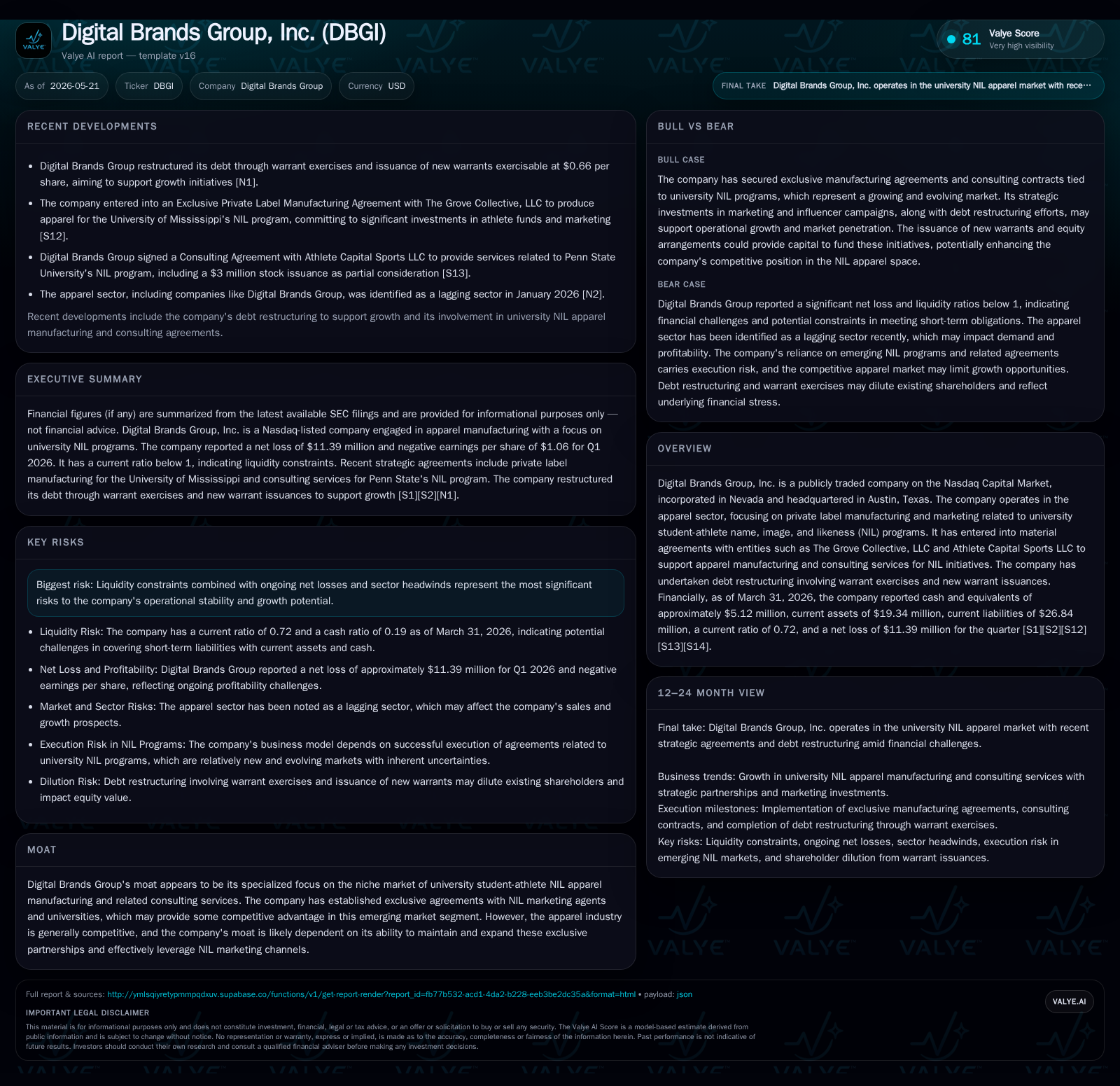
Digital Brands Group, Inc. (DBGI) recently provided fiscal year 2026 guidance targeting $55 million to $65 million in revenue and positive free cash flow from $2.5 million to $3.5 million, marking operational progress despite prior net losses. The company's business model centers on exclusive private label apparel manufacturing linked to collegiate athlete NIL marketing programs, leveraging partnerships with key entities such as The Grove Collective. While DBGI benefits from niche positioning and early mover advantages in the emerging NIL apparel segment, ongoing liquidity challenges and competitive pressures remain important risks. Near-term growth hinges on expanding NIL partnerships and scaling manufacturing capabilities within a complex regulatory and supply environment.
Q1 2026 Operating Update: Revenue Guidance and Cash Flow Outlook
In the company’s latest quarterly SEC filing dated May 20, 2026, Digital Brands Group updated its fiscal year 2026 revenue outlook to a range of $55 million to $65 million alongside a positive free cash flow projection between $2.5 million and $3.5 million [S2][S3]. This guidance reflects a noteworthy shift towards improved operational performance following several quarters marked by net losses. The issuance on May 12 further underscored management’s confidence in the ability to leverage existing contracts and scale product sales under its NIL-focused business model [S3]. These financial parameters serve as the primary near-term markers shaping investor expectations.
Business Model: Private Label Manufacturing Leveraging NIL Market Channels
Digital Brands Group generates revenue predominantly through private label apparel manufacturing tailored around university student-athlete name, image, and likeness (NIL) licensing programs [S1]. The company secures exclusive contracts with NIL marketing agencies such as The Grove Collective, LLC—whose role as an NIL agent for the University of Mississippi centralizes partner access—and supplies branded knitwear products sold through the client’s direct digital storefronts or physical outlets [S21]. This model blends manufacturing services with strategic consulting spend that includes directed advertising investments toward influencer marketing campaigns aimed at athlete-centric audiences.
Revenue mechanics hinge on contracts specifying annual minimums coupled with variable volumes driven by demand for exclusive apparel products that notably exclude game jerseys or trademarked team gear owned by athletes or institutions themselves [S21]. Successful revenue growth depends on expanding the number of university partnerships while maintaining pricing leverage through exclusivity arrangements. Customer retention benefits from high switching costs: since retooling production lines for new clients requires upfront design and compliance efforts plus negotiated authorization rights related to emerging NIL legal frameworks.
Competitive Environment: Apparel Sector Dynamics and NIL Partnership Gatekeeping
The broader apparel manufacturing sector is highly fragmented with intense price competition; however, Digital Brands Group’s focus on a nascent but growing NIL segment partially insulates it from commoditized market pressures [S1]. Having secured exclusive multi-year contracts with select marketing agents places DBGI in a gatekeeping position for an emergent channel where collegiate athletes monetize personal brand rights post-NCAA regulation reforms.
Yet barriers exist: regulatory interpretations of NIL rights continually evolve across states and institutions creating an intricate compliance landscape that could restrict product offerings or increase legal scrutiny [N1]. Moreover, supply chain tightness endemic to private label apparel—involving sourcing specialized materials and coordinating timely production runs—may impede rapid scale or margin expansion without capital reinvestment.
Growth Drivers: Expanding NIL Partnerships and Scaling Manufacturing Capacity
Digital Brands Group’s pathway to growth lies chiefly in extending its footprint among universities embracing student-athlete commercialization through new or renewed exclusive apparel agreements [S3]. Incremental revenues also derive from licensing collaborations with sports marketing firms like Athlete Capital Sports LLC which provide complementary consulting services around name-image merchandising strategies.
Manufacturing scale economies may emerge if volume thresholds are met, especially given the company’s committed investment in athlete-directed funds ($500K annually) and digital marketing expenditures (~$500K annually) designed to amplify brand visibility tied to NIL collections [S21]. Key performance indicators encompass apparel units sold under NIL branding, renewal rates of exclusive agreements, and digital campaign ROI—all determining DBGI's ability to convert niche market traction into sustainable cash flow positive operations.
Risks and Constraints: Liquidity, Competition, and Emerging NIL Regulation
Despite top-line optimism, DBGI faces material operational risk highlighted by its suboptimal liquidity position signaled by a current ratio of approximately 0.72 as of March 31, 2026 [F1], underscoring short-term coverage concerns amid current liabilities exceeding current assets ($26.84M vs $19.34M) [F1][S2]. The company carries around $6.06 million in total debt against roughly $5.12 million in cash reserves yielding net debt close to $0.94 million—a narrow buffer that constrains flexibility [F1]. Recent warrant exercises have provided some capital injection but ongoing refinancing risk remains relevant given the reported net loss of about $11.39 million last quarter [F1][N1].
Competitive threats arise from well-established sportswear manufacturers that could encroach upon the growing collegiate athlete merchandising domain should they secure equivalent licensing rights or develop superior supply chain efficiencies. Additionally, shifting regulatory scrutiny on student-athlete commercial activities—at times involving federal or state legislative proposals—could impose limitations affecting product categories permissible for sale or alter royalty structures impacting profitability [N1][S2].
What to Watch: Execution Milestones, Partnership Expansions, and Cash Management
Investor attention should focus on forthcoming quarterly earnings releases confirming whether revenue targets are met within the guided range plus demonstrating adherence to free cash flow goals set earlier this year [S3][S2]. Announcements of expanded university contracts or additional agreements with influential NIL marketing firms would validate DBGI’s strategy execution pace.
Management commentary addressing margin improvement initiatives through optimized cost structures or incremental pricing will also be pivotal amid evident capital constraints requiring careful cash management including possible further debt restructurings or equity issuances to support working capital needs (as seen in prior recent transactions involving warrants issuance) [N1][S19][S22]. Monitoring digital marketing efficiency metrics tied directly to athlete endorsements will offer additional insight into scalability potential.
Financial Snapshot: Balance Sheet Stability Amid Debt Restructuring
As of March 31, 2026, Digital Brands Group held roughly $5.12 million in cash plus total current assets nearing $19.34 million against current liabilities approximating $26.84 million resulting in a current ratio below the ideal benchmark at 0.72 indicating moderate liquidity strain [F1][S2]. The company carries about $6.06 million in total debt with net debt near $0.94 million, reflecting a balance sheet that requires prudent financial stewardship amid ongoing operating losses [F1].
The company has actively engaged in warrant exercises whereby holders converted warrants into shares generating proceeds over recent months alongside issuance of new warrants providing optionality for capital raises if needed [N1][S19][S22], reflecting strategic attempts to bolster financial flexibility while preserving stakeholder confidence during scaling stages.
This analysis synthesizes publicly available SEC filings alongside corporate disclosures as of May 2026 without incorporating speculative projections or investment advice.
Disclaimer: This is research-only, informational analysis and not investment advice. It may include AI-generated interpretation and general industry context. Always verify important details using primary sources.

Comments