
DocGo’s Mobile Healthcare Ambition: Labor Pressures, Revenue Shifts, and the Stakes of Virtual-Plus-Physical Integration
DocGo’s hybrid platform for mobile care and medical transportation aims to capture value from health plan partnerships and care gap closures, but persistent labor cost inflation, declining government revenue, and recent leadership turnover test the model’s scalability and margin potential.
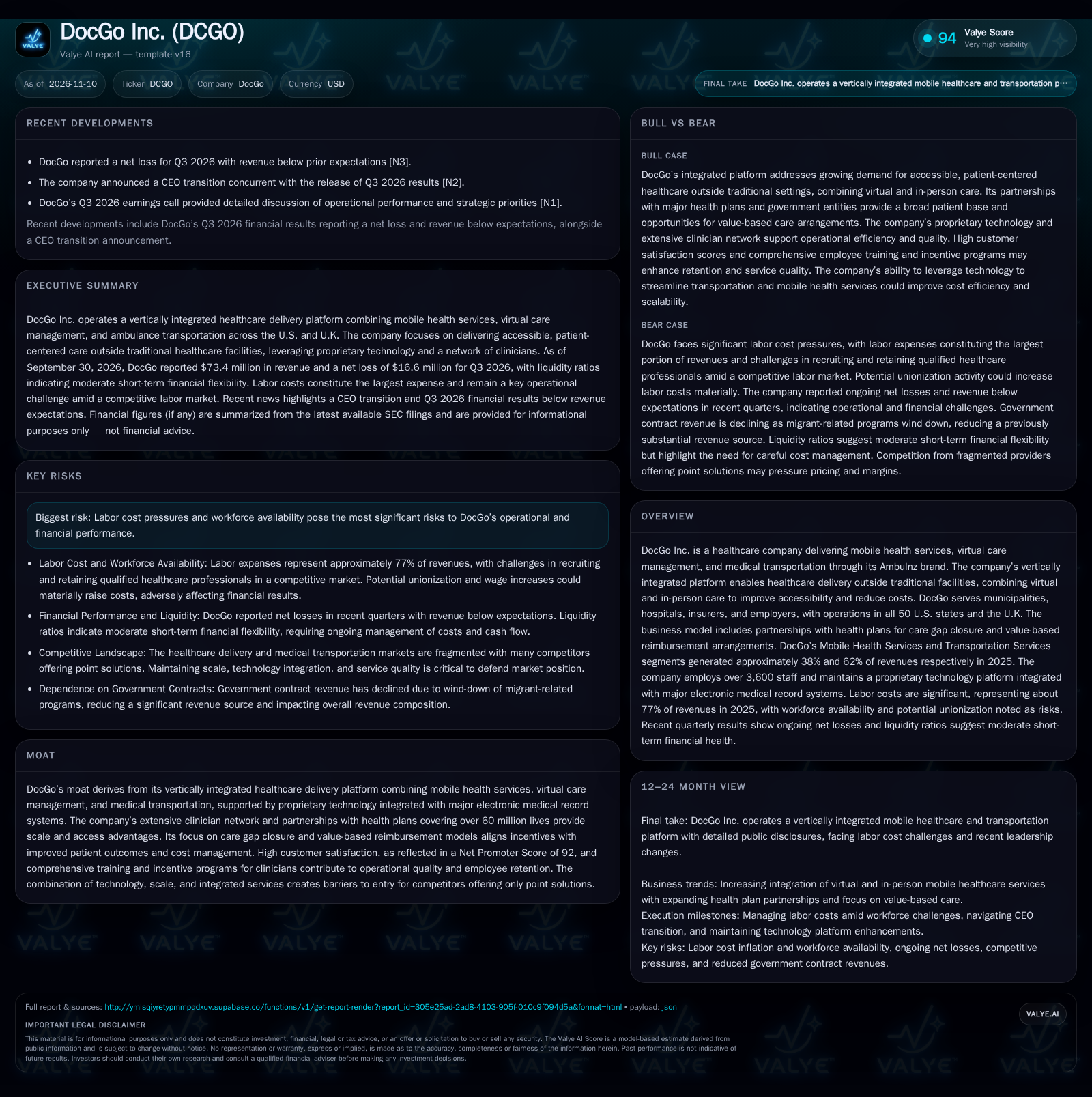
DocGo’s vertically integrated mobile health and transportation business leverages proprietary technology and health plan partnerships for care gap closure, but labor costs (77% of revenue), a Q3 2026 loss, and CEO turnover raise execution and scalability questions. Declining government contract revenue and reported liquidity position highlight the need for operational discipline and successful value-based care expansion. Monitoring labor trends, health plan adoption, and CEO transition outcomes will be fundamental for thesis validation. [S1] [S2] [N2] [N3]
DocGo Inc. is attempting to reshape out-of-hospital healthcare delivery by merging mobile health, virtual care, and technology-driven medical transportation into a unified platform. The company’s value proposition—serving health plans, municipalities, and hospitals with a hybrid of on-site and virtual services—addresses growing demand for accessible, cost-efficient care. Yet DocGo’s model faces acute challenges: labor costs now absorb 77% of revenue, government contract work is contracting, and the business reported a Q3 2026 loss and CEO transition just as execution risk is peaking. The company’s ability to manage workforce economics and deliver on value-based care promises will determine whether its platform can scale profitably, or whether competitive and cost pressures will constrain its ambitions. [S1] [S2] [N2] [N3]
DocGo’s Strategic Crossroads: Financial Losses, Labor Pressures, and Leadership Change
As of Q3 2026, DocGo reported a net loss of $16.6 million on $73.4 million in revenue, with both figures coming in below market expectations. This financial underperformance coincided with the announcement of a CEO transition, highlighting a period of heightened execution risk and strategic reassessment. Labor costs remain the company’s defining operational challenge, comprising approximately 77% of 2025 revenues and reflecting intense competition for qualified healthcare staff. Meanwhile, government contract revenue—a major historical driver—has fallen to 38% of 2025 revenue as migrant-related programs wind down, forcing a greater reliance on commercial and health plan partnerships. The company reported cash and liquidity metrics for the period; these figures do not by themselves establish operating runway, investment capacity, financial flexibility, or financing capacity. [S1] [S2] [N2] [N3]
How DocGo’s Platform Seeks to Capture Value—and Where Margin Pressure Bites
DocGo’s business model is built around delivering healthcare outside traditional facilities via a vertically integrated platform that combines virtual care management, mobile health services (on-site diagnostics, triage, and treatment), and technology-enabled ambulance transportation. The primary revenue streams are Mobile Health Services (38% of 2025 revenues) and Transportation Services (62%), each dependent on a blend of fee-for-service, value-based care contracts, and government work. The company’s partnerships with health plans for care gap closure and value-based reimbursement arrangements introduce potential for risk-sharing and incentive alignment: if DocGo can measurably improve outcomes or reduce costs for payors, it stands to capture a share of the savings.
However, the model’s scalability and profitability are fundamentally constrained by labor intensity. With labor costs absorbing 77% of revenue, DocGo’s margin structure is highly sensitive to wage inflation, recruitment bottlenecks, and retention challenges—risks exacerbated by potential unionization activity. While the proprietary technology platform aims to drive efficiency and integration with electronic medical record systems, fixed-cost leverage is limited by the need for a large, credentialed field workforce. Capital requirements are moderate, with investment focused on technology, fleet, and training, but persistent operating losses signal that the business has yet to achieve sustainable scale or operating leverage. If the company can increase patient encounters per clinician or improve route and scheduling efficiency, margin expansion may be plausible, but this remains to be proven at scale. [S1] [S2]
Competitive Landscape: Platform Integration vs. Point Solution Fragmentation
DocGo operates in a fragmented healthcare delivery and medical transportation market, facing competitors ranging from regional ambulance operators and urgent care providers to emerging telehealth and at-home care platforms. Its potential advantage lies in vertical integration: by combining mobile health, virtual care, and transportation in a unified platform, DocGo can offer health plans and municipalities a single solution for care gap closure, potentially reducing fragmentation and administrative burden for customers.
However, this integration advantage is counterbalanced by several forces. Many competitors offer point solutions with lower fixed costs or more flexible staffing models, making them nimbler in responding to local market pressures. Furthermore, DocGo’s scale and technology integration may not translate into pricing power if payors and municipalities continue to prioritize lowest-cost providers or if labor market tightness erodes service reliability. The declining share of government contract revenue also means DocGo must compete more aggressively for commercial and health plan business, where customer retention and contract renewal are not guaranteed. The company’s Net Promoter Score of 92 for Mobile Health Services suggests high satisfaction, but whether this translates into durable switching costs or pricing latitude in a cost-sensitive sector remains unproven. [S1]
If Value-Based Care Adoption Accelerates, Can DocGo Unlock Margin Expansion?
In a favorable scenario, DocGo successfully pivots from declining government contract work to deeper, high-margin partnerships with commercial health plans. The company’s proprietary platform and clinician network enable it to deliver measurable improvements in care gap closure and patient outcomes, supporting value-based reimbursement models with graduated risk-sharing. As DocGo demonstrates its ability to reduce emergency room visits and hospital admissions for managed care populations, health plans expand contract scope and duration, driving higher patient encounter volume and more predictable recurring revenue.
Margin expansion materializes if technology-driven efficiency gains allow more patient interactions per clinician and reduce idle time for transportation assets. Comprehensive training and equity incentives improve clinician retention, mitigating wage inflation. Confirmation of this scenario would come from: (1) rising revenue per clinician, (2) a shift in revenue mix toward long-term, value-based contracts, (3) improvement in operating margins, and (4) public disclosure of expanded partnerships with major payors or municipalities. Falsification would be evident if labor costs escalate faster than revenue or if value-based contract adoption stalls.
Sustained Margin Compression as DocGo Manages Labor and Revenue Mix Shifts
The most probable near-term outcome is a period of operational adjustment marked by margin pressure and muted top-line growth. DocGo’s revenue base continues to shift away from government contracts toward commercial health plan partnerships, but the pace of value-based contract adoption is gradual, and fee-for-service work remains substantial. Labor market tightness persists, keeping wage costs elevated and limiting the company’s ability to expand margins through efficiency alone.
Net losses continue, but at a manageable pace relative to liquidity, as DocGo exercises cost discipline and focuses on high-satisfaction service lines. The CEO transition results in incremental, rather than transformative, strategic shifts. The business maintains a moderate current ratio and cash balance, but does not generate the free cash flow needed for major expansion or material debt reduction. This scenario is confirmed by stable or slowly declining operating margins, a steady mix of mobile health and transportation revenue, and continued, but not accelerating, partnership announcements. Falsification would require a rapid deterioration in labor costs, customer churn, or a failure to renew critical health plan contracts.
Labor Inflation and Contract Losses Drive Accelerating Financial Strain
In an adverse scenario, labor cost inflation outpaces DocGo’s ability to raise prices or drive efficiency, as competition for healthcare professionals intensifies and unionization pressures materialize. The company faces higher turnover, staffing shortages, and service disruptions, leading to dissatisfied customers and lost contracts. The transition away from government revenue is not matched by sufficient growth in commercial and health plan partnerships, resulting in stagnant or declining top-line performance.
Confirmation of this scenario would come from (1) a spike in labor costs as a percentage of revenue, (2) shrinking contract backlog or disclosed customer losses, (3) worsening Net Promoter Scores, and (4) any urgent financing activity or workforce reduction announcements. Falsification would require stabilization or reduction of labor costs and evidence of successful contract renewals despite market pressures.
Milestones and Metrics That Will Validate or Challenge DocGo’s Mobile Health Thesis
Trends in labor cost as a percentage of revenue: A sustained increase above 77% would signal intensifying margin pressure; a decline would suggest efficiency gains or successful wage management.
Revenue mix evolution between government, commercial, and value-based health plan contracts: A useful metric would be the share of revenue from long-term, risk-sharing agreements versus fee-for-service.
Operating margin trajectory: Improvement would support scalability of the hybrid platform; continued compression would undermine the value proposition.
Number of patient encounters per clinician and per unit of transportation asset (if disclosed): Rising productivity would indicate successful technology leverage.
Net Promoter Score trends for both Mobile Health and Transportation Services: Declines could foreshadow customer churn or contract losses.
Disclosure of contract wins, renewals, or expansions with major health plans or municipalities: These would signal commercial traction and revenue durability.
CEO transition outcomes: Early evidence of strategic continuity, operational improvement, or talent retention will be central to thesis validation.
Liquidity and cash flow trends: Persistent negative free cash flow or urgent capital raises would increase financial risk and test the company’s resilience.
Disclaimer: This is research-only, informational analysis and not investment advice. It may include AI-generated interpretation and general industry context. Always verify important details using primary sources.

Comments