
Deere & Company Leverages Precision Ag and Digital Integration to Sustain Market Leadership
Deere & Company’s latest quarterly report underscores steady demand resilience powered by its smart industrial model and technological advances amidst cyclical pressures.
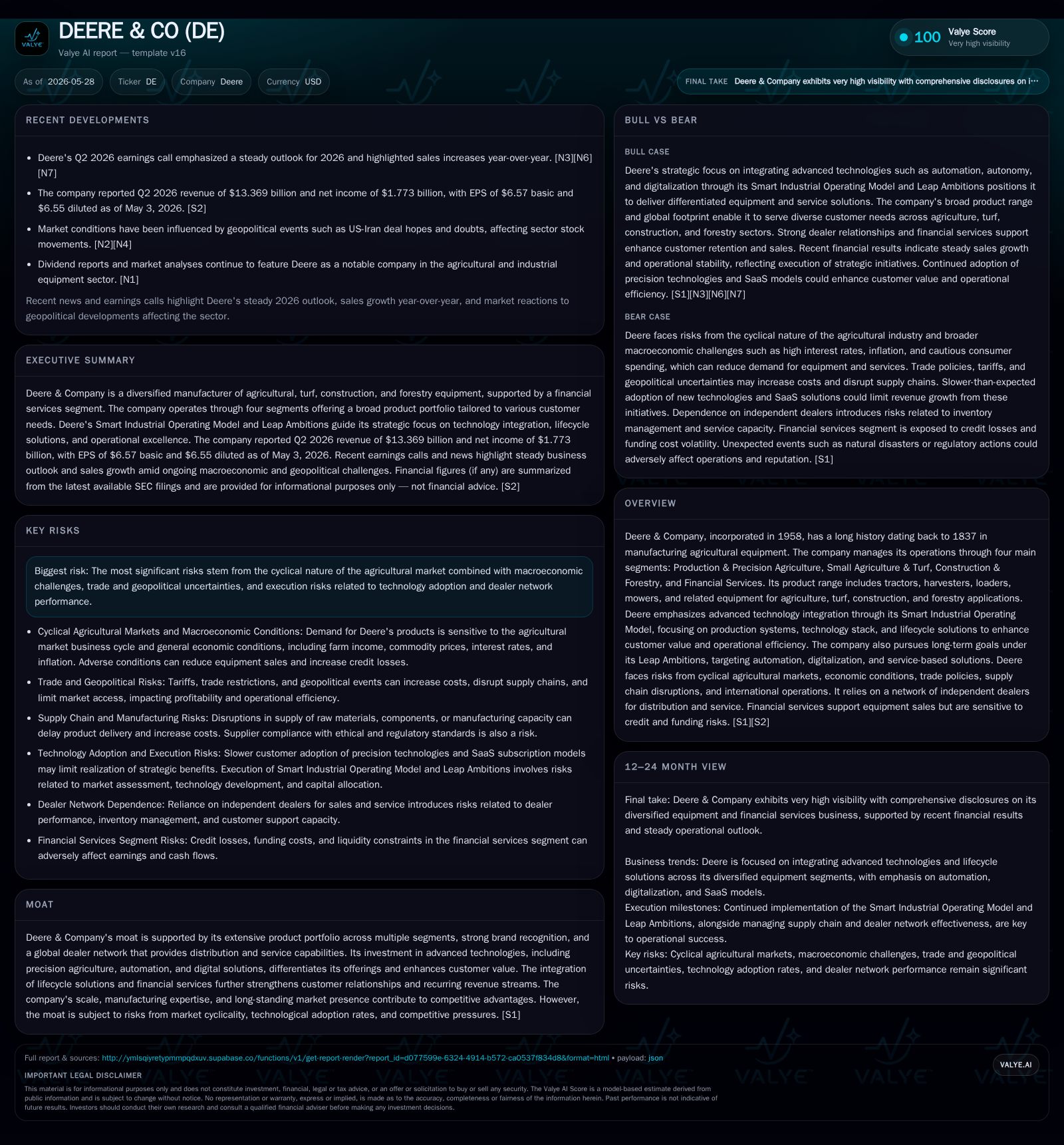
In its May 2026 quarterly filing, Deere & Company reported results that surpassed consensus revenue expectations despite ongoing agricultural market softness, reflecting the stabilizing effects of diversification into construction and forestry equipment. The company’s business model integrates advanced precision agriculture technologies, lifecycle solutions, and embedded financial services across four segments, enhancing customer value and stickiness. Deere’s competitive positioning remains robust owing to scale, dealer network coverage, and innovation investments, though it faces inherent cyclical industry risks and legal challenges over its repair ecosystem. Near term, monitoring dealer inventory trends, technological milestone progress, and regulatory developments are key to assessing execution success.
Recent Quarterly Operating Update and Its Strategic Implications
Deere's Q2 fiscal 2026 results detailed in the May 28, 2026 Form 10-Q confirm the company navigating a mixed demand environment characterized by continued softness in core agricultural equipment sales but offset by growth in the Construction & Forestry segment. The company announced revenues that exceeded analyst consensus estimates, demonstrating operational resilience despite challenging macroeconomic conditions impacting farm income and capital expenditures [S2], [S3]. This segmental balance reflects Deere’s strategic diversification beyond agriculture into construction and forestry equipment markets which have benefitted from infrastructure spending trends.
Management commentary from the Q2 earnings call noted deliberate inventory control measures within the dealer network to align supply with moderated demand signals while maintaining readiness for cyclical recovery phases. This approach supports pricing integrity amid typical agricultural industry volume fluctuations. Deere also highlighted steady progress against its Leap Ambitions initiatives focusing on automation technologies and integrated digital platforms as foundational to its sustainable competitive positioning even as raw material cost inflation and geopolitical trade uncertainties persist globally [N1], [N3].
Deere’s Business Model: Segment Synergies and Product Quality Differentiation
Deere structures operations around four principal segments: Production & Precision Agriculture (PPA), Small Agriculture & Turf (SAT), Construction & Forestry (CF), and Financial Services (FS) [S1]. The PPA segment serves large-scale farming operations with high-value equipment such as four-wheel-drive tractors, harvesters, seeding apparatuses augmented by embedded precision ag software enabling yield optimization. SAT caters primarily to smaller acreage farms and turf management with specialty tractors and mowers. CF addresses customers engaged in construction projects and timber harvesting via earthmoving machinery including backhoe loaders and excavators.
Financial Services complements product sales by providing financing for equipment purchases globally, underpinning customer lifecycle engagement and recurring revenue opportunities through loan interest margins [S1]
Integral to the business model is the Smart Industrial Operating Model emphasizing three pillars:
- Production Systems: Aligning product offerings tightly with defined customer production workflows to ensure solution relevance.
- Technology Stack: Leveraging proprietary hardware combined with embedded software layers delivering real-time telemetry data connectivity, machine learning analytics, autonomy capabilities, and digital decision-support tools.
- Lifecycle Solutions: Providing aftermarket service optimization including proactive maintenance alerts supported by dealer channel readiness ensuring quick parts availability; this enhances equipment uptime enhancement critical for customer operations.
Together these pillars generate switching cost advantages by embedding Deere deeply within primary operational processes of customers while enabling premium pricing structures through differentiated technology investments.
Industry Dynamics: Competitive Position and Structural Headwinds
Agricultural equipment demand is inherently cyclical influenced heavily by commodity prices impacting farm incomes that determine discretionary capital expenditures on large machinery. Deere’s broad geographical reach subjects it to varied government subsidy schemes, trade tariffs impacting supply chain costs, and macroeconomic factors such as inflation affecting farmers’ working capital.
Within this landscape Deere holds a durable competitive moat built on decades of brand recognition alongside one of the most extensive global dealer networks offering distribution scale unmatched by many peer mid-tier manufacturers. Their manufacturing footprint benefits from scale economies reinforcing cost competitiveness while allowing R&D investment in next-generation automation technologies — a segment where Deere strives to maintain leadership relative to peers who have historically trailed in integrated digital capabilities.
Notwithstanding strengths there are structural headwinds including disruptive market entrants pushing low-cost alternatives particularly in emerging markets as well as regulatory scrutiny especially around environmental compliance related to emissions standards on heavy machinery which impose incremental technology integration costs [S1], [S4]. Additionally, the ongoing antitrust lawsuit centered on Deere’s restrictive repair resource policy challenges operational freedom within its aftermarket services channel posing potential threat to service revenue models underpinning part of the lifecycle solutions strategy.
Growth Drivers: Technology Adoption, Precision Agriculture, and Service Innovation
Growth prospects hinge materially on increasing penetration of precision agriculture technologies which optimize input utilization (seed, fertilizer) reducing waste while improving yields thus enhancing farmer returns [S10]. Deere's Leap Ambitions articulate clear R&D focus areas around autonomy—driverless tractors—and platform-based digital solutions offering subscription-like ‘Solutions as a Service’ (SaaS) features facilitating recurring revenue expansion beyond upfront equipment sales
The factory-to-field technology stack includes sensors integrated into machinery generating actionable agronomic insights delivered via mobile applications directly accessible to farmers or agronomists. Adoption ramp-up drives improved price/mix metrics as customers pay premiums for these value-added services. Lifecycle solutions also facilitate aftermarket upgrades improving long-term customer retention thus capturing more wallet share over product life spans.
Financial Services acts as an enabled enabler for demand creation especially under high-interest rate environments where upfront capital constraints could otherwise suppress replacement cycles; flexible credit products help smooth acquisition timing preventing adverse dips in volume while maintaining margin quality.
Risks and Constraints: Market Cyclicality, Regulatory Scrutiny, and Execution Challenges
Foremost risk relates to cyclicality stemming from volatile commodities markets influencing farm incomes which dictate hunger for capital goods like tractors or harvesters; periods of excess crop inventory or low prices can sharply reduce new equipment orders leading to revenue variability [S4]. Macroeconomic factors such as rising interest rates additionally undermine farm profitability constraining credit availability indirectly suppressing demand for expensive mechanized assets
Legal/regulatory risks include the Federal Trade Commission-led antitrust litigation alleging monopolistic repair practices limiting third-party access to diagnostic tools plus related state AG actions which add uncertainty around Deere's ability to preserve its existing aftermarket service model without costly adjustments potentially diluting margins or increasing compliance costs substantially [S13]. Also heightened scrutiny on climate change regulations may increase operating costs due to required emissions reductions technologies or reporting responsibilities further pressuring earnings.
Operationally execution complexity increases as automotive-grade software development becomes central; failure to meet integration milestones on autonomous tractors or digital platform reliability could delay expected contribution timelines adversely impacting projected growth vectors aligned with Leap Ambitions goals.
Near-Term Monitoring: Guidance, Dealer Network Performance, and Legal Developments
Key near-term indicators include:
- Trends in dealer inventory levels signaling supply-demand alignment effectiveness crucial for pricing stability;
- Uptake rates of newly introduced autonomous features or digital subscription products measuring adoption velocity tied to Leap Ambitions;
- Resolution progress of the FTC antitrust litigation encompassing potential settlement announcements or regulatory rulings shaping aftermarket service strategy;
- Macro dynamics around commodity prices influencing farm cash flows thereby indirectly foreshadowing equipment purchasing rhythms documented during upcoming quarterly updates.
Monitoring earnings call disclosures relating to regional sales momentum across agriculture versus construction reflects shift nuances vital for forecasting segment-level performance trajectories accurately.
Summary Financial Context Supporting Operational Themes
While full Q2 fiscal 2026 financial details await release beyond SEC documents referenced here ([S2],[S3]), Deere maintains a robust cash position approximating $7.9 billion at quarter-end May 2026 supporting ongoing investments into innovation amid a leveraged capital structure indicated by net debt near $33.5 billion per latest available data ([F1]). This financial flexibility underpins management’s capacity to weather cyclical downturns while advancing technology development priorities critical for medium-term growth visibility. Revenue figures remain anchored at approximately $45.7 billion for the last reported annual period emphasizing scale that empowers strategic initiatives without disproportionate funding strain.
-- Disclaimer: This analysis synthesizes available public filings up to May 28, 2026 focusing on operational insights without making investment research views or forecasts about future performance.
Disclaimer: This is research-only, informational analysis and not investment advice. It may include AI-generated interpretation and general industry context. Always verify important details using primary sources.

Comments