
DeFi Development Corp. Expands Solana Treasury Amid Market Volatility
The latest quarterly filing reveals increased Solana digital asset holdings and ongoing validator operations underpinning DeFi Development's treasury strategy amidst evolving market dynamics.
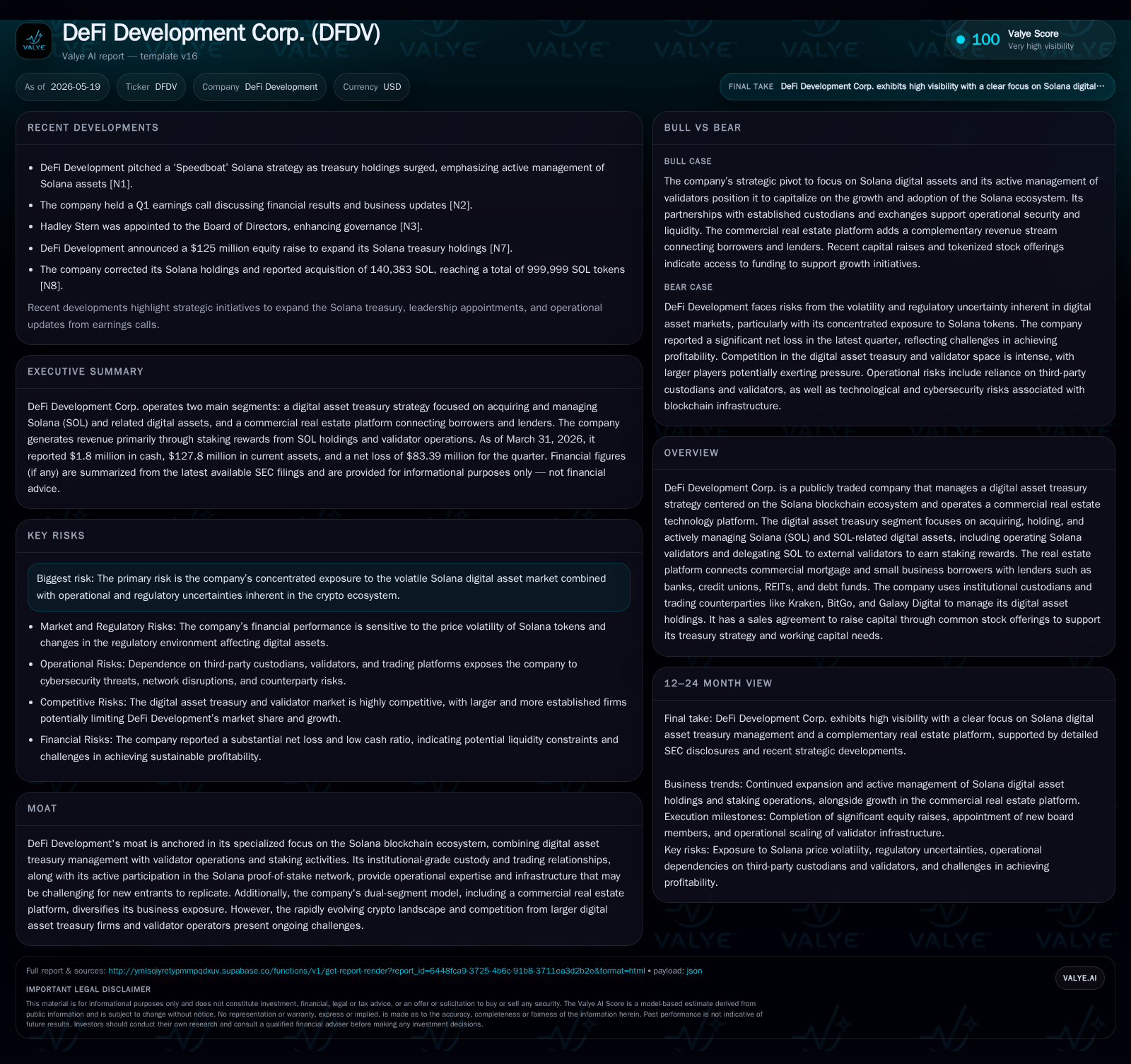
DeFi Development Corp.'s Q1 2026 update underscores a strategic commitment to expanding its Solana-based digital asset treasury, including active management of validators and staking activities. The company operates dual segments: a Solana-focused digital asset treasury and a commercial real estate technology platform connecting borrowers with lenders. Its competitive position is shaped by specialized ecosystem focus and institutional partnerships but faces risks from Solana’s price volatility and regulatory uncertainty. Key growth drivers include deepening treasury exposures, validator performance, and scaling of the real estate platform through enhanced AI capabilities. Financially, the firm maintains elevated leverage reflecting its capital-intensive digital asset accumulation strategy.
Latest Quarterly Developments and Strategic Implications
DeFi Development Corp.’s latest quarterly filing (10-Q dated May 19, 2026) reveals incremental scaling of its digital asset treasury focused exclusively on the Solana blockchain ecosystem [S2]. The company continues to amass Solana (SOL) tokens along with locked SOL and dfdvSOL liquid staking derivatives as part of an active treasury management strategy. The report details ongoing operations of company-owned Solana validators as well as delegation agreements with external validators to optimize staking rewards generated via the proof-of-stake consensus mechanism intrinsic to Solana’s network architecture [S2]. Complementing this activity is a recent equity capital raise via common stock offerings announced in a May 13, 2026 8-K filing aimed at bolstering liquidity to support both the treasury expansion and overall working capital needs [S3].
These developments underscore a deliberate pivot toward intensifying exposure within the Solana ecosystem alongside continuous infrastructure tuning aimed at maximizing yield from validator-related staking activities. As observed during the Q1 2026 earnings call highlights [N1], leadership reaffirmed strategic priorities favoring deeper integration into Solana’s epoch-based reward cycles while preserving flexibility during crypto market volatility.
Business Model: Digital Asset Treasury and Commercial Real Estate Platforms
DeFi Development operates through two primary segments outlined in its annual report [S1]:
Digital Asset Treasury Segment: This core business revolves around acquiring, holding, and actively managing SOL and SOL-based assets. Revenue stems chiefly from staking rewards accrued via operating branded validators directly on the Solana network and delegations to third-party validators. The segment achieves revenue growth through volume increases in SOL holdings combined with price appreciation potential and staking yield optimization that depends on validator uptime and network participation across epochs [S1]. Custody arrangements with institutional-grade service providers—including Kraken for trading capabilities, BitGo for secure custody, and Galaxy Digital as a counterparty—add operational rigor essential for managing vast digital asset exposures securely [S1]. Financing transactions are dynamically assessed against market conditions to ensure access to capital required for treasury augmentation.
Real Estate Platform Segment: This division runs an AI-powered technology platform that facilitates connection between commercial mortgage borrowers — including small businesses seeking refinance or property acquisition loans — and institutional lender pools such as banks, credit unions, REITs, and debt funds [S1]. Revenue primarily emerges from subscription fees tied to software access augmented with value-added data services designed to streamline borrower-lender friction. The platform aims to scale by increasing borrower volumes alongside lender participation while leveraging AI-driven analytics for better credit assessment and platform efficiency.
This bifurcated model reduces single-segment dependency yet demands operational focus across distinct markets: one fast-evolving digital finance realm subject to blockchain network dynamics; the other governed by traditional commercial real estate cycles but enhanced by technology platform adoption.
Competitive Setting in Solana-Focused Digital Asset Management
The company's moat is principally anchored in concentrated specialization within the Solana blockchain ecosystem rather than broad-spectrum digital asset exposure—a strategic niche bolstered by deep technical expertise operating proof-of-stake validators [S1]. Compared with larger diversified crypto treasury firms deploying multi-chain strategies or those reliant merely on passive asset holding, DeFi Development integrates both trustee functions and active validator participation enabling dual capture of staking rewards plus governance influence.
Such positioning affords modest switching costs given infrastructure investments in validator nodes alongside custodial contracts with industry-standard providers Kraken, BitGo, and Galaxy Digital—relationships not easily replicated outside established trust networks [S1], [N2]. However, competition remains high from well-capitalized digital asset managers expanding aggressively across ecosystems plus independent validator operators focusing purely on node performance optimization.
On the commercial real estate side, the platform competes indirectly within a crowded fintech lending intermediary space but differentiates itself through proprietary AI tooling facilitating streamlined commercial mortgage workflows—though this segment's scale compared to legacy incumbents remains comparatively smaller [S1]. Seasonal fluctuations noted in the sector also impose periodic variability impacting revenue stability [S1].
Key Growth Drivers in Treasury Expansion and Platform Adoption
Growth pathways revolve around both escalating digital asset treasury scale and expanding real estate platform engagement:
Digital Asset Treasury Growth: Continued accumulation of SOL tokens via opportunistic market purchases—enabled by equity raises—aims to expand base staked volume directly impacting yield generation potential per epoch cycle [N2]. Enhancing validator uptime and delegations further improves net staking returns. Introduction or wider adoption of derivative tokens such as dfdvSOL liquid staking instruments could attract additional investors seeking protocol-native exposure without lockup constraints.
Real Estate Platform Expansion: Scaling user adoption both among commercial mortgage borrowers and institutional lenders hinges on improving platform AI capabilities that reduce input friction points in loan matching processes fostering higher transaction velocity [S1], [N2]. Incremental subscription revenue growth tied to expanded lender networks remains a key metric alongside borrower loan volume processed through the system.
Success metrics like token stake volume under management (including locked vs liquid forms), number of active validators contributing rewards per epoch, platform subscriber counts, transaction volumes executed monthly/quarterly provide tangible KPIs reflective of traction.
Risks Rooted in Crypto Volatility and Regulatory Dynamics
Concentration risk is pronounced due to exclusive exposure on Solana digital assets—introducing vulnerability to significant valuation swings influenced by crypto market volatility heightened by macroeconomic sentiment shifts or protocol-level technical disruptions [S2], [S1]. Regulatory ambiguity also persists as federal/state agencies continue evolving policy frameworks impacting custody requirements, securities classifications of tokenized products or sovereign authority over decentralized finance activities potentially constraining operational flexibilities [S1].
Cybersecurity remains paramount given direct operation of validator nodes where breaches could lead to theft or loss of staked assets with immediate financial impact; governance disclosures assert ongoing risk oversight mechanisms but acknowledge residual threat complexities inherent in distributed ledger systems [S1]. Operational execution difficulties balancing dual segments entail risks as management allocates resources between rapid innovation demands in crypto versus more traditional albeit tech-enabled commercial real estate markets.
Competitive pressure from larger diversified crypto investors capable of deploying broader capital reserves may compress potential margins achievable solely within one blockchain ecosystem.[S1]
What Investors Should Monitor Next
Several near-term indicators will provide insight into execution progress and demand sustainability:
- Q2 2026 guidance disclosures detailing expected staking rewards influenced by average validator uptime during successive Solana epochs.
- Updates on total SOL plus derivative token balances within treasury reflecting capital deployment efficacy.
- Adoption rates for dfdvSOL tokens indicating investor reception toward liquid staking alternatives.
- Commercial real estate platform subscription growth rates alongside reported volume of loans facilitated acting as proxy for platform scalability.
- Any regulatory announcements or enforcement actions potentially affecting custodian relationships or token handling protocols.
- Effectiveness of recent equity offerings in providing adequate runway without excessive dilution or leverage strain [S3], [N2].
Tracking these variables will clarify whether strategic bets around focused Solana integration alongside prop-tech expansion deliver sustainable shareholder value.
Summarized Financial Profile and Capital Structure
As of March 31, 2026, companyfacts shows approximately $127.8 million in total debt against $1.8 million cash equivalents resulting in net debt near $126 million with a current ratio at 1.39 indicating reasonable short-term liquidity coverage amid significant obligations [F1]
Profitability has remained elusive with operating losses driven by ongoing investment into digital assets plus platform development expenses diminishing net income levels consistently over recent periods [F1]. The company relies on sales agreements enabling common stock issuances to support treasury financing needs alongside working capital deployments highlighted in recent 8-K filings [S3].
This analysis synthesizes DeFi Development Corp.’s latest operational disclosures emphasizing strategic evolution toward concentrated blockchain treasury management paired with complementary real estate technology ventures. The company's trajectory showcases specialization advantages tempered by inherent volatility typical in nascent crypto markets compounded by execution risks endemic to dual business lines. Stakeholders should weigh these dimensions carefully while monitoring execution milestones clearly detailed herein.
Disclaimer: This article is an independent industry analysis based solely on public filings dated up to May 19, 2026 [F1]. Current assets of $127,768,000 and current liabilities of $91,743,000 imply a current ratio near 1.39x for 2026-03-31
Disclaimer: This is research-only, informational analysis and not investment advice. It may include AI-generated interpretation and general industry context. Always verify important details using primary sources.

Comments