
T3 Defense Advances Its Aerospace and Defense Platform with Strategic Portfolio Moves
Recent quarterly filings reflect T3 Defense’s ongoing integration of specialized aerospace and defense acquisitions amidst liquidity challenges.
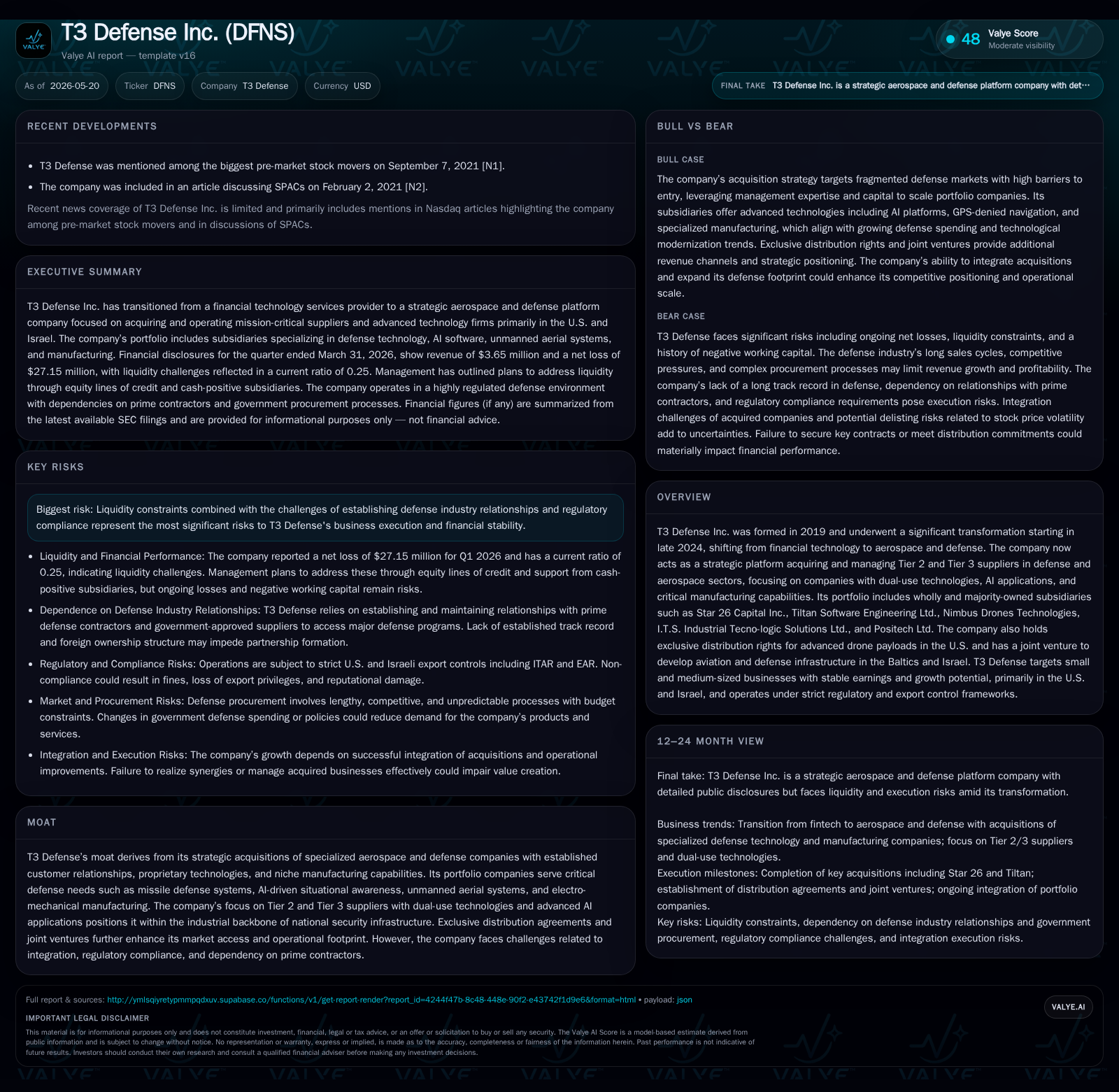
T3 Defense Inc. is progressing through its transformation from a fintech entity into a strategic aerospace and defense platform, focused on acquiring and managing Tier 2 and Tier 3 suppliers with dual-use technologies and AI capabilities. Its latest 10-Q filing reveals continuing integration efforts without material changes to risk factors, highlighting ongoing liquidity constraints despite an active equity line of credit and cash-positive subsidiaries. The company’s diverse portfolio, including Israeli-based technology subsidiaries and exclusive U.S. distribution rights for advanced drone payloads, positions it as a niche player within the defense industrial base. Execution risk remains high due to regulatory hurdles, integration complexity, and a weak working capital position. Key near-term milestones include securing further prime contractor approvals, ramping subsidiary operations to cash flow positivity, and advancing joint ventures in strategic regions.
Latest Quarterly Operating Update and Its Strategic Implications
T3 Defense's most recent quarterly filing on May 20, 2026 (10-Q) confirms continuing progress in integrating its acquired aerospace and defense subsidiaries while maintaining stability in disclosed risk factors [S2]. No new material risks or strategic shifts were reported relative to the prior annual filing. A notable legal proceeding involves a success fee dispute related to Star 26 Capital but is believed by management to be without merit [S24]. The company maintains reporting compliance with SEC electronic data requirements.
The absence of fresh risk disclosures underscores the ongoing nature of T3’s operational pivot rather than abrupt change. The transformation remains centered on deploying capital extensively into diversified Tier 2/3 suppliers across Israel, Europe, and the U.S., reflecting a patient investment stance amid integration drag.
Business Model: Platform Acquisition of Aerospace and Defense Tier 2/3 Suppliers
T3 Defense has repositioned itself from a fintech services provider historically serving retail foreign exchange markets into a strategic platform targeting specialized aerospace and defense businesses [S1], [S7]. The core model acquires controlling stakes (>50%, commonly 100%) in small to mid-sized firms characterized by stable earnings streams, technological niche expertise—especially dual-use technologies—and regional prominence.
Revenue generation arises mainly through portfolio subsidiaries’ sales of hardware (generators for missile systems), software (AI platforms for navigation and situational awareness), SaaS licenses (as with Zorronet), product distribution agreements (e.g., Blade Ranger drone payloads), and joint venture infrastructure projects. Margins depend on contract mix: recurring SaaS licenses offer higher predictability versus project-based installation revenues.
Ownership enables active management intended to improve operational efficiencies, expand sales through cross-selling within the defense ecosystem, enhance financial reporting standards, and pursue complementary bolt-on acquisitions [S7]. These capabilities aim to build long-term enterprise value anchored in critical national security supply chains
Portfolio Overview: Specialized Subsidiaries and Distribution Rights
Key portfolio components include:
Star 26 Capital Inc.: A wholly owned Israeli holding company that owns B. Rimon Agencies Ltd., providing generators integral to "Iron Dome" missile defense system launchers—a flagship critical defense product [S7], [S9].
Tiltan Software Engineering Ltd.: An AI software developer with over three decades of experience delivering simulation systems focused on GPS-denied navigation, 3D mapping, synthetic data generation across sensor modalities like infrared/SAR—all proprietary platforms avoiding third-party royalties [S1], [S20].
Nimbus Drones Technologies: A specialist in unmanned aerial systems founded recently within the group offering drone platforms compliant with ITAR/EAR regulations; notable for not relying on government funding but subject to strict cybersecurity laws [S10], [S21].
I.T.S. Industrial Tecno-logic Solutions Ltd.: Manufacturer of integrated electro-mechanical machines and assembly lines tailored for defense applications; subsidiary Positech designs top-tier motion control servo systems deployed militarily [S7], [S23].
Blade Ranger Ltd.: Supplier of advanced drone payloads with exclusive U.S. distribution rights secured through a multi-year contract entailing minimum purchase commitments scaling annually—a revenue-generating licensing/distribution channel set to expand deliveries through August 2026 onward [S10]
Mandragola Aviation JV: Majority-owned joint venture developing NATO-compliant aviation infrastructure hubs servicing Baltic states and Israel; prospective growth platform supporting maintenance repair operations (MRO) alongside aircraft modernization offering sectoral diversification [S9].
These assets form an interconnected yet geographically diverse industrial ecosystem spanning hardware manufacturing through software AI solutions aligned tightly to modern military technology needs.
Competitive Dynamics and Industry Structure in Defense Supply Chains
Within the national security industrial base ecosystem where T3 operates as a Tier 2/3 supplier aggregator lies substantial contractual conservatism driven by government prime contractors requiring rigorous standards: ITAR licensing for export-controlled technologies; DFARS compliance ensuring cybersecurity hygiene; facility security clearances often taking 12–18 months; personnel vetting; alongside anti-bribery governance under laws such as FCPA.
Customer concentration frequently centers around large primes like Rafael or Elbit Systems who subcontract specialized manufacturing or software modules downstream. Such relationships are typically long-standing due to high switching costs tied to qualified vendor status approvals.
Pricing power at this tier tends toward cost-plus or fixed-fee contracts with limited room for premium pricing absent proprietary technology breakthroughs or exclusive distribution arrangements.
Regulatory overhead creates significant barriers impeding new entrants which benefits incumbents like T3’s portfolio companies once certifications are obtained but simultaneously raises integration complexity risks for the parent company lacking internal aerospace & defense expertise [S1], [S7].
Growth Drivers: Dual-Use Technology Focus and Market Penetration Potential
T3 Defense aims to grow organically through multiple synergistic pathways:
Expanding AI-enabled situational awareness platforms such as Tiltan's Majestic.ai which integrates synthetic data training facilitating adoption by complex military installations including Israeli Defense Forces bases where multi-user command rooms have been established [S1], [S23].
Scaling Nimbus drones deployment aligned with increasing demand for unmanned aerial reconnaissance/surveillance capturing growing market interest amid global militarization trends.
Leveraging Blade Ranger's exclusive U.S. distribution rights with escalating volume targets under contract incentivizing sustained revenue growth over multiple years starting from August 2025 commitments [S10]
Cross-selling within the portfolio ecosystem where electro-mechanical manufacturing standards from I.T.S./Positech support hardware requirements complemented by Zorronet's AI video analytics platforms enhancing perimeter security applications across military & police clients regionally [S7], [S23].
Pursuing accretive bolt-on acquisitions targeting sub-$200 million enterprises that possess positive cash flows yet benefit from capital infusion and operational improvements adding scalability potential [S7], [S25].
Defense budget expansions fueled by geopolitical conflict escalation underpin structural demand support extending beyond cyclical spikes given persistent geopolitical uncertainties worldwide [S11].
Execution Risks: Integration Complexity, Regulatory Compliance, and Liquidity Challenges
Despite promising portfolio construction efforts managed under CEO Menachem Shalom since late 2024, significant risks persist:
Integration Risks: Simultaneous onboarding of multiple acquired entities located across different countries (U.S., Israel, Europe) exacerbates complexity due to varied regulations/currencies/business cultures absent an experienced A&D acquisition playbook internally increases odds of synergy shortfalls observed historically in ~70-90% of acquisitions industry-wide [S1].
Regulatory Hurdles: Establishing ITAR licensing regimes; obtaining facility security clearances critical for prime contractor eligibility; staffing cleared personnel all entail protracted timelines introducing go-to-market delays risking backlog erosion or contract loss [S1]
Liquidity Constraints: Latest financial snapshots reveal negative working capital near $30 million largely owed to warrant liabilities non-cash in nature plus current liabilities vastly exceeding current assets yielding a current ratio around 0.25 indicating tight short-term financial flexibility despite $6.4 million cash on hand supported partially by active equity line allowing ~$6.6 million monthly drawdown capacity assured through legally binding arrangements exceeding projected needs slightly [F1], [S13]. Cash positive performance at majority-owned Rimon Ltd. and Nimbus Robotics relieves parent cash needs somewhat but overall group liquidity demands careful monitoring especially amid potential acquisition financing needs or unexpected operating setbacks.
Market Execution: Building prime contractor relationships from scratch – absent legacy contracts – coupled with new regulatory demands imposes customer adoption risks delaying revenue recognition longer term.
Taken together these factors emphasize execution discipline necessity: strong governance around integration playbooks; incremental regulatory milestone tracking; preserving runway capitalization critical given negative net working capital headwinds.
What to Watch Next: Milestones in Integration, Contract Wins, and Cash Flow Improvement
Key near-term indicators helping validate T3 Defense’s execution trajectory comprise:
Successful attainment of additional facility security clearances enabling expanded bidding eligibility within established prime contractor networks particularly in U.S./Israeli defense sectors.
Delivery progress against Blade Ranger minimum payload purchase commitments extending through August 2026 assessing realized contract revenues vs plan.
Operational scale-up evidenced by evidence of subsidiary-level EBITDA positivity alleviating parent company cash demands unlike early transformational loss periods.
Advancement of Mandragola Aviation JV infrastructure build-out including NATO-compliant logistics hub development milestones proving diversification into aviation maintenance markets.
Progress on pipeline acquisitions confirming ongoing deal flow quality and management's capability in closing accretive targets qualifying for portfolio fit criteria ensuring revenue diversification unlike earlier marquee single large acquisitions such as Star 26 Capital.[S2], [S1], [S9]
Transparency into these KPIs will gauge whether T3 can convert its ambitious aerospace-defense transformation aspirations into scalable sustainable industrial platform value creation.
Concise Financial Profile Reflecting Current Liquidity and Capital Position
As of quarter end March 31, 2026 balance sheet data indicates approximately $6.4 million cash balanced against total debt near $1.56 million suggesting low leverage though net working capital remains deeply negative driven primarily by $91.6 million current liabilities dwarfed by $22.8 million current assets resulting in a depressed liquidity ratio around one-quarter (0.25) indicating urgent need for improved cash flow efficiency or external financing support if operational hiccups arise [F1]
Management stresses existing equity line credit with Esousa Holdings LLC offers up to $6.6 million monthly drawdown capacity designed explicitly to meet annual operating liquidity needs based on forecasted expense profiles plus historical successful PIPE financings totaling roughly $20 million over last year provide testament to capacity accessing public capital markets when demanded [S13]
Majority-owned subsidiaries including Rimon Ltd. supplying strategic missile system components contribute positive cash flow relieving parent capital demands partially [S13]
Nonetheless constrained working capital dictates focused stewardship prioritizing rapid subsidiary integrations achieving profitability milestones combined with cautious acquisition pacing while strengthening capital structure resilience remain management imperatives over next twelve months.
This analysis is based exclusively on publicly filed information without any forward-looking valuation or investment research views intended.
Disclaimer: This is research-only, informational analysis and not investment advice. It may include AI-generated interpretation and general industry context. Always verify important details using primary sources.

Comments