
Doximity’s Platform Growth and Litigation Headwinds Shape 2026 Outlook
Doximity's latest quarterly results highlight solid platform engagement driven by AI-powered solutions, offset by significant ongoing litigation risks.
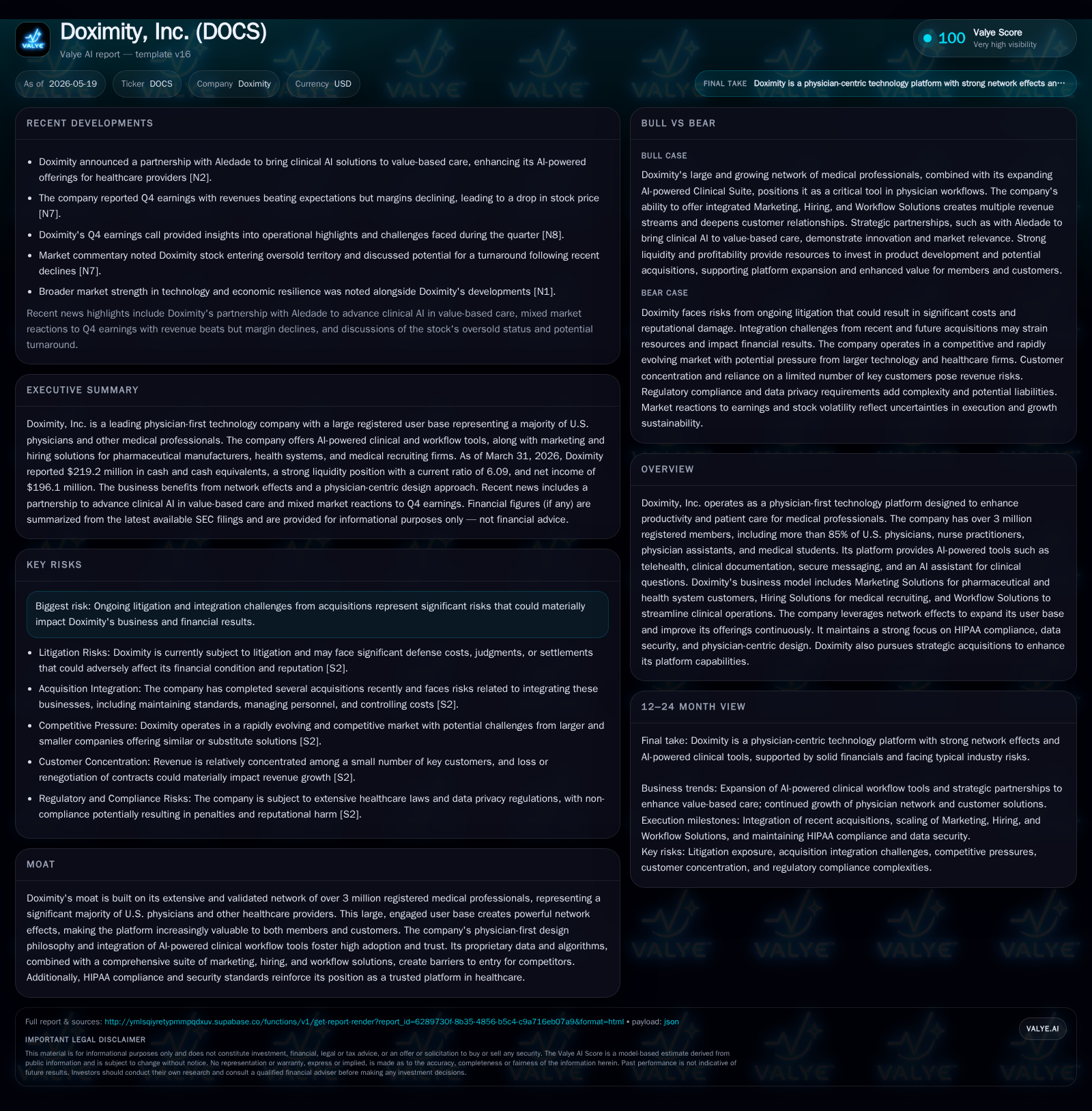
In its most recent quarter ending March 31, 2026, Doximity sustained revenue momentum supported by expansive physician network effects and AI-enabled workflow tools, confirming its position as a leading physician-focused technology platform. However, the company faces material litigation over past disclosures that imposes financial and operational overhangs. Its business model centers on monetizing broad physician engagement through Marketing, Hiring, and Workflow Solutions tailored for pharmaceutical manufacturers and health systems. The highly regulated healthcare environment, evolving compliance requirements, and customer concentration pose tangible growth constraints. Watching developments in litigation resolution and adoption rates of advanced AI features will be critical to assessing Doximity’s near-term trajectory.
Latest Operational Performance Update and Its Implications
Doximity’s latest quarterly filing for the period ending March 31, 2026 ([S2], [S3]) confirms continued revenue stability buttressed by a large and engaged network of over 3 million registered medical professionals. This represents over 85% of U.S. physicians under age 76 along with substantial coverage among nurse practitioners and physician assistants ([S1], [S16]). The company’s adherence to a physician-first design philosophy ensures resilient user engagement despite competitive pressures.
Financially, the quarter showed solid top-line outcomes but margin pressures emerged due mainly to increased legal expenses tied to ongoing shareholder litigation. Notably, Doximity reached a preliminary $31 million settlement (covered by insurance) resolving the securities lawsuit concerning disclosure of user counts and engagement estimates ([S10], [S8]). However, derivative lawsuits remain unresolved creating material litigation risk. These legal factors weigh on near-term earnings visibility but do not diminish the core platform’s operational traction.
Business Model Overview: Connecting Physicians with AI-Enabled Solutions
Doximity’s revenue model monetizes its proprietary community through three principal segments: Marketing Solutions, Hiring Solutions, and Workflow Solutions ([S7], [S16]). Marketing Solutions offer pharmaceutical manufacturers targeted modules enabling brand-specific messaging delivered directly within a HIPAA-compliant communications ecosystem leveraged by physicians daily. Hiring Solutions tap into the network’s depth to facilitate recruiting efforts for health systems via digital sourcing tools augmented by Curative Talent, an integrated personalized staffing firm.
Workflow Solutions constitute a growing pillar focused on streamlining clinical operations through telehealth communications, clinical documentation aids, scheduling optimizations, and AI-assisted clinical question answering. These offerings rely heavily on proprietary automation features such as “call nudge” reminders or seamless voice-video patient interaction transitions ([S7]). AI integration escalates value delivery by personalizing marketing content creation and offering evidence-based clinical support that complements physicians’ workflows.
Crucially, Doximity's model balances monetization with maintaining trust among medical professionals who are essential gatekeepers to the platform's value. This dual focus bolsters platform stickiness by embedding deeply into daily workflows while providing actionable insights to paying customers.
Industry Context and Competitive Positioning in Healthcare Tech
The healthcare professional networking space is structurally favorable yet increasingly competitive ([S13]). Despite larger technology companies (e.g., Zoom Video Communications, Microsoft Teams) competing in communication tech broadly, Doximity’s differentiation rests on deep vertical specialization in medical workflows supported by HIPAA compliance—a stringent regulatory requirement few generalist platforms satisfy adequately.
Competition also includes niche telehealth players (Teladoc Health), scheduling software vendors (QGenda), and emergent AI-first startups (Abridge). Doximity faces pricing pressure due to concentration among top pharmaceutical clients whose consolidation enhances their negotiating power ([S5], [S24]). Additionally, these consolidated healthcare systems could choose in-house or alternate vendors as they scale further.
Nevertheless, Doximity’s extensive validated member database spanning physicians across all specialties nationwide affords powerful network effects that create substantial entry barriers and switching costs. Customer renewal patterns historically show willingness to expand usage once benefits are realized through modular campaign additions or expanded workflows ([S1]).
Key Growth Drivers: Network Effects, AI Integration, and Customer Expansion
Growth is anchored on three interlocking levers: deepening penetration within existing enterprise customers; winning new pharmaceutical brands and health systems; and enhancing AI-enabled feature sets embedded directly in clinician workflows ([S1], [N9]). Marketing Solutions customers frequently increase budget allocation after demonstrable ROI from initial brand campaigns. Similarly, health system clients grow footprint adoption across multiple specialty lines once basic modules prove their effectiveness ([S1]).
AI capabilities extend from marketing automation—facilitating bespoke creative content—to Clinical AI Suite functionalities supporting real-time patient communication management plus evidence-based clinical decision assistance. Collaborations like the partnership with Aledade integrate population health analytics supporting value-based care models which could materially enlarge the addressable market beyond traditional pharma marketing budgets ([N9]).
Execution focus remains on rapidly prototyping physician-centric innovations fostering seamless workflow integration—a critical success factor since product disruption risks alienating busy medical professionals. Expanding hiring solutions using data science for better candidate matching also fuels growth in healthcare staffing verticals where digital transformation has lagged.
Risks to Watch: Litigation, Integration Challenges, and Regulatory Headwinds
Doximity faces elevated risk from multiple fronts. The most immediate is ongoing legal exposure from the residual derivative lawsuits linked to prior disclosure practices ([S10], [S8]). While the major securities class action settled favorably via insurer payment coverage ($31 million), unresolved derivative actions continue to represent capital allocation uncertainty along with management distraction.
Integration risks also stem from recent acquisitions such as Pathway Medical (July 2025) and prior units like AMiON or Curative Talent ([S2]). Misalignment or delays in product integration may slow cross-selling synergies or inflate operating expenses.
Regulatory complexity is pronounced given Doximity operates within heavily legislated environments covering HIPAA privacy rules plus state-level fee-splitting statutes which vary widely ([S5], [S6], [S19]). Failure of either Doximity or customers to comply can generate fines or contract terminations. Moreover, TCPA telephone communication laws impose potential liabilities tied to automated patient outreach functions embedded in some marketing workflows ([S9]).
The rapidly evolving legal framework around artificial intelligence introduces additional risk exposure—both technical (model performance errors) and regulatory (unforeseen requirements)—that could necessitate hefty compliance investments or product adjustments ([S11]). Lastly, customer concentration—where a few pharma clients account for significant portions of revenue—raises sensitivity to shifts in client spending priorities amid broader healthcare consolidation trends ([S5], [S24]).
Forecasting the Path Forward: Milestones and Market Signals to Monitor
Crucial near-term milestones include upcoming quarterly bookings renewal data that will clarify demand stability amid mixed macroeconomic signals impacting pharma budgets ([S3], [S14]). Court rulings on derivative litigations expected post-June 2026 hearing remain key upside/downside catalysts that bear watching closely.
Tracking adoption curves of recently introduced AI-enabled modules within Workflow Solutions will shed light on whether investment ramp translates into sustainable net-new client gains or expansion within large accounts ([N9]). Brand portfolio expansions among pharmaceutical customers represent gradual but sizable revenue opportunities if conversion rates hold consistent.
Observing customer concentration patterns can indicate whether consolidation pressures translate into discounting demands or reduced solution breadth allocations. Additionally, monitoring regulatory developments around telehealth enforcement post-PHE (Public Health Emergency) expiry offers insight on external policy-driven volume impacts ([S21]).
Summary of Financial Condition Supporting Operational Narrative
As of March 31, 2026, Doximity held $219 million in cash equivalents with a robust current ratio exceeding 6x, demonstrating solid liquidity cushions amid operational headwinds ([F1]). Net income was positive at approximately $196 million reflecting profitable scale despite margin compression linked partially to legal expenditures ([F1]).
This financial flexibility provides runway for continued investment in innovation including AI feature development while managing litigation-related cost spikes without immediate refinancing needs. However, any prolongation of disputes or unexpected adverse rulings could necessitate reevaluation of capital deployment priorities.
This analysis relies exclusively on documented SEC filings through early 2026 alongside verified company financial snapshots; it avoids speculative forward-looking predictions. The balance between demonstrated platform strengths rooted in extensive network effects combined with increasing legal challenges frames Doximity’s 2026 outlook as one requiring close observation of execution discipline amid structural market shifts.
Disclaimer: This is research-only, informational analysis and not investment advice. It may include AI-generated interpretation and general industry context. Always verify important details using primary sources.

Comments