
Dow Inc. Faces Pricing Pressures and Volume Fluctuations in Q1 2026 While Advancing Cost Reduction and Sustainability Initiatives
Dow’s latest quarterly results reflect broad-based price declines amid geopolitical challenges, offset by ongoing restructuring and operational adaptations.
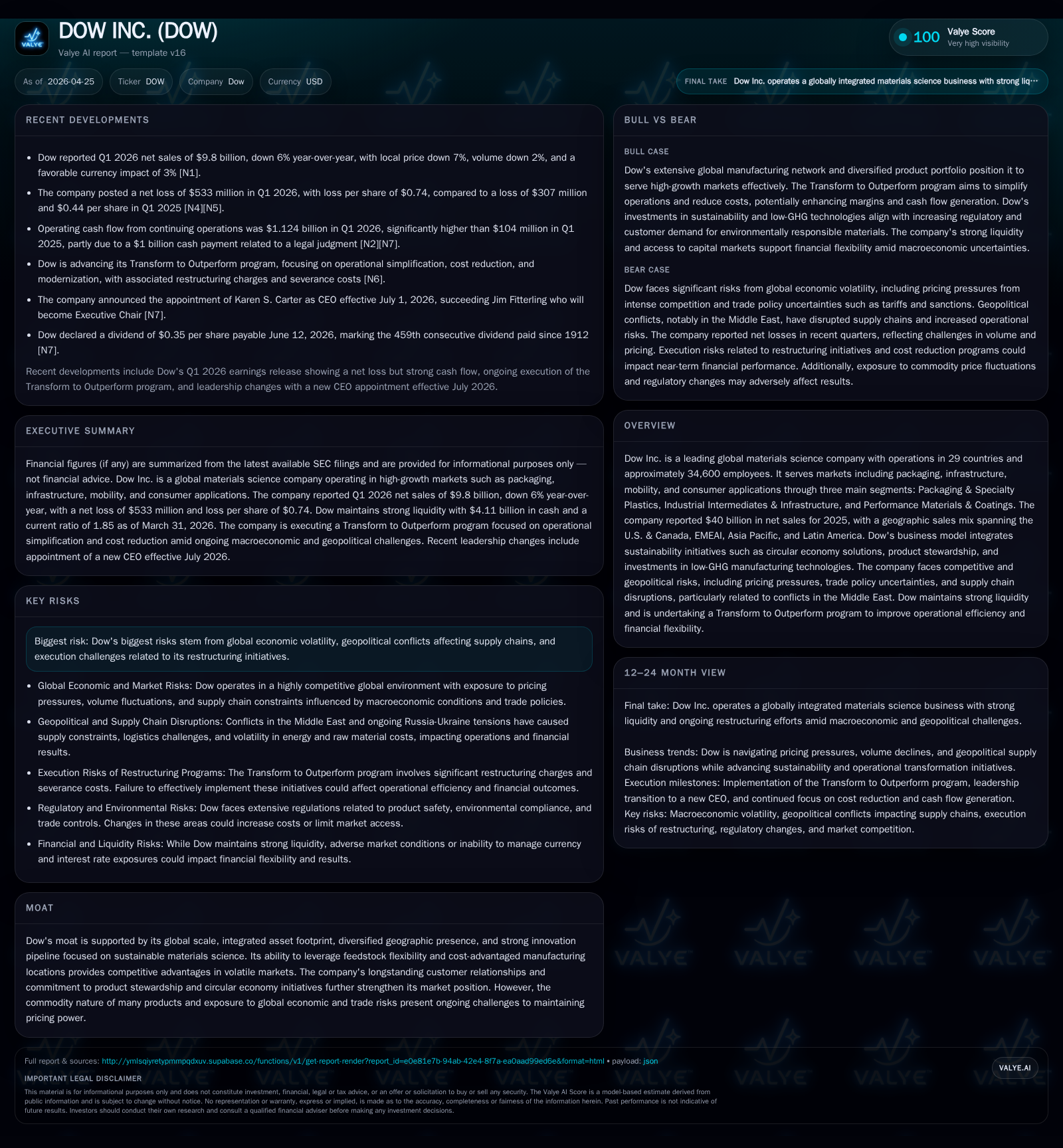
In the first quarter of 2026, Dow Inc. reported a 6% decrease in net sales compared to the previous year, driven by lower local pricing across all segments and mixed volume performance. The company is actively navigating global supply chain disruptions from Middle East geopolitical tensions while implementing its Transform to Outperform program aimed at simplifying operations and reducing costs. Dow’s integrated asset footprint and feedstock flexibility support resilience amid volatile pricing and demand conditions. Growth is constrained by competitive overcapacity and macroeconomic uncertainty, but sustainability projects like the delayed Path2Zero initiative signal longer-term strategic repositioning. Financially, Dow maintains strong liquidity, manageable leverage, and continues dividend payments, balancing capital allocation cautiously.
Recent Operating Update: Q1 2026 Snapshot
Dow Inc.'s first-quarter results released in April 2026 reveal a subdued operating environment characterized by a 6% decline in net sales to $9.8 billion compared with Q1 2025 [S2]. This downturn stemmed primarily from a pervasive drop in local pricing (down 7%), impacting all three major segments — Packaging & Specialty Plastics (-9%), Industrial Intermediates & Infrastructure (-8%), and Performance Materials & Coatings (-4%) — as well as every geographic region including EMEAI and Latin America (both -9%), Asia Pacific (-8%), and the U.S. & Canada (-6%). Volumes fell modestly by 2%, reflecting mixed dynamics across operating units [S2].
Geopolitical tensions in the Middle East during Q1 created logistical challenges affecting chemical feedstock availability, particularly through disrupted routes near the Strait of Hormuz [S2]. This conflict led to regional supply constraints notably in Asia Pacific and Europe. However, Dow's strategic positioning—with cost-advantaged production hubs in North America and Latin America—plus its feedstock flexibility have helped offset some negative impacts [S2]. The company also noted positive momentum from pricing actions instituted globally and improved operating rates.
Amid these headwinds, Dow has embarked upon its "Transform to Outperform" program launched in January 2026 aiming to simplify operations, reduce structural costs beyond the prior target of $1 billion announced in early 2025 (now targeting over $2 billion Operating EBITDA improvements), and accelerate growth initiatives [S1][S2]. Expected severance charges relating to this restructuring are estimated between $600 million to $800 million over two years covering about 4,500 roles [S2].
Business Model Overview: Integrated Materials Science with Sustainable Innovation Focus
Dow Inc. operates as a global materials science leader with a diverse portfolio addressing packaging, infrastructure, mobility, and consumer applications [S1]. Its business model revolves around producing specialty chemicals and plastics through three reporting segments: Packaging & Specialty Plastics; Industrial Intermediates & Infrastructure; and Performance Materials & Coatings [S13]. Revenue generation depends on selling these products at scale across global markets while leveraging proprietary technologies, product innovation pipelines emphasizing sustainability, and feedstock integration efficiencies.
The company's integrated asset footprint spans cost-competitive regions with manufacturing capabilities designed for feedstock flexibility—crucial for managing input volatility especially amid energy price swings heightened by geopolitical risk [S1][S2]. As detailed in its annual filings, Dow is deeply committed to circular economy solutions incorporating product stewardship alongside investments like the Fort Saskatchewan Path2Zero project—a planned net-zero emissions ethylene complex now deferred by two years but vital for decarbonization leadership [S1].
Despite innovation efforts, Dow still contends with significant commodity exposure where pricing is cyclical and sensitive to global GDP growth rates, overcapacity challenges particularly in Asia Pacific and EMEAI regions, and trade policy fluidity that can disrupt raw material sourcing [S1][S11].
Industry Structure and Competitive Position
The chemical industry remains intensely competitive with substantial global capacity additions leading to oversupply pressures demonstrated over recent years [S1][S19]. New entrants employing anti-competitive pricing exacerbate margin erosion risks for incumbents such as Dow. The company's wide geographic diversification helps mitigate localized demand shocks but cannot fully shield it from cyclical downturns or systemic trade barriers introduced recently including evolving U.S. tariff regimes [S11].
Dow’s moat lies chiefly in its global scale—operating assets spanning North America, Latin America, EMEAI, and Asia—and an integrated business model enabling cost optimization via feedstock switching depending on market fundamentals. Longstanding customer relationships buttressed by sustainability-oriented product development further reinforce its competitive position.
However, product commoditization limits sustained pricing power; even modest excess capacity or regional demand weakness can pressure volumes and prices simultaneously—as evidenced by widespread price declines in Q1 across all segments [S2][S20]. Operational reliability gains are therefore crucial to maintain customer preference when differential product offerings are limited.
Growth Drivers and Constraints
Structural growth drivers include increasing demand for sustainable packaging materials aligning with regulatory trends favoring recyclability and reduced carbon footprints; expanding infrastructure investments necessitating advanced polymer solutions; and shifting consumer preferences toward performance coatings enhancing durability while minimizing environmental impact [S1]. Dow’s strategic pivots including developing Scope 3 emissions reduction pathways demonstrate foresight into value creation opportunities beyond traditional petrochemical products.
Constraints persist from continued macroeconomic uncertainty suppressing GDP growth forecasts worldwide—particularly impacting industrial intermediates where capital-intensive upstream assets suffer from utilization rate volatility [S11][S20]. Additionally, geopolitical tensions like the ongoing Middle East conflict continually inject supply volatility into raw material markets complicating manufacturer planning horizons [S2][N1]. Trade disputes add another layer of complexity potentially triggering tariff-induced cost inflation or distribution challenges.
Capacity rationalization programs—including announced shutdowns of higher-cost European assets such as ethylene facilities in Böhlen (Germany) by end-2027—reflect efforts to realign production footprints closer to profitable demand centers while trimming excess capacity burdens [S1]. Nevertheless, execution risks around these restructuring initiatives remain nontrivial as closure-related costs press short-term earnings.
What to Watch Next
Key milestones include progress updates on the Transform to Outperform program's implementation effectiveness measured by sequential improvement in Operating EBITDA margins and cost reduction realization schedules throughout 2026–2027 [S2][N1]. Monitoring volume recovery trajectories post-Middle East conflict resolution will be critical given their influence on utilization rates.
The timeline slip for Path2Zero demands scrutiny regarding capital expenditure pacing—projected full startup phases pushed into late 2029–2030 signify several years before anticipated material returns on investment accrue [S1]. Regulatory developments around carbon emissions directives could impact future capital allocation priorities within Dow's portfolio.
Liquidity maintenance evidenced through undrawn committed credit lines (~$8.2 billion) plus accounts receivable securitization facilities expiring beyond 2028–2029 provides financial cushion; however, debt maturity profiles starting only after 2029 suggests manageable refinancing risk for now but underline the importance of sustained free cash flow generation especially given negative free cash flow patterns registered recently [S5][F1]. Dividend policy stability at $0.35 per share quarterly supports shareholder consistency though share buybacks remain dormant pending clearer recovery signals [S16][F1].
Financial Profile: Liquidity Strength Amid Margin Pressure
Historical performance (annual)
|
| FY | Rev ($bn) | CFO ($bn) | Capex ($bn) | Rev YoY |
|---|---|---|---|---|
| 2025 | 40.0 | 1.0 | 2.5 | -7.0% |
| 2024 | 43.0 | 2.9 | 2.9 | -3.7% |
| 2023 | 44.6 | 5.2 | 2.4 | |
| 2022 | 7.5 | 1.8 |
Source: SEC companyfacts cache [F1].
Capital returns and efficiency (annual)
|
| FY | Buybacks ($bn) | FCF ($bn) |
|---|---|---|
| 2025 | 0.0 | -1.4 |
| 2024 | 0.5 | -0.0 |
| 2023 | 0.6 | 2.8 |
| 2022 | 2.3 | 5.7 |
Source: SEC companyfacts cache [F1].
Dow entered Q1 2026 with solid liquidity—$4.11 billion cash plus total available liquidity approximating $13.7 billion including revolving credit facilities—offering ample runway against potential market headwinds or execution-related expenses arising from Transform to Outperform restructuring charges estimated up to $1.5 billion over two years [S4][S5][F1].
Leverage remains moderate with gross debt around $18.14 billion offset by cash balances yielding net debt near $13.6 billion at quarter-end; credit profiles sustained investment grade ratings albeit recent downgrades reflect earnings pressure considerations [F1][S6]. The current ratio approximated a healthy 1.85 indicating adequate short-term asset coverage against liabilities [F1][S15].
Operating EBIT declined sharply in Q1 (down roughly $134 million year-over-year) due primarily to squeezed integrated margins compounded by higher planned maintenance costs alongside lower equity method earnings partly related to adjustment losses connected to Sadara's project financing debt guarantees [S20]. Despite these challenges, cost reduction initiatives delivered partial offsets suggesting operational discipline progress.
Capital expenditures pared back moderately to roughly $503 million for the quarter compared with prior year reflecting capex discipline while investing strategically including funding progress toward Path2Zero construction phases [F1][S15]. Free Cash Flow remained negative on an annual basis given depressed operating cash flows relative to capex outlays though quarterly operational cash flow improved significantly year-over-year pointing toward early turnaround signs amid ongoing transformation efforts [F1][S22].
Dividends continue uninterrupted albeit reduced since mid-2025 reflecting conservative capital allocation balancing return commitments against investment needs amidst cyclical softness [S14][S16][F1]. Remaining share repurchase authority provides optionality contingent on improved cash generation trajectories.
This analysis synthesizes the latest disclosures filed through April 24, 2026 ([S2]) along with preceding annual reports ([S1]) plus supporting market commentary (). While grounded firmly in current reporting metrics ([F1]), it does not constitute investment advice but aims instead to present an integrated view of Dow Inc.’s operating environment, strategic positioning, growth prospects, constraints, and financial condition as understood within industry context.
Disclaimer: This is research-only, informational analysis and not investment advice. It may include AI-generated interpretation and general industry context. Always verify important details using primary sources.

Comments