
DSwiss Inc: Turnkey OEM/ODM Ambitions Meet Liquidity and Execution Hurdles in the Asia-Pacific Health & Beauty Market
DSwiss Inc leverages vertically integrated OEM/ODM capabilities and a growing R&D team to serve Asia-Pacific and global health and beauty markets, but faces significant liquidity pressures and must prove it can scale amid intense competition and regulatory complexity.
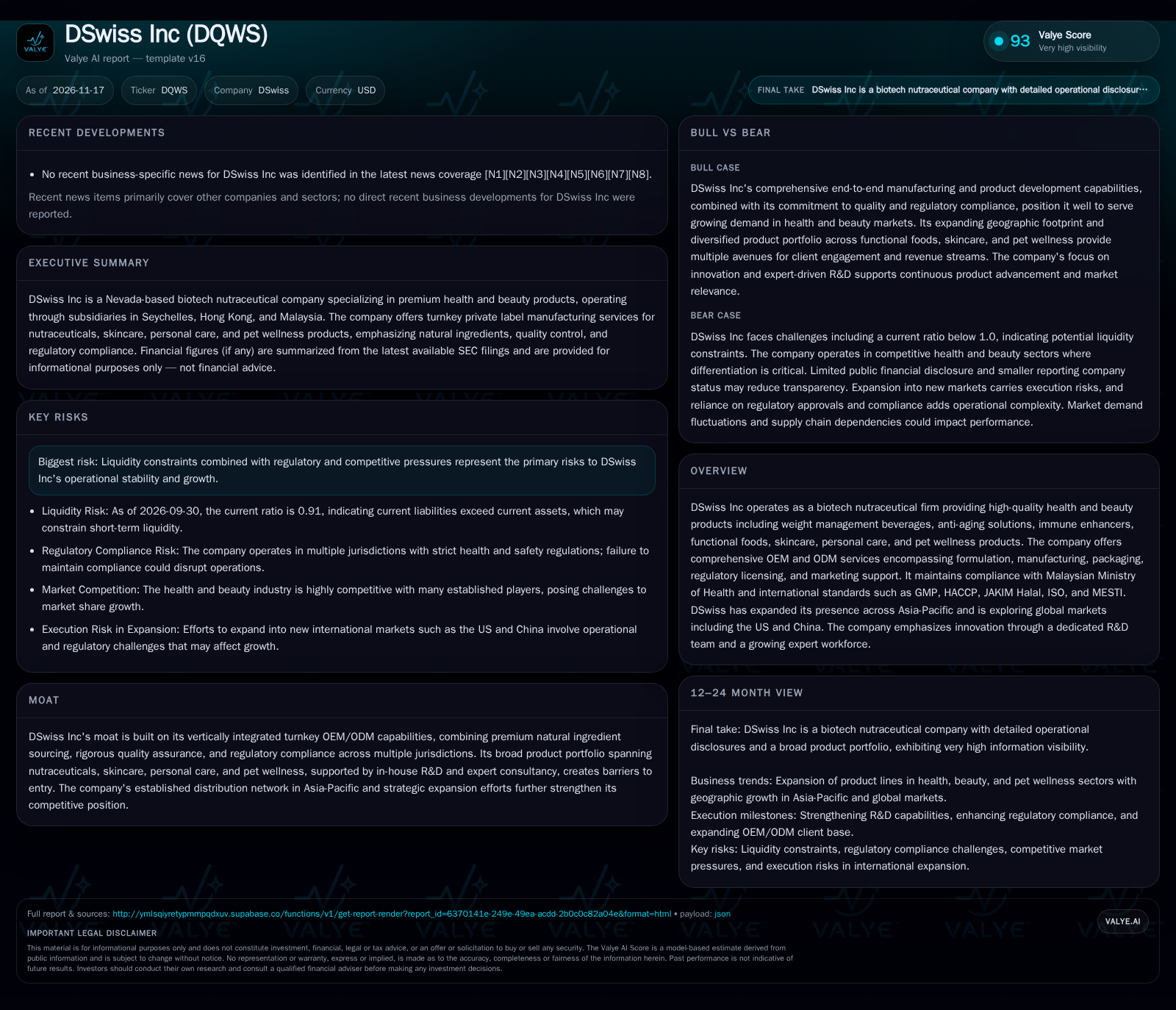
DSwiss Inc operates a vertically integrated OEM/ODM model for nutraceutical and personal care products, emphasizing regulatory compliance and product breadth. Execution on innovation, regulatory navigation, and client acquisition will determine whether the company can overcome funding and competitive pressures to realize its growth ambitions. [S1] [S2]
DSwiss Inc, a Nevada-incorporated biotech nutraceutical firm, is positioning itself as a turnkey partner for health, beauty, and wellness brands across Asia-Pacific and beyond. By integrating premium ingredient sourcing, rigorous quality control, and regulatory expertise into its OEM/ODM model, DSwiss aims to capture demand for private-label functional foods, supplements, skincare, and pet wellness products. The coming quarters will test whether DSwiss can translate its operational platform and R&D investments into sustainable growth.
Recent Financials and Operational Structure Shape Immediate Outlook
DSwiss Inc operates primarily through its Malaysian and Hong Kong subsidiaries, providing OEM/ODM manufacturing and private label solutions for a wide range of health and beauty products, including nutraceuticals, skincare, and pet wellness offerings [S1]. As of September 30, 2026, the company reported $388,490 in cash and equivalents versus current liabilities of $502,687, resulting in a current ratio of 0.91 and a cash ratio of 0.77 [S2]. This indicates that DSwiss’s liquidity position is tight, with current obligations exceeding short-term assets. The company posted net income of $70,150 for the period ending September 2026, but reported only $2,125 in revenue for the year ending September 2024, highlighting a disconnect between reported profitability and scale [S2]. DSwiss has expanded its expert team and is actively targeting further geographic expansion, including the US and China [S1]. These facts together suggest a company with operational ambition, but facing material near-term funding and execution challenges.
Beyond the immediate liquidity challenges, the operational structure of DSwiss’s subsidiaries in Malaysia and Hong Kong plays a critical role in its ability to manage supply chain complexities and regulatory compliance across diverse jurisdictions. The geographic placement offers proximity to key ingredient suppliers and cost advantages, but also exposes the company to geopolitical risks, currency fluctuations, and differing regulatory regimes. Effective coordination between these subsidiaries is essential to optimize production schedules, quality assurance, and timely delivery, which collectively impact client satisfaction and retention. Additionally, the company’s ability to integrate R&D outputs into manufacturing processes efficiently will influence its responsiveness to market trends and client customization demands.
How DSwiss’s OEM/ODM Model Could (and May Not) Deliver Profitable Growth
DSwiss’s business model relies on turnkey OEM/ODM services—that is, handling everything from product formulation and ingredient sourcing to manufacturing, packaging, and regulatory support for third-party brands [S1]. In theory, this model can capture value by offering speed-to-market, regulatory assurance, and customization to client brands seeking to outsource R&D and production. If DSwiss can scale order volumes and leverage fixed investments in R&D, quality control, and regulatory compliance, operating leverage could drive margins higher. However, the highly fragmented nature of the nutraceutical and personal care OEM market means that pricing power is typically limited, and winning contracts may require aggressive pricing or value-added services. Capital needs center on maintaining certifications (GMP, HACCP, ISO, Halal, etc.), investing in innovation, and supporting working capital for inventory and receivables. Given the company’s current ratio below 1.0, DSwiss may struggle to fund growth or absorb operational shocks without external capital or improved cash conversion. The long-term economics hinge on the company’s ability to secure scale contracts, maintain compliance, and avoid margin erosion from competitive bidding.
The scalability of DSwiss’s OEM/ODM model also depends heavily on its capacity to balance customization with standardized processes. While bespoke formulations and packaging can command premium pricing and foster client loyalty, they may reduce economies of scale and increase operational complexity. Conversely, developing standardized product platforms can improve throughput and margin stability but may limit differentiation. Moreover, the regulatory environment imposes ongoing costs and procedural delays that can affect time-to-market and cash flow. The company’s investment in digital tools for regulatory tracking, quality control automation, and supply chain transparency could be decisive in managing these trade-offs and sustaining competitive cost structures as volumes grow.
Competitive Pressures in Health & Beauty Manufacturing: Differentiation and Barriers
DSwiss operates in a highly competitive sector, with numerous contract manufacturers and established OEM/ODM providers serving both regional and global health and beauty brands. The company’s claimed advantages are vertical integration, premium ingredient sourcing, and an emphasis on regulatory compliance across multiple jurisdictions [S1]. While such capabilities can create technical barriers and appeal to brands seeking turnkey solutions, these features are increasingly common among larger, well-capitalized competitors. The breadth of DSwiss’s product portfolio (from functional foods to pet wellness) could attract a diverse client base, but may also dilute focus and strain resources. The lack of clear recurring revenue mechanisms—such as multi-year contracts or proprietary formulations—means retention and switching costs may be limited. Regulatory complexity in new markets like the US and China presents both a barrier to smaller rivals and a challenge for DSwiss itself. Ultimately, the company’s competitive position will depend on its ability to win and retain large OEM/ODM clients, maintain compliance, and innovate faster than peers.
In the context of competitive pressures, DSwiss’s emphasis on regulatory compliance could serve as both a differentiator and a cost center. While stringent certifications might deter smaller entrants and reassure clients, maintaining these standards requires continuous investment and operational discipline. The company’s breadth of product categories may offer cross-selling opportunities and risk diversification but could also dilute management focus and resource allocation, potentially weakening execution in core areas. Strategic partnerships or alliances with ingredient suppliers, technology providers, or distribution channels might enhance DSwiss’s market positioning by expanding its value proposition and mitigating resource constraints. Ultimately, the company’s ability to carve out niche expertise or proprietary capabilities within the crowded OEM/ODM landscape will influence its long-term competitive resilience.
What a Breakout for DSwiss Would Look Like: Scaling R&D-Driven Private Label Wins
If DSwiss successfully lands several sizable OEM/ODM contracts with established health and beauty brands in Asia-Pacific or the US, the company could rapidly scale revenue and leverage its R&D and compliance infrastructure. Confirmation would come from a sharp increase in reported revenue, upward movement in order backlog (if disclosed), and evidence of multi-year or recurring client relationships. Improved cash conversion and a reported liquidity-ratio trends would indicate that growth is translating into financial resilience. Expansion of the product portfolio—such as successful launches of new functional foods or anti-aging products—paired with positive client testimonials or case studies would support the thesis that DSwiss’s turnkey model is resonating with the market. The upside scenario also depends on the company’s ability to navigate regulatory hurdles in new markets, which would be evidenced by successful product registrations and compliance certifications outside Malaysia.
Likely Trajectory: Incremental Expansion Amid Tight Liquidity and Intense Competition
The most plausible outcome is that DSwiss continues to incrementally expand its client base within Asia-Pacific, leveraging its R&D and compliance strengths but facing periodic funding constraints. Revenue may grow modestly as new OEM/ODM relationships are formed, but the pace is likely limited by working capital and the need to invest in certifications and regulatory filings for each market. The company may secure some repeat business, but the absence of disclosed multi-year contracts suggests revenue visibility remains limited. Cost pressures from compliance, ingredient sourcing, and competitive bidding could cap margins, with liquidity remaining a persistent challenge unless external capital is raised. Evidence confirming this trajectory would include slow but steady revenue growth, continued investment in team and certifications, and periodic filings indicating either additional financing or tight balance-sheet management.
Liquidity Crunch or Regulatory Setback: How DSwiss Could Stumble
An adverse scenario could play out if DSwiss fails to secure sufficient new contracts or if key clients are lost, leading to stagnant or declining revenue. A significant regulatory setback—such as a failed inspection, loss of certification, or inability to register products in a key market—could disrupt operations or erode client trust. Confirming evidence would be a deterioration in liquidity metrics, disclosure of late payments or supplier issues, or sudden changes in regulatory status. In the worst case, the company could face operational interruptions or be forced to scale back R&D and expansion plans.
Milestones That Will Determine Whether DSwiss Can Deliver on Its OEM/ODM Promise
Material increases in revenue quarter-over-quarter or year-over-year, signaling successful contract wins and scaling operations.
Disclosure of multi-year or recurring OEM/ODM client contracts, which would provide revenue visibility and test retention.
Expansion of product registrations and certifications, particularly in new target markets such as the US and China.
Evidence of successful product launches or new category entries (e.g., functional foods, pet wellness) with client or market validation.
Updates on R&D investments and the development of proprietary formulations or differentiated offerings.
Disclosure of any external financing, debt issuance, or equity raises to support working capital and expansion.
Disclaimer: This is research-only, informational analysis and not investment advice. It may include AI-generated interpretation and general industry context. Always verify important details using primary sources.

Comments