
Roman DBDR Acquisition Corp. II Advances Governance and Operational Readiness Ahead of Business Combination
Recent governance changes, administrative agreements, and capital positioning detailed in Roman DBDR Acquisition Corp. II’s latest quarterly filing set the stage for its upcoming merger with ThomasLloyd Climate Solutions.
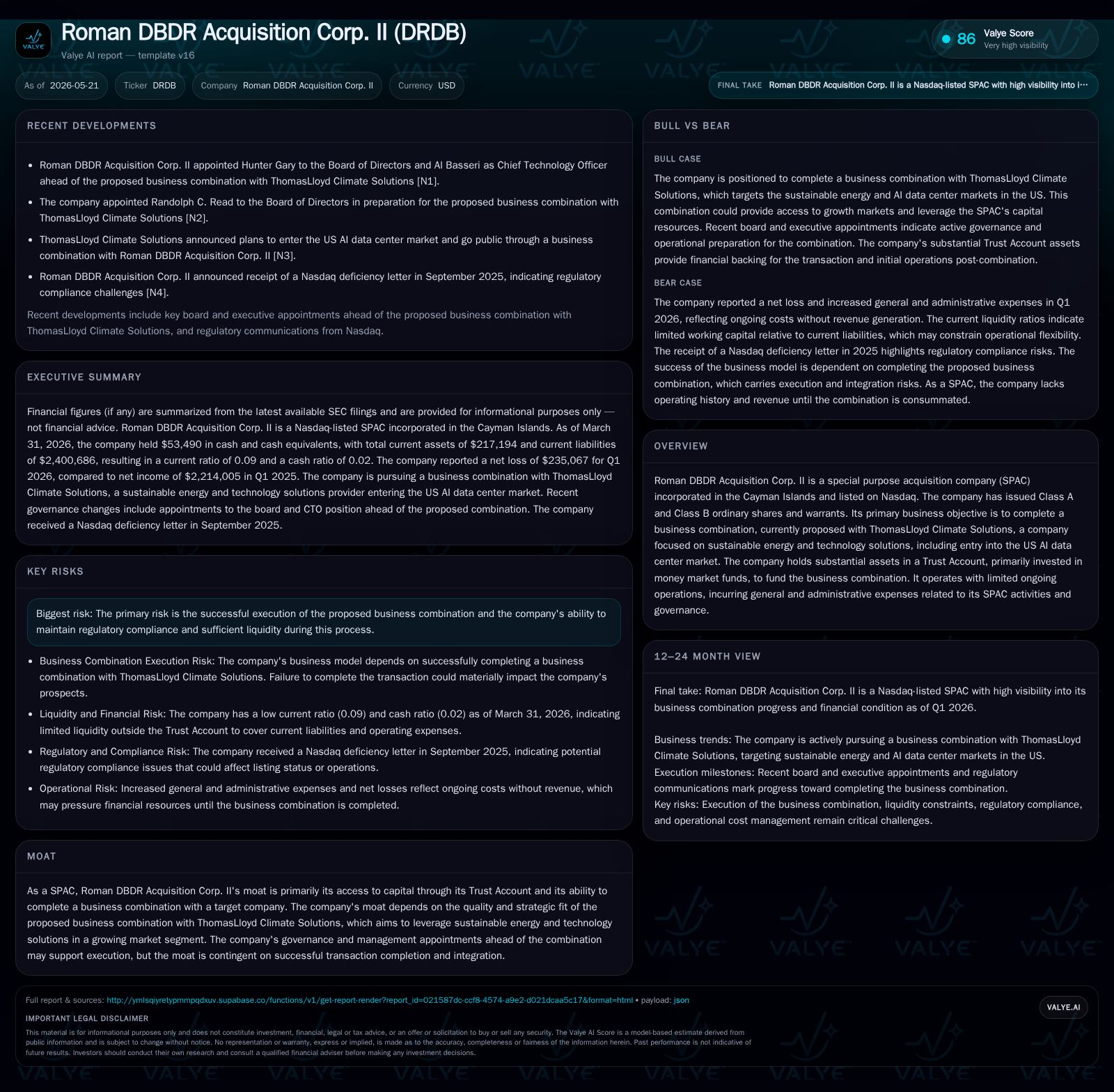
Roman DBDR Acquisition Corp. II’s Q1 2026 10-Q filing highlights key operational and governance developments including sponsor and shareholder redemption waivers, stable trust account investments, and board refreshment with new independent director and CTO appointments. Structured as a Cayman Islands SPAC focused on sustainable energy technology, it faces typical SPAC-related execution risks, regulatory scrutiny, and liquidity constraints ahead of completing its merger with ThomasLloyd Climate Solutions. Despite a low current ratio reflecting pre-combination capital deployment, strategic leadership enhancements signal preparedness for post-merger integration.
Recent Quarterly Developments Refine Operational Focus
Roman DBDR Acquisition Corp. II’s Q1 2026 Form 10-Q highlights ongoing operational activity consistent with its SPAC structure [S2]. The Company continues to incur monthly administrative expenses totaling $10,000 under an Administrative Services Agreement initiated in December 2024 with its Sponsor. These costs cover office space, utilities, and administrative support; $30,000 was recorded and paid during Q1 2026 within accrued expenses on the balance sheet
A significant development is the documented waiver by both Sponsors and public shareholders of their redemption rights on Founder Shares and Public Shares related to both the consummation of the business combination and associated shareholder votes. This step aligns interests to prevent dilutive redemptions that could complicate or delay transaction approval [S2]
Trust Account funds remain conservatively invested primarily in money market funds as of March 31, 2026—a shift from U.S [S2]. Treasury Bills held at year-end 2025—reflecting standard risk mitigation practices common among SPACs managing capital prior to de-SPAC events
Governance adjustments reported in May 2026 include the resignation of director Michael Woods alongside the appointment of Hunter C [S3][N1]. Gary as an independent director and Compensation Committee member. Additionally, Al Basseri was named Chief Technology Officer, bringing expertise in AI-driven platforms and cybersecurity architectures vital for overseeing technological due diligence related to the ThomasLloyd merger
Business Model Overview: Capital Vehicle for Climate-Tech Acquisition
Roman DBDR Acquisition Corp. II functions as a Cayman Islands-incorporated special purpose acquisition company raised through an initial public offering selling units composed of one Class A ordinary share plus one-half of one redeemable warrant at $10 per unit. Warrants are exercisable at $11.50 per share following full exercise of over-allotment options completed in early 2025 [S2]
Founder Shares held by Sponsors confer economic benefits but generally lack redemption privileges unless waived—a condition currently met to facilitate smooth business combination progression without disruptive shareholder exits [S2].
The Company holds substantial liquid funds within its Trust Account earmarked for financing the pending merger consideration upon closing; these funds are managed conservatively reflecting custodial best practices for SPACs [S2].
Operating expenses remain minimal as Roman does not generate revenue until completion of its de-SPAC transaction; value creation is contingent entirely on successful business combination execution aligned with investor expectations [S1][S2]
Industry Context: Navigating SPAC Climate-Tech Merger Dynamics
Roman occupies a niche within evolving capital markets focusing on sustainability-driven acquisitions via SPAC vehicles targeting climate technology companies. This positioning responds to growing ESG investment demand alongside heightened regulatory scrutiny governing blank-check companies.
Climate-tech SPAC mergers require thorough due diligence across complex value chains including renewable power generation infrastructure and digital ecosystems optimized for energy-efficient AI data centers—a growth area fueled by global decarbonization policies and surging computational demands.
Competition from traditional private equity firms investing directly in climate-tech startups adds pressure on SPACs like Roman to demonstrate cost-effective capital allocation amid increasing investor sophistication and regulatory oversight.
Governance Enhancements Support Transaction Execution
Board refreshment with Hunter C. Gary’s appointment enhances independent oversight crucial during proxy solicitation processes ahead of shareholder votes. Meanwhile, naming Al Basseri CTO underscores focus on technological evaluation capabilities essential for assessing ThomasLloyd Climate Solutions’ platform centered on secure scalable AI-driven infrastructure [S3][N1].
These moves signal deliberate realignment of governance structures aimed at bolstering transaction integrity and preparing for post-merger integration challenges.
Growth Drivers Linked to ThomasLloyd Climate Solutions Merger
The proposed business combination enables Roman’s entry into AI data center markets leveraging ThomasLloyd’s renewable energy systems designed for sustainable digital infrastructure.
This strategic alignment taps into converging growth trends: expanding clean energy deployment combined with rising demand for scalable cloud computing solutions underpinned by ESG compliance imperatives.
Successful closing depends on timely regulatory approvals followed by realization of synergies through technology ecosystem integration and potential expansion opportunities financed via enhanced capital market access post-merger [N1][S1].
Key Risks: Execution Uncertainty, Regulatory Scrutiny, Liquidity Constraints
Primary risks include securing shareholder approvals amid dilution concerns linked to founder share/warrant structures despite current waiver agreements intended to align stakeholder incentives [S2]. Delays or failures could jeopardize the limited lifespan benefits inherent in the SPAC structure.
Regulatory landscape remains challenging as SEC intensifies disclosure requirements particularly around complex climate-tech transactions conducted via blank-check vehicles.
Liquidity analysis shows current assets at approximately $217K versus current liabilities exceeding $2.4M yielding a low current ratio (~0.09), reflective of typical pre-combination SPAC balance sheets reliant on transaction closure timing rather than internal cash flows for operational funding [F1]
Reported total debt stood around $242K from prior periods with net debt near $189K after accounting for cash balances—highlighting moderate leverage but emphasizing dependence on sponsor support until deal completion [F1]
Upcoming Milestones To Watch
Attention focuses on forthcoming shareholder meetings convened to approve the ThomasLloyd merger proposal alongside disclosures relating to financing arrangements critical for closing execution.
Further governance or management adjustments may occur signaling readiness enhancements ahead of integration phases.
Market reception following these events will likely influence investor sentiment toward Roman’s transition from a capital vehicle into an operating entity aligned with sustainability investment themes.
Financial Position Summary Reflecting Pre-Combination Status
At March 31, 2026 quarter-end, Roman held approximately $53,490 in cash equivalents outside its Trust Account while maintaining substantial investments primarily in money market funds within the Trust Account [F1][S2]. Total debt last measured at approximately $242,512 dates from an earlier period producing net debt near $189K after cash offsets.
Operating results remain negative consistent with administrative expense absorption during this pre-revenue stage prior to de-SPAC completion [F1]
Disclaimer: This analysis is based exclusively on publicly available SEC filings and reputable news sources as cited; it does not constitute investment advice or endorsement regarding Roman DBDR Acquisition Corp. II or any securities.
Disclaimer: This is research-only, informational analysis and not investment advice. It may include AI-generated interpretation and general industry context. Always verify important details using primary sources.

Comments