
Daedalus Special Acquisition Corp.: SPAC Ambition, Consumer AI Targets, and the Realities of the Pre-Deal Phase
Daedalus Special Acquisition Corp. enters the crowded SPAC field with a consumer AI focus, a cash-rich trust, and a management team steeped in gaming and tech. The opportunity is substantial, but without a target, execution and valuation risk dominate the near-term outlook.
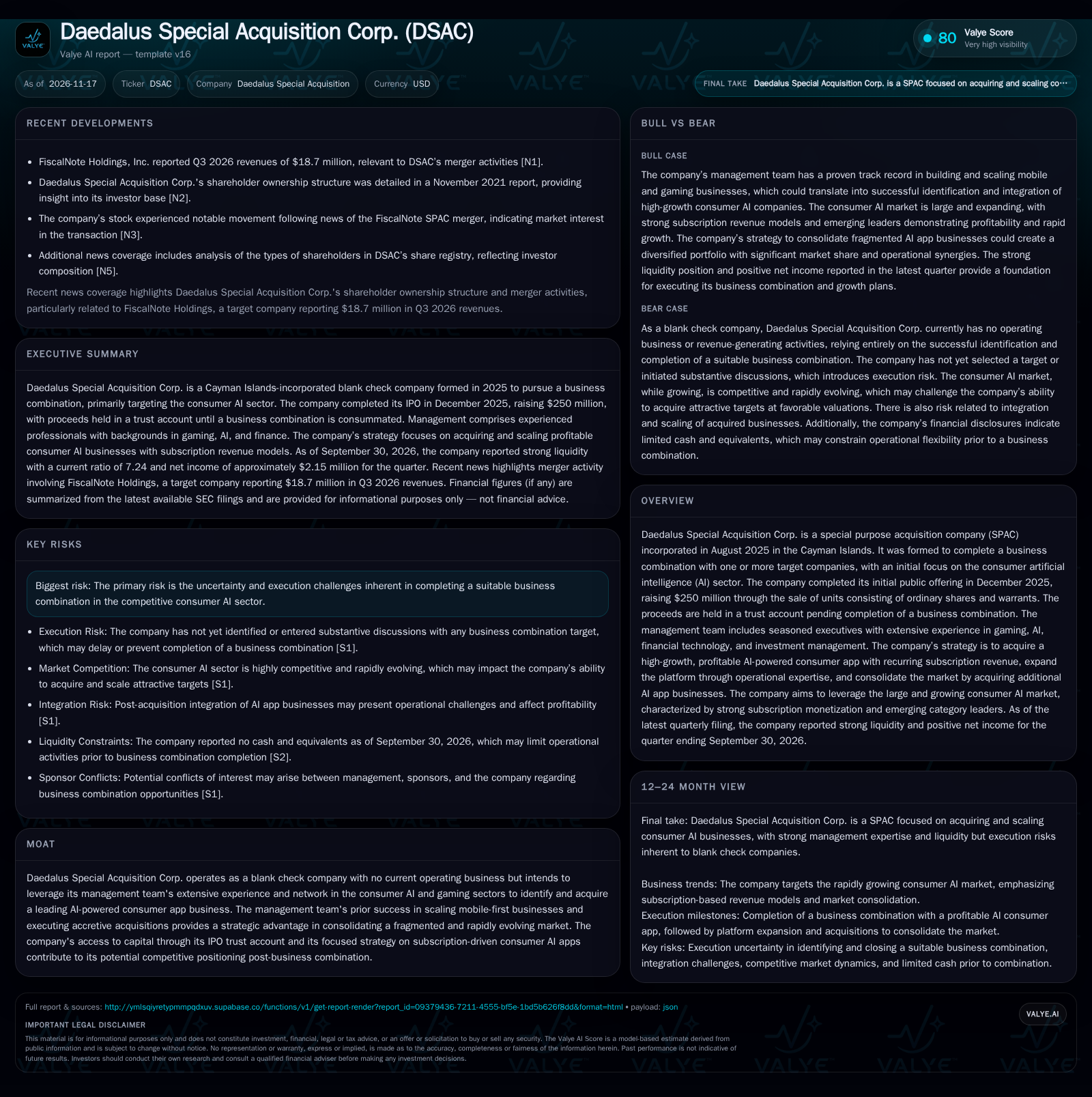
Daedalus Special Acquisition Corp. is a blank-check company with $250 million in trust, aiming to acquire a high-growth, subscription-driven consumer AI business. The management team brings deep operational and deal-making experience from gaming and AI sectors.As of September 30, 2026, Daedalus reported a reported current ratio and net income driven by trust account interest, but has yet to identify a target. Success will hinge on sourcing and closing a compelling deal amid fierce competition and volatile valuations in consumer AI. [S1] [S2]
Daedalus Special Acquisition Corp. embodies the classic SPAC promise: a substantial war chest, a management pedigree built on gaming and AI success, and an ambitious goal to anchor a platform in the burgeoning consumer artificial intelligence market. With $250 million in trust and a stated strategy to acquire and scale a profitable, subscription-driven AI app, Daedalus is positioned to move quickly once a target is found. However, as of September 2026, the company remains in pre-deal limbo—generating its income from trust account interest, not operations. The clock is ticking, and the journey from blank-check to operating business will test both the opportunity set in consumer AI and the team’s ability to navigate valuation, integration, and execution risks. [S1] [S2]
Current State: Trust-Funded, Pre-Deal, and Poised for Action
Daedalus Special Acquisition Corp. completed its IPO in December 2025, raising $250 million through the sale of 25 million units at $10 each, with proceeds placed in a trust account at JPMorgan Chase Bank. Each unit includes a Class A share and a quarter-warrant, providing potential upside for investors if a deal is consummated. A further $6.85 million was raised via private placement to the sponsor and underwriters. [S1]
As of September 30, 2026, Daedalus reported current assets of $659,615 and current liabilities of $91,090, resulting in a current ratio of 7.24. Net income for the quarter was $2,149,196, entirely attributable to interest income from the trust account rather than operating activities. The company had no reported cash or equivalents outside the trust. [S2]
Critically, Daedalus has not yet identified or engaged in substantive discussions with an acquisition target, meaning the business remains in the pre-deal phase, with execution risk and opportunity cost rising as the deadline for a business combination approaches. [S1] [S2]
How Daedalus Could Unlock Value: The Mechanics of a Consumer AI Roll-Up
As a SPAC, Daedalus’ economics hinge entirely on its ability to close a business combination that creates value for shareholders. The stated strategy is to acquire a high-growth consumer AI app business with a recurring subscription revenue model and strong unit economics, then expand through operational expertise and further M&A. [S1]
If executed, such a platform could benefit from high-margin digital subscriptions, low incremental distribution costs, and the potential for operating leverage as the customer base scales. Consumer AI apps—particularly those in productivity, personalization, or entertainment—often monetize via monthly or annual subscriptions, with churn and retention as critical drivers of long-term value.
The company reported profitability for the period. However, the SPAC structure places a premium on speed and deal quality: failure to close a deal within the designated timeline typically results in liquidation and return of trust proceeds. Until a deal is completed, Daedalus earns only passive interest, not operating income, and cannot deploy capital for growth or integration.
Competing in the Consumer AI Land Grab: Advantages, Uncertainties, and Peer Dynamics
Daedalus’ management team brings direct experience in gaming, AI, and technology, which may confer sourcing and integration advantages in a crowded field. Their backgrounds suggest the ability to identify promising consumer-facing AI applications and to scale digital products across global markets. [S1]
However, the consumer AI sector is highly competitive, with new entrants, established tech giants, and private equity all seeking to acquire or build category leaders. Valuations are volatile, and the best targets attract multiple suitors. Platform incumbents or deep-pocketed strategics may be able to outbid SPACs for the most attractive assets. Additionally, rapid shifts in AI technology and user preferences could erode moats or render newly acquired businesses less relevant.
Peer SPACs and direct listings targeting AI apps or digital platforms provide both a benchmark for deal terms and a source of competitive tension. Daedalus’ success will depend on its ability to move quickly, secure a differentiated asset, and add value post-acquisition—none of which are guaranteed at this stage.
If Daedalus Lands a Category Leader: The Upside Case for Platform Scale
The most favorable scenario is one in which Daedalus successfully acquires a profitable, fast-growing consumer AI app with strong subscription retention and a clear path to category leadership. This would enable the company to leverage its management expertise, realize operating synergies, and potentially execute follow-on acquisitions to consolidate the market.
Confirmation of this scenario would include announcement of a definitive agreement with a recognized AI app leader, evidence of robust recurring revenue and customer retention metrics, and demonstration of post-deal growth or margin expansion. A favorable market reaction to the deal announcement—reflected in warrant and share price appreciation—would further validate the value-creation thesis.
Falsification would occur if Daedalus announces a deal for a marginal, undifferentiated AI asset, or if post-acquisition financials reveal weak retention, high churn, or deteriorating margins.
Most Likely Trajectory: Deal Sourcing, Valuation Hurdles, and the Race Against Time
The most plausible near-term path is that Daedalus continues to evaluate targets amid intense competition and fluctuating valuations in the consumer AI sector. Management’s network and experience may provide access to proprietary deal flow, but securing a high-quality, appropriately valued target will be challenging.
Confirmation of this scenario would involve incremental disclosures—such as initiation of due diligence, non-binding LOIs, or updates on sector focus—followed by an eventual deal announcement, potentially late in the SPAC’s lifecycle. Deal terms may reflect current market tensions, with high valuations offset by earnouts or contingent consideration.
This scenario would be falsified if Daedalus fails to announce a credible transaction before the SPAC deadline, resulting in liquidation and return of trust proceeds to investors.
When the Clock Runs Out: Liquidation Risk and Erosion of SPAC Option Value
The adverse case arises if Daedalus is unable to identify, negotiate, or close an acquisition within its designated window. In this outcome, the trust is liquidated and funds are returned to shareholders, with warrants expiring worthless.
This scenario could be confirmed by prolonged silence on deal progress, repeated deadline extensions, or disclosures indicating difficulty in sourcing attractive targets. Heightened redemptions or waning sponsor engagement may further signal the risk of non-completion.
Alternatively, a forced or low-quality acquisition—done to beat the deadline—could destroy rather than create value, particularly if the acquired business lacks scale, subscription stickiness, or a defensible AI moat.
What Will Determine Daedalus’s Success in Consumer AI Acquisitions?
Any announcement of a definitive business combination agreement, including target identity, sector, and transaction terms.
Disclosure of target company revenue, profitability, and—if available—subscription retention or churn metrics would help test the quality of the acquisition thesis.
Updates on the SPAC’s remaining timeline, including any extensions or amendments to the business combination window.
Changes in redemption rates or warrant trading activity around deal announcements would provide signals on market confidence and perceived deal quality.
Evidence of post-deal management continuity or operational integration plans, which would clarify the platform-building intent.
Sector-wide shifts in consumer AI valuations, funding flows, or regulatory changes that could affect acquisition pricing or business model sustainability.
If disclosed, pipeline of potential targets under evaluation or any signed letters of intent.
Disclaimer: This is research-only, informational analysis and not investment advice. It may include AI-generated interpretation and general industry context. Always verify important details using primary sources.

Comments