
Data Storage Corp Transforms Telecom Focus Post CloudFirst Divestiture
Following the divestiture of its CloudFirst business, Data Storage Corp focuses on its telecommunications subsidiary Nexxis and strategic acquisitions in high-growth tech sectors.
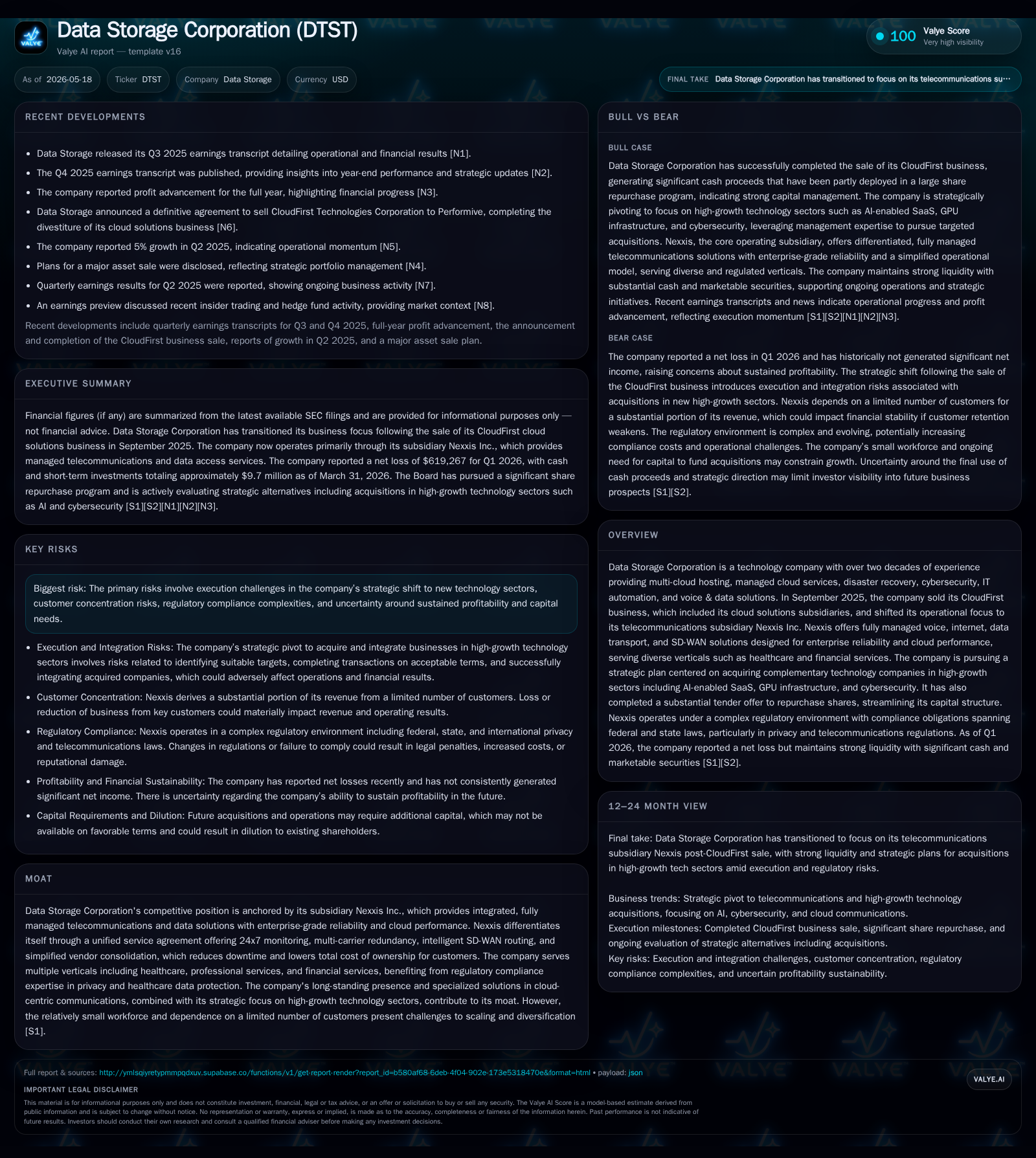
Data Storage Corporation’s latest quarterly filing confirms a decisive pivot from cloud hosting to enterprise telecommunications and targeted technology acquisitions. The company has sold its CloudFirst cloud solutions business and is concentrating operations through Nexxis Inc., providing integrated voice, data transport, and SD-WAN services to regulated verticals. A recently completed tender offer has streamlined capital structure and improved liquidity, positioning the firm to pursue acquisitions in AI-enabled SaaS, GPU infrastructure, and cybersecurity. Execution risks remain significant given integration challenges and regulatory complexity, but the strategic shift aligns with evolving industry demands for unified, high-availability telecom services.
Latest Quarterly Operating Update Validates Pivot
Data Storage Corporation’s May 15, 2026 10-Q filing [S2] confirms the company’s resolved pivot from its legacy cloud hosting business toward a streamlined operational focus on its wholly owned telecommunications subsidiary Nexxis Inc. This comes after the September 2025 sale of its CloudFirst business—a move that materially reshaped revenue streams and cost structure. Latest disclosures affirm that all active operations concentrate on delivering managed voice, internet access including multi-carrier redundancy, data transport infrastructure, and SD-WAN solutions through Nexxis. Alongside this operational realignment is the completion of an aggressive tender offer announced late 2025 [S4], repurchasing approximately 72% of outstanding shares at $5.20 per share by January 2026 [S8], [S15]. The resulting capital structure streamlining leaves Data Storage with roughly $10 million cash plus strong liquidity ratios [F1], positioning it to fund strategic initiatives without immediate financing needs.
This capital lightening simplifies leverage considerations while allowing renewed focus on acquiring technology assets in AI applications, GPU infrastructure-as-a-service platforms for demanding computational workloads, and cybersecurity—all poised for high growth [S1]. A corresponding press release attached to the Form 8-K dated May 15 reaffirms management’s commitment to pursuing these higher-margin recurring revenue opportunities alongside steady organic growth from Nexxis’ nationwide multi-vertical telecom footprint [S3].
Business Model Evolution Focused on Enterprise Telecom
Historically known for multi-cloud hosting and managed cloud services including disaster recovery and IT automation [S1], Data Storage shifted decisively after divesting CloudFirst cloud solution subsidiaries to place its bets on Nexxis—a fully managed telecom services provider emphasizing integrated voice/data solutions tailored for enterprise reliability and cloud-centric performance [S5]. Nexxis’ offerings are structured under unified service agreements combining voice communications (including VoIP) with secure internet connectivity and intelligent software-defined WAN routing.
Key product features cited include multi-carrier redundancy—crucial for mission-critical connectivity—and proactive 24x7 monitoring by dedicated technical teams to ensure uptime far exceeding legacy telecom infrastructures often plagued by vendor fragmentation. This bundled architecture simplifies operations for customers by consolidating billing into a single invoice streamlining vendor management overhead [S1], [S5].
Customer verticals served—healthcare, financial services, distributed enterprises—illustrate the need for high compliance standards (HIPAA/HITECH) plus robust performance SLAs supporting hybrid work models reliant on cloud applications hosted locally or across public clouds. The value proposition clearly targets lowering total cost of ownership relative to multi-vendor legacy setups while improving resilience essential for regulated environments facing increasingly stringent data privacy frameworks [S18].
Competitive Positioning of Nexxis in the Communications Market
The telecom landscape serving enterprise customers has traditionally been fragmented across multiple carriers and disjointed vendor relationships causing operational friction. Within this context Nexxis carves a competitive niche through seamless integration of voice/internet/WAN layers managed end-to-end under one agreement offering intelligent SD-WAN routing that dynamically optimizes traffic flows across redundant carriers.
This not only translates into fewer points of failure but also enables simplified troubleshooting—a known pain point in large-scale deployments where customer IT teams often spend excessive time resolving third-party vendor disputes. In addition, Nexxis leverages advanced monitoring tools enabling real-time fault detection which minimizes downtime risk critical to verticals like healthcare where communication continuity impacts patient outcomes [S5].
While price competition exists among major telecom providers servicing enterprise segments, Nexxis differentiates through its white-glove customer experience philosophy paired with regulatory compliance expertise—creating switch costs rooted more in operational reliability than pure pricing metrics [S1]. This forms part of its moat alongside multi-carrier redundancy which is increasingly demanded as organizations transition away from traditional MPLS networks towards more flexible SD-WAN frameworks optimized for cloud application delivery
Industry Structure and Technology Adoption Dynamics
Enterprise telecommunications is progressively shaped by three forces: rapid SD-WAN adoption driven by hybrid work trends; increasing regulation requiring strict data privacy controls especially in healthcare; and demand for cloud-first communication architectures enabling resilient business continuity.
SD-WAN tech replaces legacy WAN connections by leveraging broadband internet combined with centralized orchestration to route traffic intelligently ensuring QoS tailored for voice/video/data simultaneously. This reduces dependence on expensive private lines while increasing agility—Nexxis taps directly into this trend with its intelligent routing capabilities underpinning critical service guarantees.
Beyond technology adoption rates lies regulatory complexity: federal/state laws such as HIPAA impose stringent controls on how patient data traverses networks necessitating business associate agreements codifying data protection terms—which Nexxis incorporates within their service model offering vertical-specific compliance support [S18]. Further telecom regulations related to lawful intercept obligations require maintaining technical capabilities that can impact network design costs but are necessary to operate at scale.
These factors create natural switching costs due to certification needs plus ongoing compliance audits deterring clients from fragmented vendor ecosystems leading them toward integrated service providers like Nexxis.
Growth Drivers: Acquisition Strategy and Market Tailwinds
Data Storage’s strategy extends beyond organic growth at Nexxis into acquisitions targeting complementary sectors featuring recurring revenues and scalable margins within AI-enabled SaaS verticals; GPU IaaS addressing computationally intensive workloads such as machine learning; plus cybersecurity platforms offering SOC services critical to securing expanding attack surfaces as enterprise footprints evolve [S1], [S4].
These acquisitions aim to create a technology consolidation platform leveraging cross-selling between telecom connectivity solutions and next-generation software offerings enhancing stickiness with end-customers. The available cash reserves post-tender offer along with reduced share count provide balance sheet capacity supporting deal activity without immediate dependence on external capital markets pushing value enhancement via synergy realization.
Market tailwinds are favorable: AI adoption accelerates creating demand for dedicated GPU infrastructure; cybersecurity needs intensify amid sophisticated threats; hybrid work models boost cloud-first communications uptake all aligning well with Data Storage’s refocused playbook anchored on highly-regulated industries valuing integrated turnkey solutions rather than disparate point products.
Key KPIs likely monitored internally would include pipeline volume for acquisition targets fitting strategic filters; booking rates for new Nexxis contracts servicing critical verticals; retention/renewal rates influenced by contract length under unified service agreements; plus operating margin trends reflecting scale efficiency improvements as overhead absorbed across broader tech portfolio expansions.
Risks and Execution Challenges in Strategic Realignment
Notwithstanding clear strategic intent several risks persist. Execution risk surrounding timely identification and integration of acquisition targets is pronounced given fast-moving technological shifts especially within AI/cybersecurity domains characterized by heavy R&D spend cycles requiring nimble adaptation [S1], [S22]. Mismatch between acquired company cultures or incompatible system architectures could elevate integration costs or delay synergy attainment.
Customer concentration risks heighten as business narrows toward telecommunications dominated by mid-to-large regulated enterprises—any significant client loss would meaningfully impact results absent broad diversification. Regulatory dynamics add complexity: continuous evolution in privacy statutes requires ongoing investments maintaining compliance frameworks which could pressure margins or constrain product innovation velocity.
Financially while solid cash reserves give cushion uncertainty remains if acquisitions scale quickly enough to cover incremental expense load risking pressure on profitability until critical mass achieved. Additionally material weaknesses reported related to internal controls over accounting processes call attention to escalating governance demands accompanying corporate transformation [S24]. Vigilant management will be vital guarding against dilutionary capital raises or adverse valuation impacts should execution falter.
Key Milestones and What to Watch Next
Looking ahead investors should closely monitor announcements regarding new acquisitions particularly those fitting AI SaaS or cybersecurity niches signaling tactical execution of stated strategy [S2], [S3]. Traction metrics at Nexxis such as quarterly bookings growth reflecting expanding penetration into target regulated verticals will be key demand indicators sustaining confidence.
Guidance updates providing clarity on margin trajectories incorporating synergies from acquired entities will illuminate scaling effectiveness while commentary about timing/phasing of further capital deployment episodes offers insight into balance sheet prioritization decisions.
Potential regulatory developments impacting telecom or cybersecurity product parameters warrant attention given their direct influence over operating models potentially forcing unforeseen capex or compliance costs requiring adjustment strategies.
Concise Financial Profile Supporting Strategic Narrative
As of March 31, 2026 Data Storage held cash & equivalents totaling approximately $114K supplemented by current assets near $11.6 million against current liabilities about $2 million yielding a robust current ratio approximating 5.74 indicating strong short-term liquidity available for operational funding purposes [F1]. Total debt stands modest at roughly $70K evidencing a low leverage posture supportive of acquisition financing flexibility absent reliance on heavy external borrowing.[F1]
Net debt computed conservatively suggests a negative figure implying net cash position enhancing financial resilience amidst strategic transitions. Operating income remains negative historically but management has emphasized reinvestment cycles consistent with growth stage post-divestiture restructuring while striving toward sustainable profitability anchored by law-compliant enterprise telecom solutions together with accretive acquisition integrations.
This analysis synthesizes material data disclosed through latest SEC filings combined with sector expertise reflecting Data Storage Corporation’s evolving positioning post-CloudFirst divestiture towards a focused enterprise telecommunications provider complemented by select high-growth tech acquisitions. While execution risks persist given transitional complexity the firm aligns strategically along enduring industry secular trends favoring integrated managed communication solutions emphasizing reliability, compliance adherence, and simplified operations demanded by modern distributed enterprises.
Disclaimer: This report is for informational purposes only and does not constitute investment advice or a research view regarding any security or company mentioned herein.
Disclaimer: This is research-only, informational analysis and not investment advice. It may include AI-generated interpretation and general industry context. Always verify important details using primary sources.

Comments