
Duke Energy Corp's Infrastructure-Driven Growth Amid Rising Capital Intensity and Regulatory Complexities
Duke Energy balances growth in regulated utilities with increased capital expenditures and evolving regulatory landscapes.
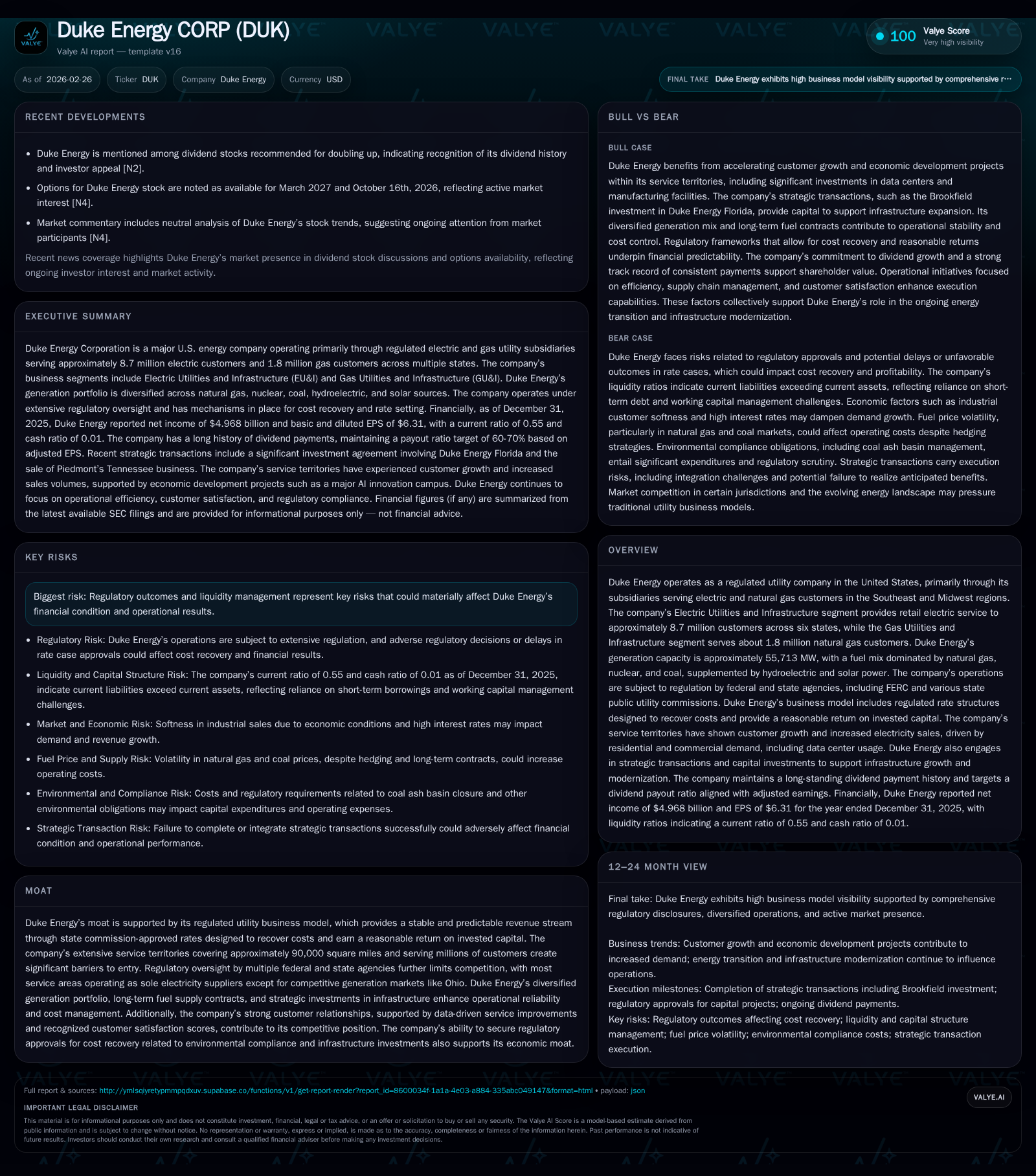
Duke Energy operates a broad U.S. regulated utility footprint serving millions of electric and natural gas customers, generating substantial operating income driven primarily by infrastructure investments in energy modernization. Despite flat revenues reflecting regulatory rate design nuances, net income and operating income grew moderately in 2025. The company faces opportunities in expanding electrification, AI-driven data center load growth, and energy transition funding alongside constraints from heavy capital expenditure commitments and regulatory oversight. Liquidity remains robust backed by strategic asset sales and credit facilities, though cash flows reflect heavy reinvestment resulting in negative free cash flow in 2025. The sustainable dividend streak underscores confidence in long-term regulated cash flows amidst execution risks related to environmental mandates and evolving energy mix.
Historical Performance
Duke Energy's financial trajectory demonstrates steady growth in profitability during sector challenges. Operating income expanded from approximately $1.86 billion in 2023 to $8.63 billion in 2025 [F1], underscoring intensified infrastructure investment and operational scale.
Historical performance (annual)
| FY | Net ($bn) | CFO ($bn) | OpInc ($bn) | Capex ($bn) | Net YoY |
|---|---|---|---|---|---|
| 2025 | 5.0 | 12.3 | 8.6 | 14.0 | +9.8% |
| 2024 | 4.5 | 12.3 | 7.9 | 12.3 | +59.2% |
| 2023 | 2.8 | 9.9 | 1.9 | 12.6 | +11.4% |
| 2022 | 2.5 | 5.9 | 1.2 | 11.4 |
Source: SEC companyfacts cache [F1].
Capital returns and efficiency (annual)
| FY | FCF ($bn) | ROE% |
|---|---|---|
| 2025 | -1.7 | 9.6 |
| 2024 | 0.0 | 9.0 |
| 2023 | -2.7 | 5.8 |
| 2022 | -5.4 | 5.2 |
Source: SEC companyfacts cache [F1].
Reported revenue data is inconsistent over recent years due to changes in reporting boundaries or segment adjustments; thus revenue figures are not presented for YoY comparison [F1].
Growth drivers include regulated rate increases approved by state commissions, storm recovery surcharges notably at Duke Energy Florida contributing significantly to revenue enhancements (e.g., a $753 million increase in storm-related revenues reported for 2025) [S22], and expansion into attractive service territories characterized by population migration trends and industrial growth such as data centers.
Future Growth Prospects
Duke Energy is positioned to capitalize on accelerating electrification fueled by domestic industrial onshoring and AI data center proliferation within its network footprint [S1]. Its Electric Utilities segment covers approximately 90,000 square miles serving about 8.7 million customers primarily across six states [S6], providing a stable baseline demand.
Energy modernization initiatives include smart grid technologies such as self-healing networks that prevented an estimated 2.2 million outages during weather events [S23]. The company’s decarbonization strategy emphasizes nuclear power—supported by anticipated tax incentives—and partnerships expanding renewable resources complemented by emerging low-carbon technologies including advanced nuclear reactors and carbon capture systems [S23].
Growth is moderated by challenges including complex regulatory approvals for cost recovery related to new generation assets or retirements [S1], supply chain and labor market constraints potentially increasing project costs or causing delays [S1], and technology transition risks where immature solutions may not achieve commercial scalability or may be superseded rapidly.
Capital-intensive projects require ongoing financing access amid rising interest rates which could impact customer rates or constrain capital deployment pacing [S15]. These factors delineate Duke Energy’s expansion potential and margin preservation boundaries.
Forecasts, Milestones & Expectations
Recent filings do not provide explicit future earnings guidance beyond affirmations of meeting or exceeding prior adjusted earnings guidance midpoints [S1]. Key upcoming milestones include completion of the Piedmont Tennessee business sale expected March 31, 2026 [S6], along with phased closings related to the $6 billion Brookfield infrastructure partnership involving Duke Energy Florida extending through mid-2028.
Regulatory docket developments warrant close monitoring—especially generation licensing renewals for nuclear facilities critical to clean baseload capacity—and transmission upgrades enhancing grid resilience against extreme weather remain key operational indicators.
Returns & Capital Allocation
Despite substantial reinvestment reflected by high capex ($14 billion in FY25), Duke Energy maintains strong operating cash flow generation ($12.33 billion) anchored by utility operations [F1]. Free cash flow was negative approximately $-1.7 billion indicating continued reliance on debt/equity issuances to fund capital growth without compromising liquidity buffers.
Equity stood near $51.8 billion at fiscal year-end reflecting incremental shareholder equity accretion aligned with asset additions [F1]. Dividend policy remains progressive with about two percent annual increases recently targeting payout ratios between 60-70% of adjusted EPS balancing shareholder returns with retained earnings for capex needs [S4].
Share repurchases have been immaterial post-2015 with last significant buybacks noted then [F1]. Capital structure optimization involves prioritizing secured first mortgage bonds ahead of unsecured debt issuance where feasible, supplemented by commercial paper backed by credit facilities ($7.8B available) ensuring liquidity under various market conditions [S4][S15]. Credit ratings are currently stable at investment grade levels supporting borrowing cost advantages yet remain sensitive to execution risks or macroeconomic tightening [S17].
Strategic Positioning & Moat
Duke Energy’s moat stems from its entrenched regulated utility status commanding exclusive licensed territories limiting direct competition except limited wholesale markets such as Ohio retail auctions [S16]. Multi-agency regulatory oversight—including FERC plus state public utility commissions—enables aligned rate structures insulating margins while permitting timely recovery of prudent investments including modernization efforts.
Diversification across fuel sources—natural gas, nuclear, coal alongside renewables—and long-term fuel contracts provide operational resiliency mitigating commodity price volatility common among peers.
A large customer base spanning residential through industrial sectors offers demand durability alongside scale efficiencies exploiting grid digitization benefits demonstrated during recent severe weather responses reducing outage impacts substantially [S23]. Innovative offerings supporting data center expansions linked to AI growth signal forward-looking integration enhancing customer value beyond traditional models.
Risks & Regulatory Challenges
Principal risks center on regulation-dependent cost recovery frameworks which if unfavorable can compress earnings; EPA rules effective April 2024 impose stricter emissions caps mandating accelerated asset retirement or retrofits potentially raising costs beyond expectations [S1][S22].
Liquidity risk arises from large capital requirements necessitating ongoing access to debt/equity markets at reasonable terms amid tightening macroeconomic policies; failure could impair project progress delaying critical infrastructure needed for load growth accommodation [S15][S21].
Technology transition risk is significant; investments into novel low-carbon technologies carry uncertain commercial scalability risking suboptimal returns if surpassed prematurely or delayed deployment occurs.
Execution risks include labor constraints elevating project cost inflation risk plus uncertainties from environmental litigation exposures such as ongoing MTBE matters related to legacy contamination claims without material current impact reported hereafter [S1].
Conclusion
Duke Energy represents a large diversified U.S.-centric regulated utility anchored in electric and natural gas service provision complemented by substantial ongoing modernization investments aligned with growing load demands driven by economic development trends including AI workload clustering regionally. While operating earnings improvements validate strategic execution capabilities, substantial capital outlays generate continued negative free cash flow posing financial management challenges requiring disciplined liquidity stewardship. Regulatory navigation remains critical given intertwined approvals necessary for cost pass-throughs alongside emissions compliance mandates altering generation profiles more abruptly than prior cycles. The balanced approach investing simultaneously in nuclear life extensions plus renewables hybridized with prospective advanced technology ventures fosters an adaptable platform sustaining reliability while advancing carbon goals within competitive costs. Stable dividend continuity entering its centennial year reaffirms confidence in consistent underlying cash flow underpinning investor stability amidst transformative pressures reshaping the utility sector. Monitoring regulatory developments regarding next-generation asset approvals plus multi-year transactional closings impacting capital structure evolution will offer key markers for ongoing fundamental assessment.
This analysis is informational only and does not constitute investment advice or recommendations regarding Duke Energy Corporation or its securities.
Disclaimer: This is research-only, informational analysis and not investment advice. It may include AI-generated interpretation and general industry context. Always verify important details using primary sources.

Comments