
DUKE Robotics Elevates Military and Civil Drone Solutions with NASDAQ Uplisting
DUKE Robotics’ recent $9.2 million capital raise and NASDAQ uplisting position it for growth in advanced robotic and drone markets despite liquidity challenges.
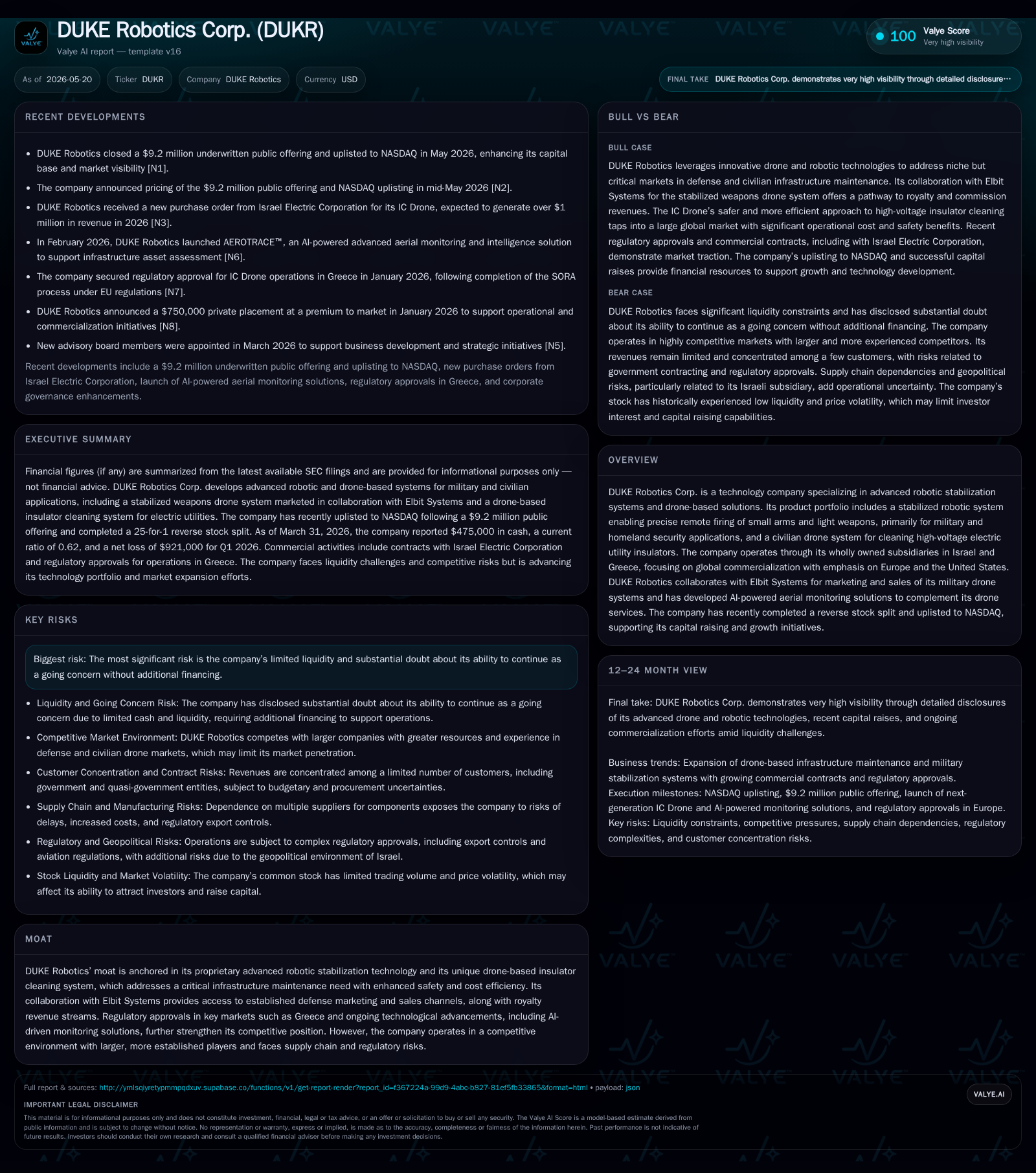
DUKE Robotics Corp. closed a $9.2 million underwritten public offering alongside a NASDAQ uplisting, enhancing its capital access and market visibility. The company specializes in military-grade robotic stabilization systems and civilian drone solutions targeting utility infrastructure maintenance, leveraging partnerships such as with Elbit Systems to market defense products. Regulatory clearances, including Greece’s SORA authorization for drone operations, underpin its European expansion, while AI-enabled aerial monitoring augments its product offerings. However, substantial doubt about DUKE's ability to continue as a going concern persists due to limited liquidity and revenue traction.
Latest Quarterly Update: Capital Raise and Market Listing Impact
On May 20, 2026, DUKE Robotics reported closing an underwritten public offering raising approximately $9.2 million in gross proceeds [S2][N1][N2][S3]. This fresh capital infusion represents a critical buffer to fund operational costs and ongoing product development amid previously stated cash constraints. Concurrently, the company uplisted its common stock from the OTCQB Venture Market to the NASDAQ exchange under ticker "DUKR," broadening its investor base and signaling maturation from a microcap OTC-listed entity to a more mainstream publicly traded company.
This dual milestone addresses immediate financial concerns arising from significant doubt about DUKE’s ability to continue as a going concern without additional financing [S1][S2]. By entering NASDAQ’s higher liquidity platform alongside new funding, DUKE aims to improve capital raising potential which is essential given its current working capital deficit (current assets of $813k versus liabilities of $1.31 million) resulting in a current ratio of just 0.62 at quarter-end March 31, 2026 [F1].
While the recent equity raise does not fully resolve broader cash flow challenges given the operating loss run rate exceeding $1.2 million over the last reported annual period [F1], it provides an important runway extension for commercial expansion initiatives.
Business Model Overview: Military Stabilization Tech and Civil Infrastructure Drones
DUKE Robotics’ revenue model derives primarily from the sale and licensing of advanced robotic systems targeting defense applications alongside commercial drone services focused on electric utility infrastructure maintenance.
The flagship military technology is an advanced robotic stabilization system that enables precise remote firing of small arms and light weapons in real-time scenarios [S1]. Originally tailored for unmanned aerial systems (UAS), this platform has modular adaptability allowing integration across various military ground platforms, serving homeland security forces globally.
Complementing this is DUKE’s civilian-grade IC Drone designed specifically for cleaning high-voltage electrical insulators—an application challenging manual methods due to safety hazards and efficiency gaps [S1][S4]. Revenues are generated through direct sales of hardware components accompanied by service contracts via subsidiary Duke Greece, particularly after achieving regulatory approvals enabling compliant operation across Europe.
Strategically, DUKE engages Elbit Systems Land Ltd. through a collaboration agreement that leverages Elbit’s established defense sales network to promote stabilized weapons systems [S1]. This relationship also produces royalty income streams tied to defense-focused products leveraging DUKE’s patented technologies.
The business depends on technology differentiation in stabilization mechanics combined with drone sensor capabilities enhanced by proprietary AI analytics—manifested most recently in the launch of AEROTRACE™ [S4]. This solution integrates aerial image capture with AI-assisted analytics helping critical infrastructure operators monitor asset conditions beyond mere cleaning services.
Competitive Landscape: Defense Collaboration and Civil Drone Market Positioning
DUKE Robotics occupies a niche intersecting military-grade robotics stabilization with specialized civilian UAV services—a hybrid positioning uncommon among direct competitors who traditionally focus solely on either large-scale defense prime contracting or broad civil drone markets.
The defense segment encompasses substantial barriers including regulatory export controls (e.g., CFIUS reviews in U.S., Israeli export licenses) and entrenched incumbents with decades-long government relationships [S1][S18]. DUKE’s partnership with Elbit Systems alleviates part of these hurdles by accessing marketing channels otherwise onerous for smaller firms.
In the civil domain, the IC Drone faces competition from UAV service providers focusing on infrastructure inspection but distinguishes itself through tailored insulator cleaning functionality coupled with risk mitigation advantages over manual labor approaches [S4]. However, scale limitations compared with industry leaders in commercial drones present headwinds for rapid market penetration.
Supply chain vulnerabilities are non-trivial given global logistics disruptions affecting component sourcing for electronics and aerospace assemblies. Additionally, patent protections around DUKE’s stabilization technologies provide some moat but must be continually defended against IP litigation risks [S13].
Sector-Specific Technology and Regulatory Milestones
A critical enabler for DUKE’s European ambitions was the operational authorization received on January 13, 2026 from the Hellenic Civil Aviation Authority after completion of SORA (Specific Operations Risk Assessment) mandated by EU Regulation 2019/947 [S1][S4]. This aligns the IC Drone capabilities within EU airspace regulatory frameworks—significantly easing boundary-crossing deployments throughout Europe.
Emphasizing innovation, DUKE Israel secured allowance for its "Stabilization System" patent from the US Patent Office in mid-2021—a foundational asset supporting both military exclusivity and potential licensing leverage [S12]. The analogous introduction of AEROTRACE™ leverages contemporary advances in AI-driven aerial intelligence gathering to expand service offerings beyond traditional visual inspections or cleaning tasks.
Compliance extends into governmental contract regulations applying distinctively across countries—covering cybersecurity standards, export controls on dual-use technologies, safety certifications for UAVs operating near critical infrastructure assets—as well as ongoing government procurement rules [S18][S19]. These create layered entry barriers ensuring only vetted solutions earn adoption but concurrently add cost and timeline burdens slowing commercialization velocity.
Growth Drivers: New Operational Authorizations and Geographic Commercialization
Near-to-mid term growth vectors hinge largely on geographic rollout success following regulatory clearances. Duke Greece’s SORA authorization functions as a beachhead into wider European civil markets wherein energy utilities must maintain aging grid assets both reliably and cost-effectively [S4]. Scaling contract wins here provides volume growth opportunities driven by recurring service revenues tied to seasonal insulator maintenance cycles.
Military sales prospects are anchored by continued collaboration with Elbit Systems which handles marketing efforts concentrating on multi-theater opportunities involving U.S., Israeli, and potentially NATO forces interested in precision stabilization enhancements [S1]. Introduction of successive improved robotic platforms or new models diversifying tactical capabilities could incrementally widen addressable markets over time.
On the technological front, integrating AI-enhanced monitoring products like AEROTRACE™ creates upsell pathways alongside core drone operations allowing customers deeper asset intelligence from combined cleaning plus inspection workflows [S4]. Commercial agreements via wholly owned subsidiaries ensure tighter customer relations and localized operational control facilitating iterative adaptation of offerings per client feedback.
However, realizing these growth drivers remains contingent upon effective capital deployment fueled by recent equity raises enabling expanded sales efforts, increased production capacity where necessary, and continuing R&D developments converging product quality improvements with cost efficiencies [N1][N2][S3]
Risks and Constraints: Liquidity Challenges and Competitive Headwinds
Substantial doubt regarding DUKE Robotics’ ability to maintain continuity without further financings remains central risk disclosed explicitly in both annual and quarterly filings [S1][S2][F1]. Despite recent capital raises totaling $9.2 million gross proceeds [N1], cash balances near $475k at quarter end March 2026 remain modest relative to operating burn rates exceeding $1 million annually along with current liabilities significantly surpassing current assets producing a low current ratio of 0.62 [F1]. This signals persistent working capital pressure necessitating close management attention.
The nascent nature of revenues (~$377k trailing annual) reflects early commercial adoption stages where product development cycles intersect uncertain customer procurement timelines especially within complex government contracting environments [F1][S1]. The IC Drone's civilian segment introduces additional execution challenges arising from newly honed business models still undergoing refinement internally that may disrupt focus or resource allocation adversely impacting financial results if not managed adequately.
Competitive headwinds stem from entrenched aerospace-defense contractors wielding greater scale advantages including broader manufacturing bases, deeper funding capabilities for R&D investments or compliance obligations fulfillment [S18]. Regulatory scrutiny remains elevated related not only to export controls but also safety/liability exposures heightened by deployment near critical infrastructure – any adverse incident could trigger reputational damage constraining further contract awards.
Supply chain disruptions affecting electronic components or precision mechanical parts further shadow operational reliability contributing incremental risk layers to ramp schedules or margin profiles [S20]
Near-Term Catalysts: Market Penetration Metrics and Strategic Partnerships
Market acceptance markers include ramping contract wins within European energy sectors facilitated by Duke Greece subsidiary post-SORA clearance; measurable repeat service deployments during peak maintenance seasons provide tangible volume indicators [S4]. Concurrently expanding cooperation depth with Elbit Systems enhances visibility into prospective defense pipeline opportunities worldwide where stabilized robotic platforms increasingly feature in modern warfare robotics architectures.
Technology rollout pace—such as adoption levels for AEROTRACE™ AI-driven monitoring solutions across existing customers—is another important benchmark reflecting cross-selling potential onto established drone service footprints enhancing overall client wallet share.
Monitoring industry regulatory trends particularly any tightening or relaxation around UAV usage restrictions remains pivotal since such developments can materially accelerate or inhibit go-to-market speed especially within urban or heavily regulated national environments.
Financial Profile Snapshot: Capital Adequacy and Operating Cash Flow
As of March 31, 2026, DUKE Robotics held approximately $475k in cash equivalents against total current liabilities exceeding $1.31 million leading to a constrained working capital position reflected by a current ratio of roughly 0.62 [F1]. Total debt is minimal (~$5k), indicating low leverage on balance sheet but limited available liquid resources underline the ongoing funding gap.
Operating performance continues at a negative EBITDA trajectory evidenced by last reported operating loss exceeding $1.2 million with corresponding net loss just above $1.24 million on modest trailing revenues below $400k annually highlighting early commercial-stage expense absorption versus top-line generation challenges [F1]
Revenue generation primarily driven by nascent IC Drone contracts plus limited stabilized weapons sales royalties underscores need for scaling operational volumes rapidly whilst controlling R&D burn tightly to extend cash runway ahead of sustainable profitability milestones.
The recent $9.2 million equity raise somewhat bolsters financial flexibility but must be prudently employed against investment priorities given market execution risks remain elevated.
This analysis synthesizes publicly filed SEC disclosures up through May 20, 2026 alongside company press releases detailing financing milestones while embedding sector-specific context concerning UAV regulatory frameworks (e.g., SORA), defense export controls (CFIUS), robotic weapons stabilization uniqueness, and civil infrastructure drone market dynamics. The evolving hybrid military-civilian product strategy positions DUKE Robotics at an intersection granting it differentiated technological moats; yet execution success depends critically on securing ongoing capital commitments while navigating complex regulatory landscapes amid robust competition from long-established defense contractors specializing either exclusively in military robotics or civilian UAV sectors.
No investment advice is offered herein; readers should consider this strictly as an informed business assessment based on available disclosures.
Disclaimer: This is research-only, informational analysis and not investment advice. It may include AI-generated interpretation and general industry context. Always verify important details using primary sources.

Comments