
Dixie Group Confronts Liquidity Strains, Supply Chain Disruptions, and Product Strategy Shifts
As the company leans into luxury vinyl and wood flooring amid a tough competitive landscape, its ability to adapt product strategy and control costs will be central to any sustainable improvement.
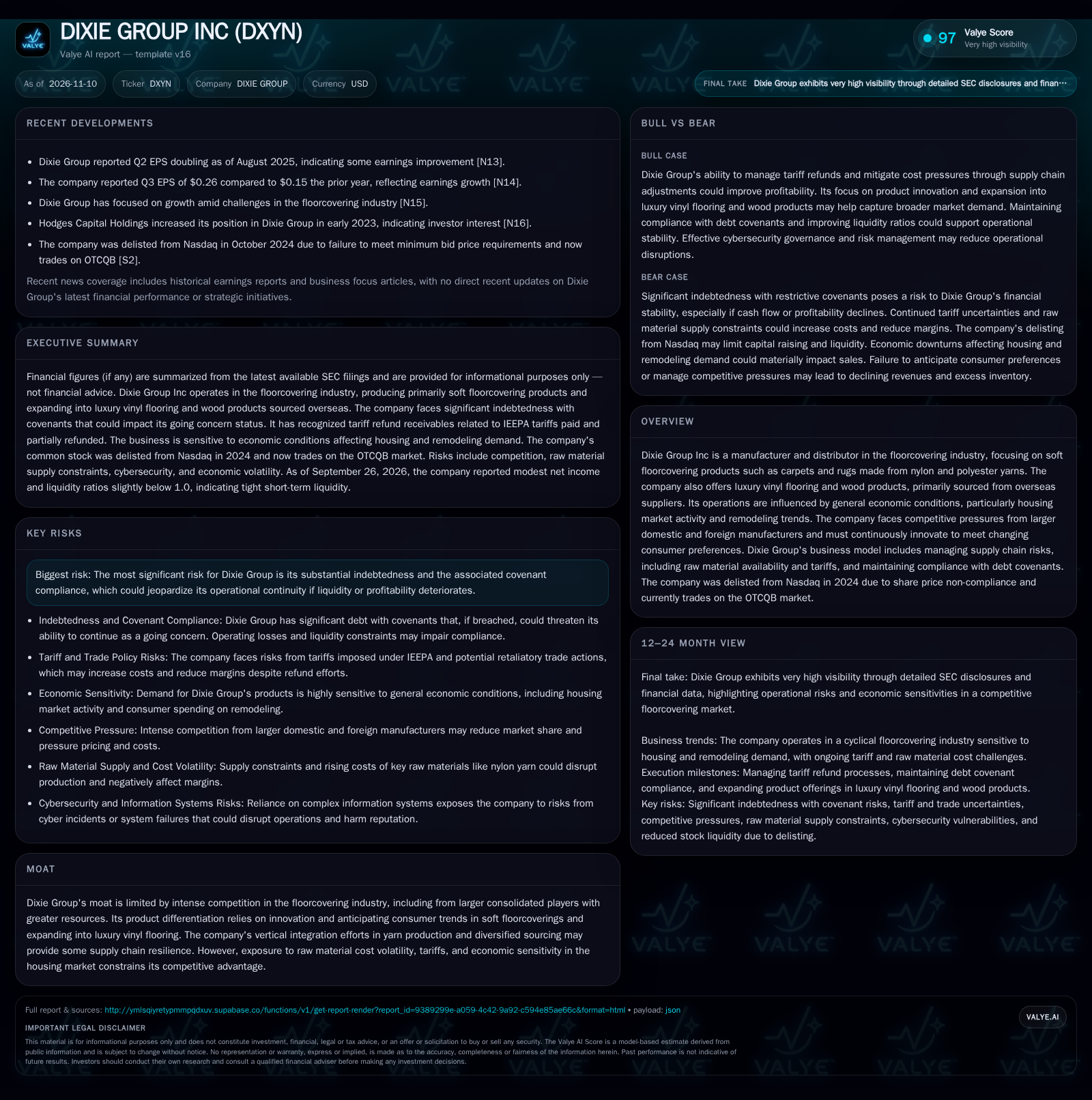
Dixie Group posted a slim profit in Q3 2026 and recognized significant tariff refund reversals, but faces a current ratio below 1.0, persistent debt covenant pressure, and ongoing supply chain volatility. Its strategic pivot toward luxury vinyl and wood flooring may expand addressable markets, but execution risks and intense competition persist. The future hinges on managing liquidity, innovating product lines, and maintaining compliance as the industry contends with economic cyclicality and shifting consumer demand. [S2]
The ongoing pivot toward luxury vinyl and wood flooring is a strategic response to evolving consumer preferences and competitive pressures, yet execution risk remains high as raw material volatility, indebtedness, and the aftereffects of a 2024 Nasdaq delisting shape the near-term outlook. The company’s ability to balance innovation, cost control, and covenant compliance will be decisive in determining whether this is a sustainable turn or merely a brief respite. [S2]
Financial Position and Strategic Initiatives Shape Near-Term Prospects
Dixie Group reported Q3 2026 revenue of $65.2 million and net income of $577,000, marking a modest return to profitability after ongoing market and operational headwinds. This result was supported in part by the recognition of $3.3 million in cost of sales reversals tied to tariff refunds, highlighting the company’s exposure to trade policy and its ability to recover prior costs. As of September 26, 2026, Dixie’s cash balance stood at $3.7 million, with current assets of approximately $107 million and current liabilities of $111 million, yielding a current ratio of 0.96 and a cash ratio of just 0.03. These figures underscore persistent liquidity pressure and the need for careful working capital management. The company’s delisting from Nasdaq in 2024, now trading on OTCQB, further restricts market access and may complicate capital raising. [S2]
Product Mix, Cost Management, and Debt Profile Influence Earnings Potential
Dixie Group’s revenue is generated from sales of soft floorcoverings (carpet and rugs) and an expanding portfolio of luxury vinyl flooring (LVF) and wood products. The economics of these segments differ: carpets are typically lower-margin and more commoditized, while LVF and wood can offer higher margins but come with greater exposure to import tariffs, shipping costs, and currency risk. The company’s cost base is heavily influenced by raw material inputs, especially nylon yarn, where recent supply constraints and price inflation have pressured gross margins. Operating leverage is present but limited by the cyclical and competitive nature of the industry. Fixed costs include manufacturing overhead, debt service, and compliance expenses linked to covenant-heavy loan agreements. [S2]
Profitability may be episodically improved through tariff refunds or supply chain windfalls, but sustainable margin expansion would require either a favorable shift in product mix (toward LVF/wood or premium carpet offerings), durable cost reductions, or improved pricing power—each of which is challenged by industry structure and consumer price sensitivity.
Operating Amid Consolidation and Resource Demands in the Floorcovering Sector
Dixie Group operates in a highly competitive landscape dominated by larger domestic and international manufacturers with greater scale, deeper distribution, and broader product portfolios. The recent trend toward industry consolidation has increased the resource gap between Dixie and its largest rivals. These competitors often benefit from better raw material procurement terms, more efficient logistics, and stronger brand/channel relationships, making it difficult for smaller players to compete solely on price or assortment.
Dixie’s competitive strategy has centered on product innovation and design differentiation, particularly in the premium and fashion-oriented segments of soft flooring. The move into luxury vinyl and wood flooring is an attempt to capture growth in faster-growing, design-driven categories, but this pivot also exposes the company to new competitive threats—including import risk, regulatory scrutiny over sourcing practices, and the need to manage inventory and quality across a global supply chain. Customer loyalty in flooring is typically low, with switching costs modest except for highly specified commercial installations. This keeps pricing power and retention fragile in most residential channels.
Margin Recovery Possible Through Tariff Adjustments and Product Innovation
A favorable scenario for Dixie Group would involve successful recovery of the remaining tariff refunds, ongoing cost moderation in key raw materials, and effective execution on the expansion into luxury vinyl and wood flooring. If the company can sustain or improve its product mix toward higher-margin categories and capture incremental market share in design-driven segments, operating margins could rebound. Evidence for this scenario would include a sequential improvement in gross margin (excluding one-time tariff reversals), a rising share of revenue from LVF/wood, and a return to a current ratio above 1.0, indicating improved liquidity. [S2]
Additional upside would be signaled by new customer wins or partnerships in the premium residential or commercial channel, successful integration of supply chain technology to mitigate disruption risk, and evidence of positive free cash flow generation supporting debt repayment. This would suggest that Dixie Group is not only surviving but adapting to industry shifts with strategic agility.
Persistent Structural Challenges Limit Profitability Expansion
The most plausible outcome is that Dixie Group continues to operate under significant liquidity and competitive pressure, with modest profitability sustained through a combination of cost vigilance and incremental product innovation. Tariff refunds and episodic supply chain relief may provide short-term margin support, but persistent indebtedness and covenant compliance requirements limit strategic flexibility. [S2]
In this scenario, the company’s product mix shifts gradually toward LVF and wood, but margin expansion is offset by ongoing raw material volatility and pricing pressure from larger rivals. Liquidity ratios remain tight, with working capital management a constant focus. Any economic downturn or housing market slowdown would quickly translate into sales declines, given the sensitivity of flooring demand to remodeling activity and consumer confidence. Confirmation of this scenario would come from stable revenue in the $60–70 million quarterly range, continued low but positive net income, and no significant improvement in liquidity metrics.
Operational Stress Risks Rise with Liquidity Deterioration and Covenant Pressures
The key risk is that persistent margin pressure from rising raw material costs, renewed tariff exposure, or a drop in housing/remodeling activity erodes operating cash flow to the point that Dixie Group cannot maintain compliance with debt covenants. [S2]
This scenario would be confirmed by a return to net losses, further deterioration in the current or cash ratio, an increase in short-term borrowings, or explicit disclosures of covenant breaches or going concern warnings. Additional downside would be signaled by inventory build-up (indicating demand shortfall), loss of key customers, or regulatory actions impacting imported goods. Delisting from Nasdaq exacerbates the risk by limiting access to equity capital or institutional investors.
Factors Influencing the Success of Dixie Group’s Strategic Transformation
Quarterly gross margin trends, especially excluding one-time tariff reversals, to assess underlying profitability and cost control.
Product mix evolution—specifically, the share of revenue from luxury vinyl and wood flooring compared to traditional soft floorcoverings.
Disclosure of any new covenant compliance issues, waivers, or amendments in SEC filings.
Raw material cost trends and supply chain disruptions, particularly for nylon yarn and imported LVF/wood (if disclosed).
Evidence of successful product launches or channel expansion in higher-margin categories—new customer wins or partnerships would help test the thesis.
Any progress or setbacks in tariff refund recoveries, as these have a direct impact on cash flow and reported margins.
Stock trading volume and price volatility on the OTCQB, as a gauge of market confidence and capital access.
Disclaimer: This is research-only, informational analysis and not investment advice. It may include AI-generated interpretation and general industry context. Always verify important details using primary sources.

Comments