
Electronic Arts Adapts Growth Amid Merger Uncertainty and AI Expansion
EA balances its franchise-driven live service model with merger-imposed constraints while pursuing AI-led development innovation in a competitive gaming landscape.
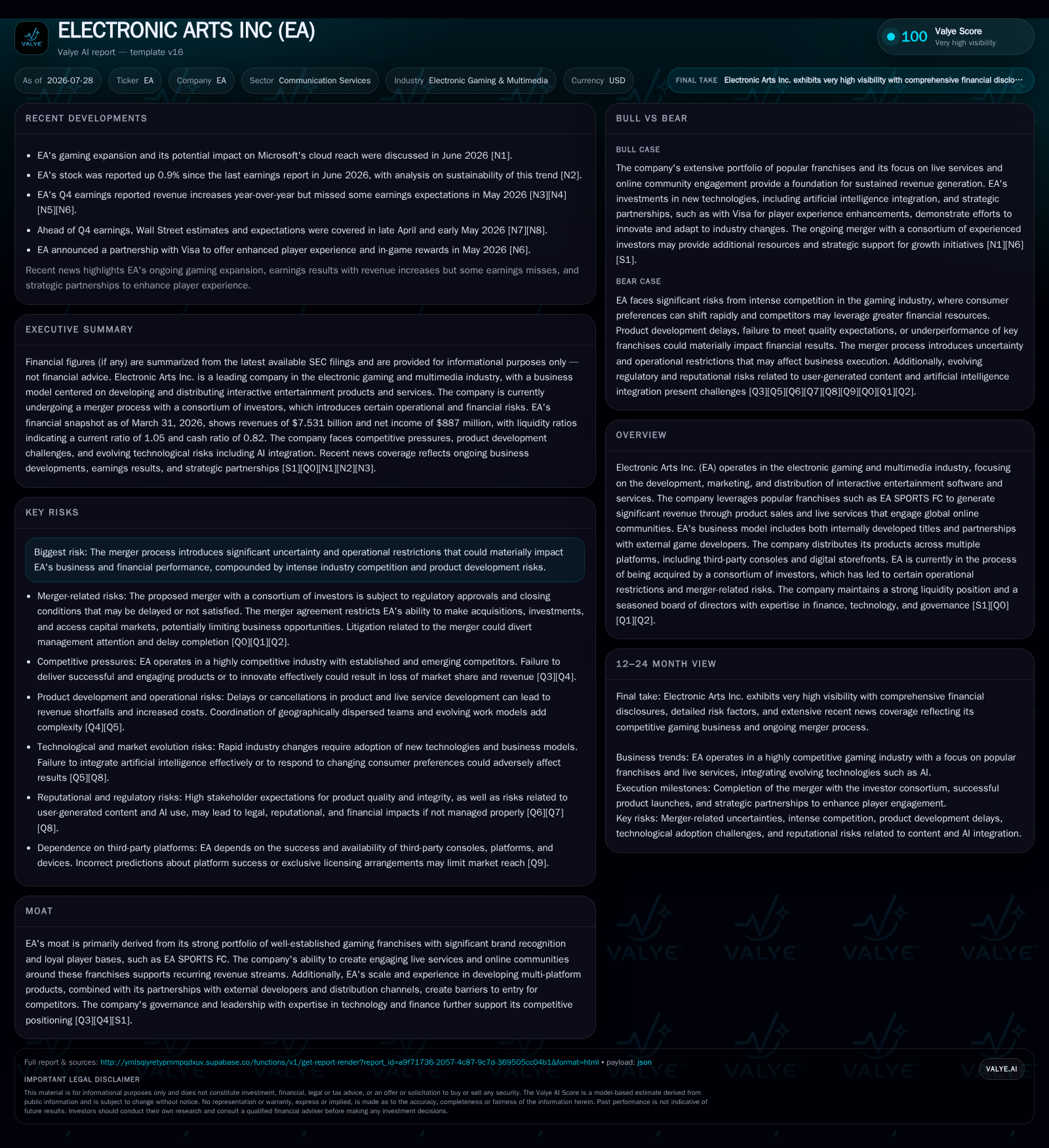
Electronic Arts continues to derive substantial revenue from its franchise portfolio, particularly the EA SPORTS FC series, leveraging live services and multiplatform digital distribution to maintain engagement and recurring streams. The pending acquisition by an investor consortium imposes operational and capital restrictions that limit strategic flexibility and heighten uncertainty impacting talent retention and deal execution. Meanwhile, EA is actively advancing a bold generative AI strategy aimed at increasing game development efficiency and expanding player experiences, positioning itself competitively amid intensifying industry dynamics driven by peers such as Activision Blizzard and Take-Two Interactive. Key risks include delays in product launches, evolving regulatory scrutiny on monetization models, and successful merger completion.
Merger Conditions Reshape Operational Freedom and Talent Dynamics
Electronic Arts' current operating environment is significantly shaped by its pending acquisition by a consortium comprising the Public Investment Fund, Silver Lake Group affiliates, and Affinity Partners. The Merger Agreement imposes restrictions preventing EA from making acquisitions or accessing debt and equity markets without consortium consent until deal closing targeted for the first quarter of fiscal 2027 [S2][S7]. This limitation directly constrains EA's ability to pursue opportunistic deals or strategic investments during this pendency window.
Such operational constriction also translates into elevated uncertainty among stakeholders. The company acknowledges risks that this ambiguity could impair its capacity to attract and retain key talent—a vital consideration given the highly specialized nature of game development roles—while also potentially disrupting relationships with customers, suppliers, and financial partners [S2]. These factors collectively amplify execution risk near-term. Progress on regulatory approvals remains a critical confirmation point for mitigating these risks ahead of deal closure [S7].
Franchise IP Strength Underpins Recurring Revenue during Intense Competition
Despite these constraints, EA continues to generate substantial recurring revenues primarily anchored by its flagship franchises. The EA SPORTS FC series remains a cornerstone revenue driver due to consistent user retention anchored by features such as Ultimate Team—a live service incorporating microtransactions that foster ongoing player spend beyond initial product sales [S1][S10]. This franchise-based reliance delivers relatively predictable cash flow yet exposes EA to disproportional risk should product quality issues or competitive encroachments emerge
Retention rate is a pivotal KPI here: maintaining stable active monthly users (MAU) within these franchises supports a strong average revenue per user (ARPU) through penetrated in-game purchases [S13]. Peer companies like Activision Blizzard with Call of Duty series or Take-Two Interactive with NBA 2K alike demonstrate the centrality of deep brand loyalty intertwined with live services for recurring monetization. In comparison, EA’s sustained success in managing marquee IP supports its moat but underscores pressure from newer titles challenging entrenched consumer time budgets
Leveraging GenAI: Innovating Game Development Efficiency and Expansion
Significantly, EA is deploying an assertive generative AI (GenAI) strategy aimed at transforming its game development capabilities. The company reports achieving approximately 10% progress on goals aligned to transformation—including establishing AI partnerships, developing an investment framework around GenAI technologies, advancing research efforts, creating novel gameplay narratives, and setting explicit internal adoption milestones [S1].
This technological pivot addresses an industry-wide challenge: long development cycles characterized by high fixed costs which can delay revenue realization. By integrating advanced AI tools into creative processes—from concept design through quality assurance—EA positions itself not only to accelerate production timelines but also enhance innovation potential that may uplift engagement metrics over time. Confirmation of these benefits will lie in observing reduced cycle length KPIs alongside margin trends reflective of improved R&D productivity.
Multiplatform Publishing and Digital Distribution Sustain Player Reach
EA’s diversified distribution model encompasses multiple platforms including major third-party consoles (PlayStation, Xbox), PCs via digital storefronts (Origin/Epic/GOG), mobile devices, as well as emerging cloud gaming services. This multiplatform approach is foundational in navigating shifting consumer device preference trends while maximizing total available audience reach [S1].
The transitioning industry mix increasingly favors digital sales channels supported by subscription models and live service frameworks—segments characterized by higher gross margins relative to physical retail. This shift also enhances user acquisition dynamics where digital storefronts enable constant engagement touchpoints through downloadable content (DLC) releases, timed content drops, and microtransaction updates.
By contrast with some peers more focused on console exclusives or mobile-only strategies (e.g., Ubisoft emphasizing multi-genre PC plus consoles; Sony Interactive Entertainment investing heavily into exclusive console content), EA’s broad channel footprint mitigates concentration risk but demands ongoing platform partnership management.
Live Service Engagement Metrics Illuminate Revenue Resilience Challenges
Operationally critical are metrics tracking user engagement within live services: active monthly users (MAU), retention rates over successive time periods post-acquisition or launch, penetration rates of in-game purchases, along with subscription count trajectories where applicable. These KPIs serve as immediate signals of revenue durability amid volatile gamer preferences.
EA’s disclosures reflect stable engagement targets met within franchises like Battlefield 6 post-launch milestones along with EA SPORTS FC meeting specified retention thresholds across core markets [S20]. However, reliance on a narrow set of franchises elevates vulnerability to any adverse shifts—from competitive offerings eroding playtime share to regulatory scrutiny limiting monetization instruments like loot boxes or virtual currency sales.
Peer benchmarking emphasizes how leading publishers invest heavily not only in content refresh cadence but also sophisticated in-game economies designed to optimize lifetime value per player—a competitive battlefield where failing to innovate can quickly erode audience loyalty.
Growth Prospects via Digital Adoption Offset by Merger-Related Limitations
Macro growth drivers remain fundamentally favorable: expansion of digital marketplaces worldwide eases entry barriers; rising acceptance of subscription gaming models fosters predictable top-line streams; mobile plus cloud segments continue gaining traction globally; esports popularity drives ancillary monetization avenues. Additionally, technological advances such as cross-platform multiplayer cultivate larger interconnected communities incentivizing stickiness.
Nonetheless, EA’s near-term capacity to capitalize on these tailwinds is mitigated by the capital market access curtailments owing to the pending acquisition agreement restricting borrowings or equity issuances absent consortium approval [S2]. This constraint limits aggressive marketing spending or ancillary studio investments compared with more nimble peers unencumbered by such governance restrictions.
Consequently, while structural secular trends endorse an optimistic medium-term growth outlook linked to live service expansion powered by digital delivery innovations, transactional leverage casts a shadow over unbridled strategic aggressiveness until closing conditions fully resolve.
Risks: Product Timing, Regulatory Environment, Merger Execution, and Talent Retention
EA faces multifaceted risk exposures underscored repeatedly across filings. Product timing risk remains material as missed development schedules or launch delays can materially impact quarterly revenues owing to seasonality inherent in major title rollouts [S10][S15]. Game development complexities magnify this vulnerability given global dispersed teams requiring agile coordination alongside creative inspiration moderated by evolving player feedback loops
Regulatory uncertainty has intensified surrounding virtual goods monetization—particularly loot boxes labeled akin to gambling in several jurisdictions—posing compliance cost increases or outright monetization prohibitions threatening established in-game economies [S26]. Additionally, intellectual property disputes remain an ongoing legal exposure area.
The execution importance of completing the pending merger looms large—inability or delay injects disruption costs including elevated professional fees already incurred close to $1 billion potential termination fees—and possible operational dislocation affecting stock price performance plus stakeholder confidence [S2][N1][N3]. The confluence of merger-induced restrictions together with industry competition pressure further complicate talent retention efforts pivotal for creative continuity.
"Watching the Close": Milestones in Regulatory Approval and Post-Merger Integration Plans
Monitoring progression through final regulatory gatekeeping stages represents a critical near-term focus area impacting strategic clarity for all stakeholders. The expiration of Hart-Scott-Rodino antitrust waiting periods occurred on February 9th 2026 clearing one hurdle; however additional regulatory permissions remain outstanding as conditions precedent mandated under the Merger Agreement with anticipated closing calendar Q1 FY2027 [S7]
Successful consummation will re-open flexibility windows allowing renewed access to capital markets alongside accelerated decision-making breadth—enabling more assertive participation in evolving competitive dynamics including M&A ventures or increased R&D spend targeting frontiers such as immersive AI applications within gameplay ecosystems.
Conversely delayed closure or termination would perpetuate operational restrictions prolonging heightened uncertainty likely exacerbating retention challenges combined with possible negative market valuation adjustments.
Financial Profile Discussion: Revenue Stability Meets Margin Pressures Against Investment Priorities
Liquidity metrics remain healthy evidenced by a current ratio slightly above one at ~1.05 supported by over $2.7 billion cash reserves offsetting low nominal debt load predominantly from dated issuances distant from current balance sheet dates—yielding net cash positive position fundamental for operational resilience throughout transactional interregnum phases [F1][S22][S24]
Disclaimer: This analysis is intended solely for informational purposes reflecting evidence publicly disclosed up to July 2026 without offering investment advice or research views.
Disclaimer: This is research-only, informational analysis and not investment advice. It may include AI-generated interpretation and general industry context. Always verify important details using primary sources.

Comments