
Sun Communities Strengthens Core Affordable Housing Assets with Strategic Capital Moves
Sun Communities balances aggressive portfolio optimization and operational discipline amid a significant UK holiday parks impairment.
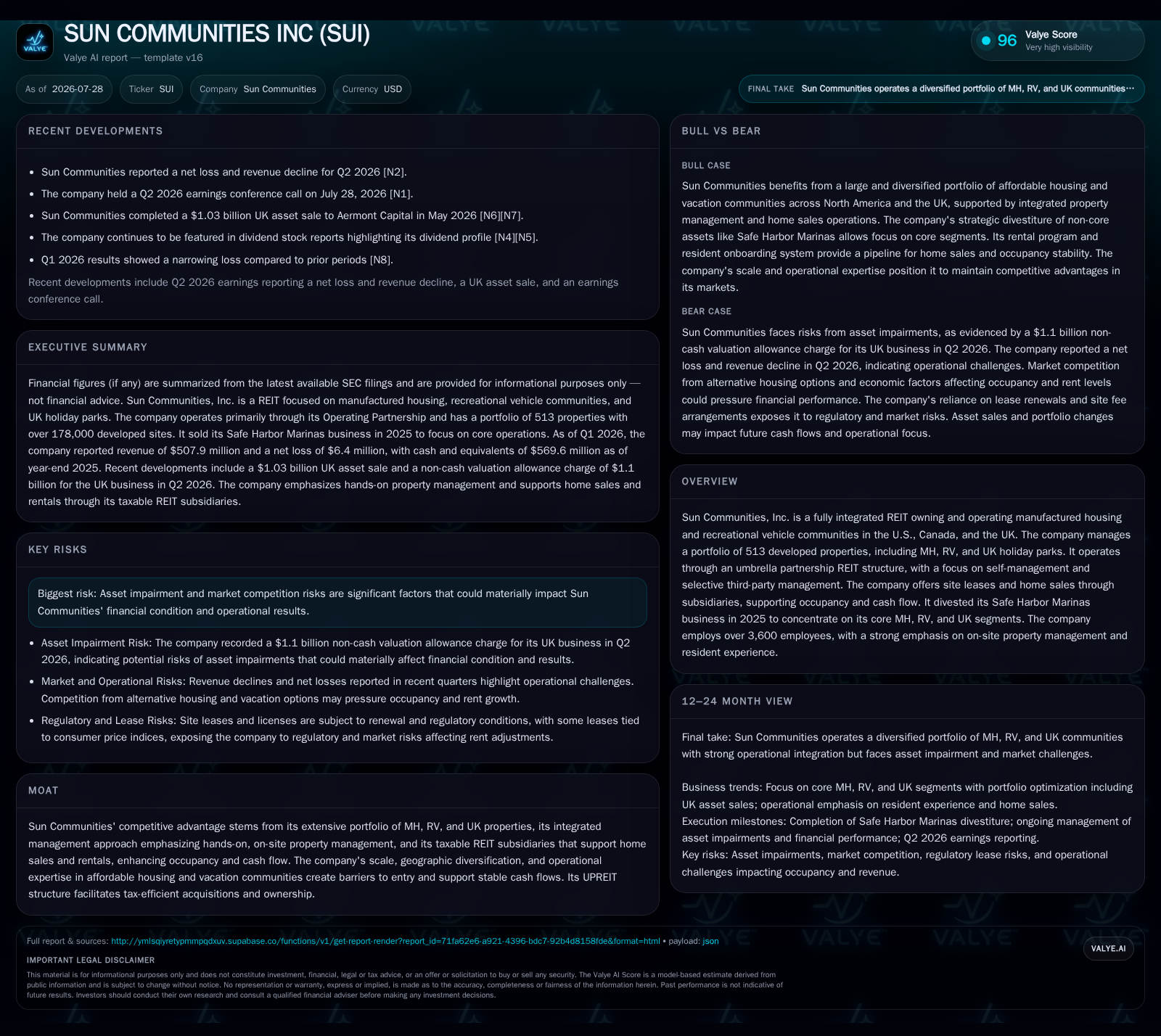
Sun Communities reported a $1.1 billion non-cash impairment charge on its UK holiday parks in the Q2 2026 filing, demonstrating localized pressures within this segment. The company continues to double down on its core manufactured housing (MH) and recreational vehicle (RV) communities through targeted acquisitions, home sales via its taxable REIT subsidiary, and enhanced property management. Despite geographic concentration risks and economic headwinds, Sun's strategic capital allocation and integrated business model underpin stable occupancy and funds from operations.
Impairment Recognition Signals Pressure on UK Holiday Parks but Aligns Portfolio Focus
In the second quarter of 2026, Sun Communities recorded a significant non-cash goodwill impairment charge of approximately $1.1 billion related to its UK holiday parks segment [S2]. This impairment reflects a reassessment of the expected future cash flows from these seaside properties predominantly located in southern England, where market softness and evolving consumer preferences have pressured valuations. The charge aligns with Sun’s strategic focus on portfolio optimization, signaling a deliberate shift away from underperforming or lower-return assets in the UK holiday parks toward strengthening its core manufactured housing (MH) and recreational vehicle (RV) communities in North America [S3]. While geographic diversification across the U.S., Canada, and the UK offers scale benefits, the UK holiday parks segment remains exposed to fragmented market dynamics and recent economic headwinds affecting leisure travel demand, which have contributed to the impairment and underscore valuation risk [S2].
Core Business Model Anchored in Site Leases Supported by Taxable REIT Subsidiary Home Sales
Sun Communities operates as a fully integrated real estate investment trust (REIT) owning and managing a portfolio of 513 developed properties comprising 294 MH communities, 166 RV communities, and 53 UK holiday parks as of December 31, 2025 [S1]. The company’s primary revenue driver is recurring rental income generated from leasing individual land parcels or sites equipped with utilities to residents and vacationers. These site leases provide stable net operating income (NOI) underpinned by long-term occupancy trends and lease renewal rates, which are critical KPIs in the MH and RV community REIT sector [S1].
Complementing rental operations, Sun’s taxable REIT subsidiary (TRS), Sun Home Services, markets, sells, and leases new and pre-owned manufactured homes within its MH communities. This vertical integration supports occupancy by lowering barriers to entry for prospective residents who can purchase homes directly connected to leased sites, thereby enhancing resident retention and increasing funds from operations (FFO) per share [S1]. The combined revenue streams from site leases and home sales create operational leverage and reduce volatility relative to peers reliant solely on rental income.
Operational Advantage Derived from Self-Managed Property Platform
A key competitive advantage for Sun Communities is its predominantly self-managed property platform, which covers approximately two-thirds of its portfolio [S1]. Employing over 3,600 full- and part-time staff, the company maintains direct control over property management functions including resident services, lease administration, maintenance, and amenity operations [S1]. This hands-on approach fosters stronger resident relationships, contributing to higher lease renewal rates—a vital factor for sustaining occupancy and NOI stability in the manufactured housing sector.
Direct operational control also enables Sun to manage site-level operating expenses more effectively, including utilities, maintenance, insurance, and property taxes, compared to competitors that outsource management or rely on ground lease arrangements. The company’s investment in community amenities further enhances resident satisfaction and supports pricing power, which can translate into same property NOI growth over time [S1]
Industry Competition and Geographic Concentration: Balancing Risks
Sun Communities competes with other MH and RV community REITs and faces indirect competition from alternative housing options such as apartments and site-built single-family homes, which vie for similar affordable housing demand [S1]. Regulatory and zoning constraints limit new community development in many markets, adding supply-side challenges but also protecting existing community values.
Geographically, Sun’s portfolio is concentrated with approximately 26.4% of developed sites in Florida, 19.4% in Michigan, 12.1% in the UK, 6.1% in Texas, and 4.9% in California [S1]. This concentration exposes the company to localized economic risks including weather-related disruptions in Florida and industrial shifts in Michigan that could impact occupancy rates and rental pricing. Currency fluctuations between the U.S. dollar and British pound sterling add further volatility risk specific to the UK holiday parks, as evidenced by the recent impairment charge [S2][S3].
Growth Path Driven by Acquisitions, Home Sales, and Amenities Investment
Following the strategic divestiture of the Safe Harbor Marinas business, which generated net cash proceeds of approximately $5.5 billion in 2025, Sun has prioritized portfolio optimization and accretive growth investments [S1]. In 2025, the company acquired 11 MH and three RV communities for a total cash consideration of $457 million, primarily funded through 1031 exchange escrow accounts to defer tax liabilities [S1].
Capital reinvestment in property improvements and amenities aims to enhance resident experience and support lease renewal rates, contributing to organic NOI growth. Additionally, Sun repurchased titles to 32 UK properties previously held under ground leases for $386.8 million, reducing financial liabilities and simplifying ownership structures to improve operational control [S1]
Home sales through the TRS remain a vital revenue channel, though success depends on favorable financing conditions for buyers [S1]. Tightening credit markets and rising interest rates pose challenges to affordability, which could constrain home sales volumes and margins, impacting overall FFO growth
Risks Include Economic Sensitivity, Impairments, and Financing Environment
Sun Communities faces risks from economic downturns that could depress occupancy and rental rates, particularly in key states like Florida and Michigan where local economic conditions heavily influence resident demand [S1]. Rising operating expenses, including property taxes, insurance premiums, and utilities, may pressure site-level margins.
Asset impairment risk remains a material concern, highlighted by the recent $1.1 billion goodwill write-down in the UK holiday parks segment [S2][S3]. This reflects the sensitivity of asset valuations to market conditions, consumer preferences, and leisure travel trends in a fragmented UK market
Furthermore, the availability and affordability of financing for manufactured home purchasers are critical to sustaining TRS home sales revenue [S1]. Heightened lending criteria and increased repossession rates could reduce demand for new home sales, indirectly affecting occupancy and cash flow stability
What to Watch Next: Occupancy Trends, Rate Growth, Asset Quality Signals
Key operating metrics to monitor include occupancy rates across MH, RV, and UK segments, as these directly influence rental revenue and NOI [N1][N2]. Same property NOI growth provides insight into organic property performance excluding acquisitions or dispositions. Lease renewal rates serve as an intermediate indicator of resident retention and pricing power, while home sales volumes and margins from the TRS offer early signals of consumer affordability and demand dynamics
Additional impairment announcements, particularly within the UK holiday parks, would warrant close attention given their potential to affect asset valuations and market sentiment [N2]. Portfolio activity such as acquisitions and dispositions will also reflect management’s confidence in core asset classes and strategic direction [N3].
Financial Profile Discussion: Capital Structure, Cash Flow Stability, Recent Impairments Impact
The recent $1.1 billion non-cash impairment charge related to the UK holiday parks does not impact liquidity but signals the need for ongoing vigilance regarding asset valuation and cash flow trends [S2]. Maintaining strong same property NOI growth and occupancy rates will be essential to underpin adjusted funds from operations (AFFO) and support the company’s balanced capital allocation strategy, which includes acquisitions, property improvements, and shareholder returns
Sun’s financial policy reflects a conservative approach to leverage combined with targeted reinvestment in high-quality affordable housing assets, positioning the company to navigate macroeconomic uncertainties while pursuing sustainable cash flow growth [S1]
This analysis is based solely on available SEC filings dated through July 28, 2026 ([S1], [S2], [S3]), company facts data ([F1]), and related market commentary ([N1], [N2], [N3]). It incorporates industry-standard KPIs relevant to manufactured housing and recreational vehicle community REITs without providing investment advice or price forecasts.
Disclaimer: This is research-only, informational analysis and not investment advice. It may include AI-generated interpretation and general industry context. Always verify important details using primary sources.

Comments