
Highwoods Properties Advances Portfolio Optimization and Strengthens Capital Structure in Q2 2026
Recent sales and financing actions underscore Highwoods’ strategic focus on core office markets amid evolving leasing dynamics and interest rate considerations.
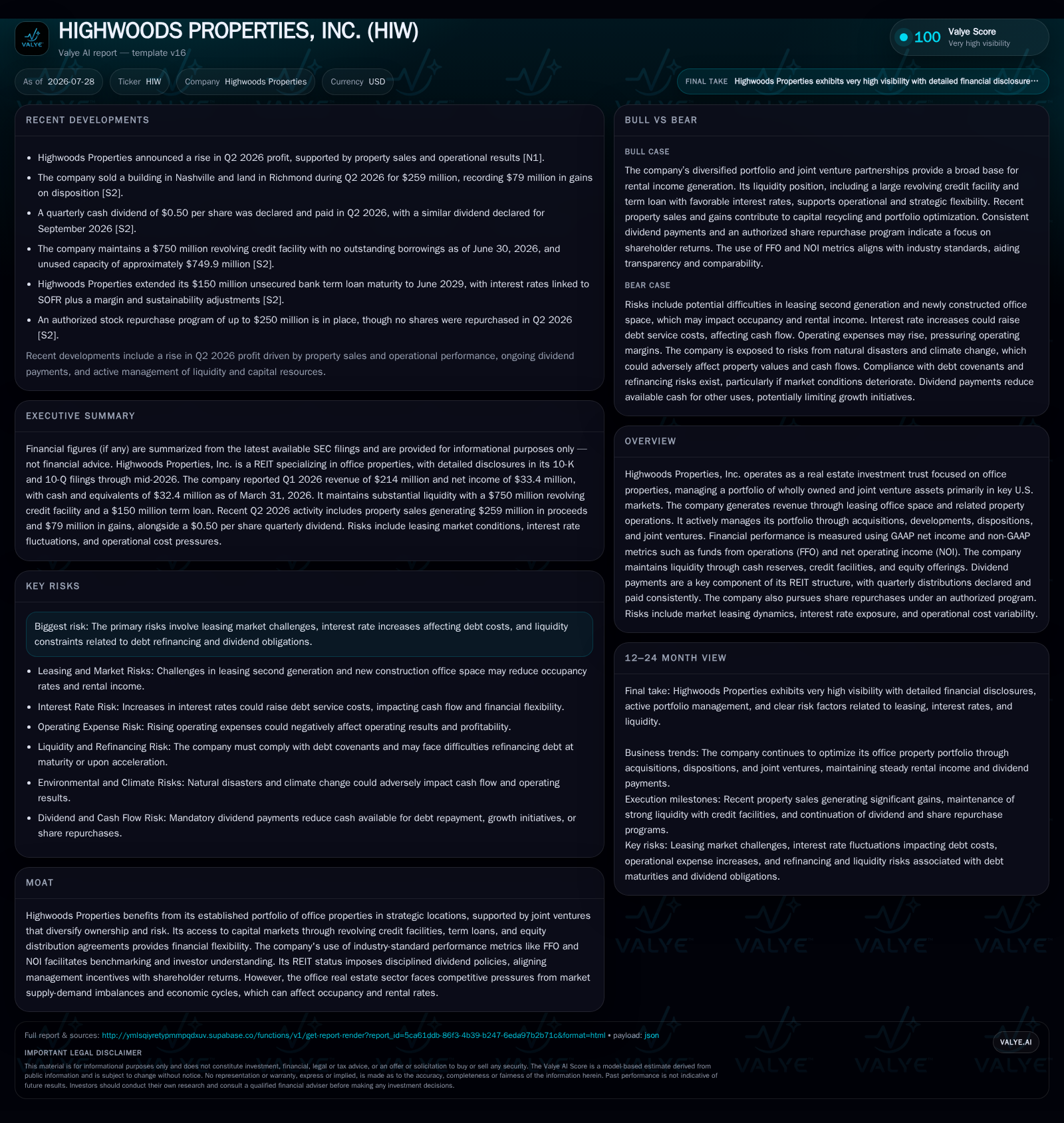
In Q2 2026, Highwoods Properties generated solid gains from the disposition of non-core assets totaling $259 million, reinforcing its commitment to portfolio optimization. The company also enhanced its capital structure through secured joint venture loans with fixed interest rates and extended unsecured bank term loan maturities. Despite persistent office sector challenges, Highwoods maintains stable leasing operations, a disciplined dividend policy, and liquidity buffers including a nearly $750 million unused revolving credit facility, positioning it to navigate market uncertainties while pursuing growth via acquisitions and developments.
Recent Operating Update
During the second quarter of 2026, Highwoods Properties (HIW) strategically intensified its portfolio optimization efforts by disposing of a building in Nashville and land in Richmond for an aggregate price of $259.0 million, resulting in recognized gains totaling $79.0 million [S2], signaling the company’s continued focus on shedding non-core assets typically defined by location, age, or quality factors [S1]. This active capital recycling reflects management’s response to persistent structural shifts and competitive pressures within office markets, particularly amid supply-demand imbalances.
Supporting growth initiatives and risk management, two major joint ventures—Midtown East and Granite Park Six—secured significant longer-term financing during the quarter. Midtown East obtained a $44.8 million secured loan to refinance construction debt plus an additional $10.9 million line of credit, both bearing interest fixed effectively at 6.3% via rate hedges maturing in July 2036 [S2]. The Granite Park Six venture drew $86.6 million from a secured loan with an effective fixed interest rate of 5.9%, used primarily to redeem preferred equity previously contributed by Highwoods and redistributed remaining proceeds to partners [S2]. These financing moves reduce short-term repricing risk; notably, such interest rate hedges are prudent against prevailing uncertainties in variable-rate exposure for property-level debt.
On the unsecured debt front, Highwoods extended the maturity on a $150 million unsecured bank term loan from May 2027 to June 2029 at an interest rate of SOFR plus 90 basis points, with options for further extensions contingent on no defaults occurring [S3][S6]. The extension offers increased capital flexibility amid a still-evolving interest rate environment affecting borrowing costs across the REIT sector.
The Board also authorized a new stock repurchase program allowing for up to $250 million in buybacks to be financed through proceeds from non-core asset sales combined with available cash or credit facilities; however, no shares were repurchased during Q2 itself [S9]. This program signals capital return discipline but maintains operational flexibility.
Business Model Specifics
Highwoods operates as an equity REIT specializing in commercial office properties located across key U.S. markets. Its revenue stems mainly from leasing office space coupled with ancillary property services using long-term lease contracts that often include scheduled rental escalations and tenant reimbursement mechanisms for operating expenses.
The portfolio mix includes wholly owned assets as well as joint ventures that allow risk sharing and capital efficiency while preserving exposure to strategic growth corridors. Leasing metrics such as occupancy rate, average rental rate per square foot, lease renewal percentages, and tenant-credit quality materially influence recurring income streams measured by Net Operating Income (NOI) and Funds From Operations (FFO), which adjust GAAP results by excluding non-cash depreciation of real estate assets.
Property capital expenditures are targeted toward tenant improvements and building upgrades aimed at maintaining competitiveness in increasingly amenitized office environments that tenants prioritize amidst hybrid work trends.
Dividend payments adhere to REIT tax compliance requirements mandating distributions of at least 90% of taxable income (excluding net capital gains). As reflected in recent quarterly dividends of $0.50 per share paid consistently since at least 2025 [S1][S18], dividend sustainability is tightly linked to steady rental collections and disciplined cost management.
Industry Position and Competitive Context
Highwoods' position within the office REIT sector places it among peers focused primarily on metropolitan U.S. markets such as Boston Properties and SL Green Realty; however, it distinguishes itself with a mixed model leveraging joint ventures alongside wholly owned properties which can buffer balance sheet leverage while preserving upside participation.
The company's portfolio composition prioritizes quality assets in key growth corridors but faces standard sector-wide headwinds encompassing excess suburban supply relative to urban demand variability, evolving tenant space requirements due to hybrid workforce patterns, and competitive alternatives like coworking spaces.
Financial covenant compliance remains intact even as market volatility poses refinancing uncertainties; the company's recent proactive financing measures—including term loan extensions and interest rate hedging strategies—compare favorably against peers grappling with impending maturities or sharper debt cost escalations.
Growth Drivers
Growth initiatives center on several fronts:
- Economic Recovery & Office Demand: Select office markets benefiting from employment growth spur continued leasing momentum driving same-property NOI stability or growth.
- Portfolio Pruning & Capital Recycling: Disposals such as those completed in Q2 streamline asset mix toward core holdings yielding higher returns.
- Joint Venture Finance: Use of joint ventures combined with secured loans featuring effective fixed rates enhances capital efficiency while enabling participation in development projects without overleveraging balance sheet.
- Development & Reinvestments: Targeted tenant improvements and property upgrades improve competitiveness attracting premium rents in mature markets.
- Equity Offerings & Repurchases: Access to flexible equity distribution agreements supports opportunistic financing matching shareholder return policies including dividends plus buybacks under optimal conditions.
Risks & Watchpoints
Key risks facing Highwoods include:
- Leasing Market Dynamics: Pressure on lease renewals or slower absorption due to evolving tenant preferences or economic softening could erode occupancy or rental increase assumptions critical for NOI stability [S1][S19].
- Interest Rate Exposure: While recent hedge contracts mitigate near-term variable rate risks on specific loans, any future refinancing at elevated rates could raise debt service costs affecting cash flow available for dividends or capital investment [S5][S8].
- Liquidity Constraints: Despite substantial credit lines currently undrawn, unexpected liquidity tightening triggered by covenant breaches or economic shocks would constrain operations or capital activities.
- Development Execution: Delays or cost overruns on projects funded through joint ventures or direct investments could dilute anticipated returns requiring further capital infusion or impair asset economics.
- Competitive Alternatives: Accelerated adoption of remote work models or emergence of alternative workspaces may reduce traditional office demand longer-term.
- Regulatory Changes: Adjustments impacting REIT tax treatment or reporting standards could influence net income recognition or dividend policies.
What To Watch Next
Investors should monitor several milestones:
- Quarterly same-property NOI trends alongside leasing metrics including occupancy rates and average rents indicating market health versus peers.
- Progress on announced non-core asset dispositions beyond Q2’s large transactions affecting portfolio quality and capital availability.
- Execution pace under the stock repurchase program relative to announced authorization size reflecting management views on valuation opportunities.
- Developments regarding refinancing activity particularly as the revolving credit facility matures in January 2028 alongside monitoring for covenant adherence under current market conditions.
- Updates on joint venture project timelines coupled with any material changes in mezzanine/preferred equity funding or secured loan drawdowns impacting leverage ratios.
- Dividend declarations maintaining consistency amidst macroeconomic uncertainties affirming commitment to shareholder returns aligned with REIT obligations [S18]
Financial Profile Discussion
As of March 31, 2026, Highwoods reported cash and equivalents of $32.4 million [F1]. The company’s total debt was approximately $6.7 million as of December 31, 2025, with net debt negative $25.7 million at that date, reflecting a strong net cash position [F1]. The unsecured bank term loan maturity extension from May 2027 to June 2029 at SOFR plus 90 basis points with options for further extensions was confirmed in the June 2026 8-K filing [S3][S6]. Compliance with financial covenants remains current, supported by proactive refinancing and interest rate hedging strategies [S3][S6].
Highwoods’ access to flexible equity distribution agreements established in early 2026 authorizes up to $300 million issuance capacity supporting contingent capital raising potential though no new common shares were issued during Q2 suggesting ready availability without immediate dilution concerns [S2][S9]
This financial discipline combined with diversified financing sources including joint venture funding structures creates resilience allowing Highwoods management discretion over capital deployment balancing shareholder returns with growth investments amid ongoing office market uncertainties.
Disclaimer: This is research-only, informational analysis and not investment advice. It may include AI-generated interpretation and general industry context. Always verify important details using primary sources.

Comments