
Everus Construction Group’s Strategic Transition Fuels Robust Revenue and Margin Expansion
Everus Construction’s spinoff independence and diversified segments underlie strong financial growth and capital discipline.
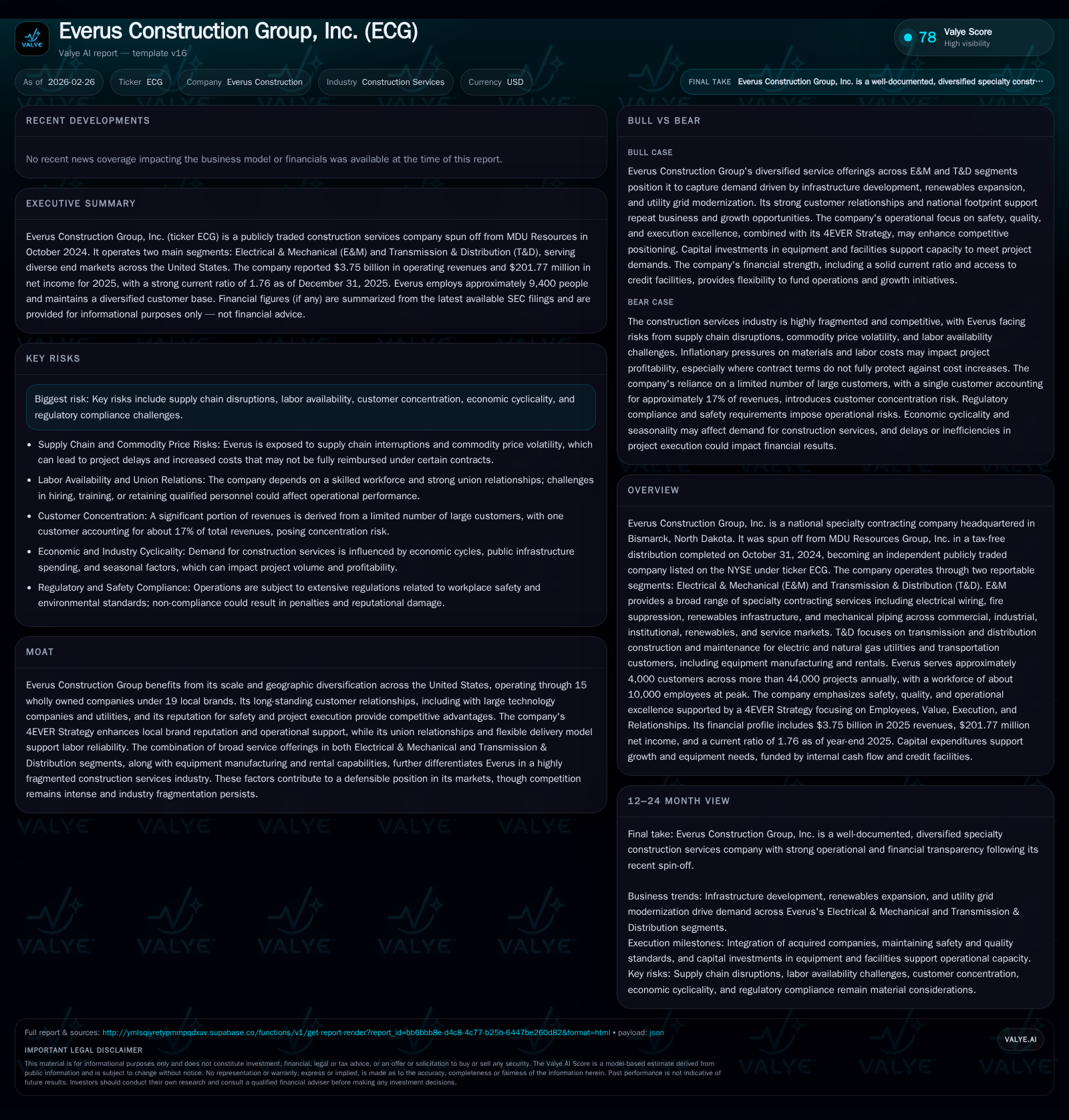
Everus Construction Group emerged as an independent publicly traded company following its 2024 tax-free spinoff from MDU Resources, unlocking operational focus that translated into substantial revenue and operating income growth in 2025. The company benefits from its dual-segment structure—Electrical & Mechanical (E&M) and Transmission & Distribution (T&D)—which delivers a complementary revenue mix and supports margin expansion despite industry complexity. Everus’s capital allocation strategy reflects measured reinvestment amid rising capital expenditures, while leveraging scale, geographic diversification, and strong customer relationships to navigate sector challenges such as supply chain disruptions and labor market tightness.
From Spin-Off to Standalone Success: Evolution of Everus Construction Group
Everus Construction Group transitioned from a wholly owned subsidiary under MDU Resources Group into an independent public company on October 31, 2024 through a tax-free spinoff[S1]. Headquartered in Bismarck, North Dakota, Everus has since concentrated on sharpening operational capabilities across its specialty contracting niche spanning electrical, mechanical, transmission, and distribution services nationwide[S9].
The company’s footprint is composed of 15 wholly owned subsidiaries that operate under 19 local brands. This multi-brand local presence caters to specialized geographic markets while enabling scale economies that reflect a transformation from its regional roots starting in 1997 to ranking as the 12th largest specialty contractor according to ENR's Top 600 list for 2025[S1][S9]. The combination of service depth and broad geographic coverage positions Everus uniquely among U.S. specialty contractors who typically face regional fragmentation.
Independence has further propelled tailored corporate governance and resource allocation designed to drive growth while maintaining localized customer intimacy through their "4EVER Strategy" which reinforces employee engagement, value creation, execution excellence, and relationship building across their operating companies[S9].
Segment Synergies Drive Revenue Mix and Historical Growth
Everus operates two main segments driving its financial performance: Electrical & Mechanical (E&M) and Transmission & Distribution (T&D)[S4][S5][S6]. These segments differ both in client base concentration and typical service scope.
The E&M segment accounted for approximately 77% of total contract revenues in 2025[S10], covering electrical wiring, fire suppression systems installation, renewables infrastructure like solar projects through brands including Bombard Renewable Energy (a top solar installer), mechanical piping across commercial data centers, industrial plants, institutional facilities such as healthcare and education campuses, and service/maintenance markets[S9][S23]. This segment also registered an improved operating margin of roughly 7.5% in 2025 compared to roughly 6.7% the prior year[S10], reflecting better project execution efficiency amid rising revenues.
T&D contributed around 23% of revenues focusing primarily on transmission line construction and maintenance for utilities and transportation clients in Midwestern and Western U.S. markets[S10]. This segment commands higher operating margins (~10.6%) due to specialized equipment manufacturing/rental capabilities along with critical infrastructure projects driven by grid modernization initiatives[S10][S24].
In aggregate, Everus realized a striking year-over-year operating income surge from $189.9 million to approximately $264.8 million (+39.4%) alongside net income rising by over +40%, substantiating the strength granted by diversified contract portfolios across segments[F1]. The company served roughly 4,000 customers via more than 44,000 projects during fiscal year 2025 exhibiting customer breadth supportive of risk dispersion though top customers can represent material single-digit percentages or occasional mid-teens concentration within segments[S4][S25].
Historical performance (annual)
| FY | Net ($mm) | CFO ($mm) | OpInc ($mm) | Capex ($mm) | Net YoY |
|---|---|---|---|---|---|
| 2025 | 202 | 157 | 265 | 67 | +40.7% |
| 2024 | 143 | 163 | 190 | 48 |
Source: SEC companyfacts cache [F1].
Capital returns and efficiency (annual)
| FY | FCF ($mm) | ROE% |
|---|---|---|
| 2025 | 90 | 32.0 |
| 2024 | 115 | 33.9 |
Source: SEC companyfacts cache [F1].
Summary table shows significant earnings growth supported by moderate cash flow stability amid increased capital spending.[F1]
Navigating Project Complexity and Industry Dynamics: Profitability Drivers
Margin improvement at Everus is intimately linked to how it manages project complexity and labor dynamics within a challenging market characterized by high fragmentation[S1][S10]. Larger or more complex projects tend to deliver superior gross profits as they absorb overheads efficiently but come with elevated execution risks such as regulatory delays or unforeseen site conditions — especially within fixed-price contracts common among T&D work where cost overruns directly affect profitability.[S1][S19]
Everus strategically mitigates these risks using design-assist services that integrate early engineering collaboration to optimize project scopes ahead of construction phases while deploying experienced project managers who adeptly handle right-of-way issues often encountered during transmission line builds.
A notable driver is subcontractor utilization which generally depresses margins since subcontracted work yields lower gross profit percentages versus direct labor execution; however, subcontracting provides scalability for peak workloads ensuring timely deliveries when internal workforce capacity limits appear.[S1] Inflationary pressures on copper, aluminum, steel prices plus heightened insurance costs related to increasing wildfire risks have introduced additional cost layers that Everus aims to offset through inflation pass-through clauses embedded contractually where feasible.[S1] Safety reputation bolstered through union partnerships further supports operational continuity amidst labor market tightness[S1][S8].
Looking Ahead: Market Tailwinds, Growth Opportunities, and Constraints
Everus’s markets benefit from structural tailwinds including grid upgrades fueled by aging infrastructure replacement mandates paired with expanding renewable energy installations aligning closely with the bipartisan federal support framework prevalent since the Inflation Reduction Act era – factors expected to sustain demand momentum[N1][S24]. The rise in underground utility placements driven by environmental regulations adds niche demand within T&D excavation/boring services[S5][N2]. Digital infrastructure build-out accompanying AI adoption also stimulates specialized E&M data center electrical works.
However, constraints persist notably from supply chain volatility impacting key materials costs along with sector-wide labor shortages despite the firm's robust union relationships. Rising insurance premiums inflate operational expense bases uncovered fully only if contract adjustments facilitate cost pass-throughs[S1][N6]. Seasonality also introduces challenges due to weather disruptions affecting timely project scheduling intrinsic to construction industries[S1]. Economic cyclicality inherent within infrastructure funding cycles call for vigilance regarding public spending shifts which could temper near-term order inflows.[N7]
Key Milestones to Monitor: Backlog, Customer Concentration, and Contract Wins
Backlog stood at approximately $3.23 billion at the end of 2025 compared with about $2.59 billion the prior year reflecting solid booking momentum although some volatility stems from timing differences linked with contract awards under large MSAs or master agreements commonly maintained with key utility customers[S18][N3]. E&M backlog dominated at nearly $2.84 billion while T&D backlog amounted close to $384 million highlighting where future recognized revenues will emanate.
Customer concentration remains balanced with no one account exceeding low double-digit proportions at the consolidated level but top-10 clients contribute over four-tenths of revenues underscoring some reliance whose retention will be crucial[S4][N2]. Recent quarterly commentary emphasizes continued success in securing multi-year contracts especially with major utility partners reinforcing recurring revenue streams critical for near-term visibility.[N1][N3] The progress executing the "4EVER Strategy" is also visible through incremental enhancements in local brand reputation strengthening competitive standing regionally.[N2] Seasonal risk management combined with effective pipeline conversion will determine backlogged orders translating into profitable revenue metrics.
Capital Allocation Discipline: Balancing Growth Investments with Shareholder Returns
Post-spinoff Everus has demonstrated prudent capital stewardship evident in record-setting equity growth reaching approximately $630 million at year-end 2025 from around $423 million the prior year strongly driven by retained earnings accumulation given robust profitability metrics[F1][S11]. Return on equity estimated near 32% signals efficient equity utilization amid ongoing business expansion.
Operating cash flows totaled $156.8 million but declined modestly versus prior period partially due to working capital increases accompanying rapid revenue growth accelerating accounts receivable balances[F1][S16]. Meanwhile capex jumped substantially by around +38%, primarily deployed toward vehicle fleets, equipment upgrades essential for sustaining large-scale project execution capabilities – including anticipated range projections toward $90-$100 million capex guidance for fiscal 2026 signaling investment intensity tied closely to demand forecasts[F1][S16].
Absence of publicized dividend payouts or share buyback programs thus far indicates focus skewed towards reinvestment for organic growth consolidation rather than immediate returns though this remains monitorable depending on future liquidity positions.[S11][N1] Everus also manages leverage carefully maintaining compliance with credit covenant ratios embedded within its term loan facility initiated at separation hence preserving flexibility for potential bolt-on acquisitions or opportunistic investments[S7].
Risks Embedded in Industry Fragmentation, Supply Chains, and Labor Markets
Despite favorable positioning Everus confronts several tangible risks typical within specialty contracting sectors that might restrain performance upside or create volatility:
- Supply chains remain vulnerable particularly for copper, aluminum raw materials critical for electrical installations exposing the firm to price spikes or procurement delays requiring agile sourcing strategies.[S1]
- Labor market tightness persists even amid union partnerships due to skilled workforce scarcity compounded regionally impacting project ramp-up agility.[N6]
- Customer concentration combined with competitive pressures demands constant innovation in bid structuring emphasizing pre-construction design-assist value add as well as flawless safety records.[N7][S1]
- Regulatory compliance cost escalation including insurance premium inflation tied partly to wildfire risk exposure adds overhead pressures potentially squeezing margins absent full contractual recovery mechanisms.[S1]
- Industry fragmentation breeds aggressive pricing scenarios especially for smaller contracts requiring continuous operational efficiency advancement.[S6]
Investment community analyst coverage reflects neutral outlooks emphasizing balanced opportunities coupled with cautious recognition of sector cyclicality along with execution-centric risk factors shaping future returns profiles.[N6][N7]
This analysis synthesizes publicly available SEC filings along with recent earnings call disclosures without recommending any investment decisions or price targets concerning Everus Construction Group Inc.
Disclaimer: This is research-only, informational analysis and not investment advice. It may include AI-generated interpretation and general industry context. Always verify important details using primary sources.

Comments