
Eline Entertainment Group: The Realities and Stakes of a Zero-Revenue Public Shell
Eline Entertainment Group, Inc. (EEGI) has completed its corporate rehabilitation but remains a dormant shell with no operations, cash, or revenue as of late 2026.
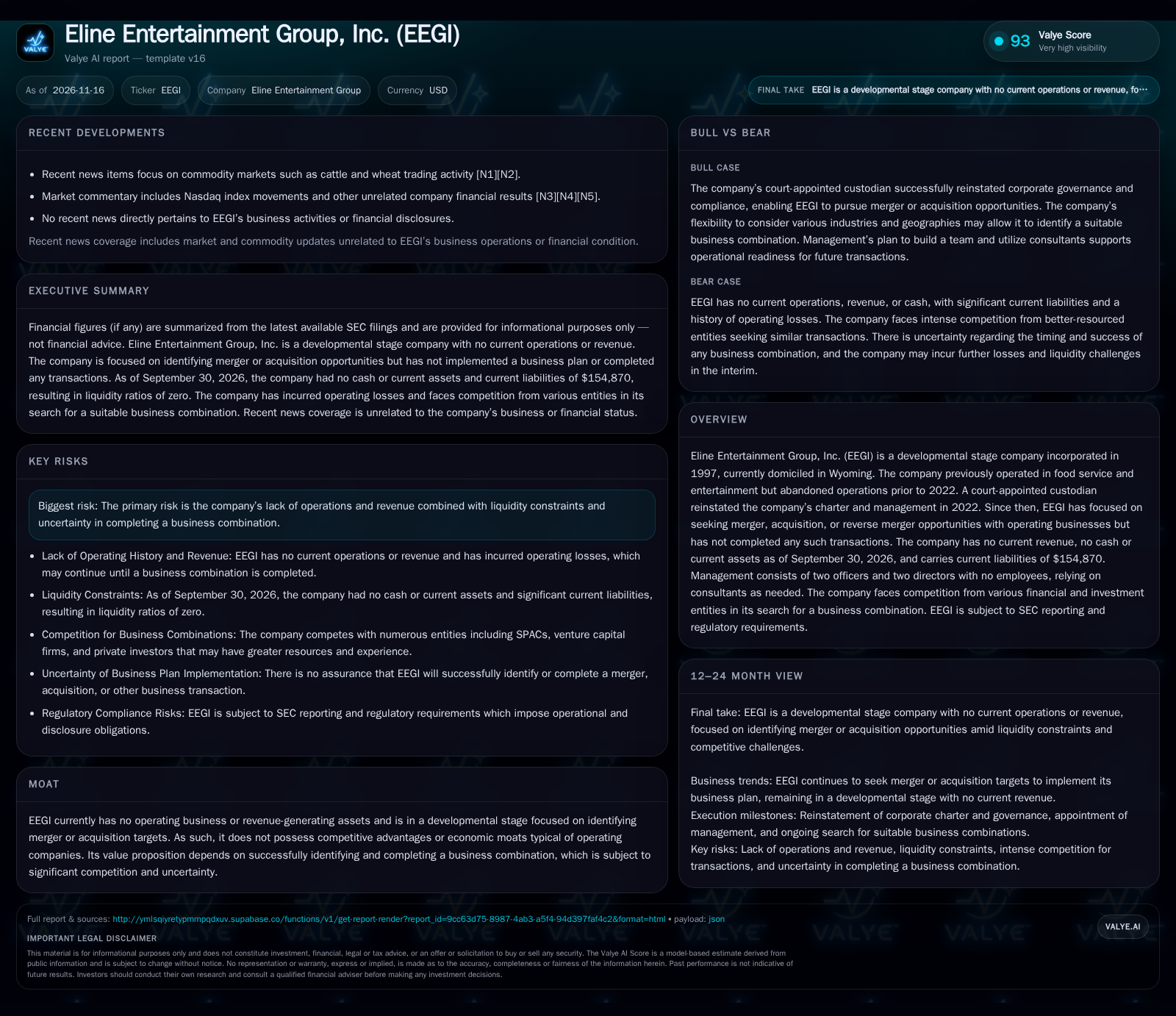
EEGI is a reorganized public shell with no current operations, revenue, or cash, carrying $154,870 in current liabilities. The thesis rests on EEGI's ability to attract a viable partner before liquidity pressures and regulatory costs force further distress or dilution. [S2]
Eline Entertainment Group, Inc. (EEGI) exemplifies the high-risk, high-uncertainty proposition of a public shell company in the aftermath of custodial rehabilitation. With no operations, zero cash, and mounting current liabilities, EEGI’s only path to value creation lies in the successful identification and completion of a merger or acquisition. The next phase for EEGI will test the durability of its public listing and its ability to attract a viable transaction partner against steep odds. [S2]
EEGI’s Status: A Clean Shell but an Empty Balance Sheet
As of September 30, 2026, Eline Entertainment Group, Inc. reported zero cash, zero current assets, and current liabilities totaling $154,870, resulting in both a current and cash ratio of zero. The company generated no revenue and posted a net loss of $6,536 for the quarter. EEGI has no operating business, no employees, and relies on two officers and two directors, with plans to use independent consultants as needed. The company’s only articulated plan is to identify and complete a merger, acquisition, or reverse merger with an operating business, but no agreements or arrangements have been made to date. This setup positions EEGI as a pure blank-check entity, with its future entirely tied to the successful execution of a business combination before regulatory costs or creditor actions force further distress. [S2]
Shell Company Economics: Fixed Costs, No Revenue, and the Merger Lottery
EEGI’s current economics are defined by the absence of any revenue-generating business. The company incurs fixed public-company costs, including SEC reporting, legal, and administrative expenses, without any offsetting income. The $6,536 quarterly operating loss reflects minimal overhead, but with zero cash reserves, even modest expenses pose a threat to continuity. The business model, typical for public shells, is to create value by offering a ready-made public listing to a private operating company via merger or acquisition. If successful, this can result in a step-change in revenue and capital structure, often accompanied by a recapitalization or equity issuance. However, the ongoing negative cash flow and lack of assets mean EEGI is entirely reliant on external parties (potential merger targets or sponsors) for funding and operational viability. In practice, this structure creates a highly levered bet on a single transformative transaction, with the economics sharply binary: transformative upside if a deal closes, but little to no residual value if not.
The Crowded Field: EEGI’s Place Among Shells, SPACs, and Deal-Makers
EEGI competes directly with a wide range of entities seeking to attract merger candidates: special purpose acquisition companies (SPACs), other public shells, and private equity or venture vehicles. Most competitors are better capitalized, have active deal teams, and offer greater certainty of closing and post-merger support. The key competitive levers in this market are speed, transaction certainty, reputation, and the ability to absorb regulatory and legal costs during the deal process. EEGI’s lack of cash and operating infrastructure puts it at a disadvantage compared to SPACs, which typically raise substantial capital upfront and can offer capital infusions to targets. Furthermore, the limited number of viable merger candidates and heightened regulatory scrutiny of shell transactions intensify the competition. EEGI’s only potential differentiator is its clean corporate structure post-custodianship, which could appeal to a niche target seeking a low-cost, low-legacy-liability path to public markets—but this is a narrow and highly opportunistic window.
Unlocking Value: What a Successful Reverse Merger Could Deliver
The most favorable scenario for EEGI is the identification and consummation of a reverse merger or acquisition with a viable private operating business. In this pathway, a private company in need of a public listing but lacking the capital or time for a traditional IPO could use EEGI as a vehicle to go public. If EEGI attracts such a target, the transaction could bring in new management, fresh capital (via private placements or PIPEs), and a business plan capable of generating revenue. The value creation would come from both the intrinsic value of the operating business and the liquidity premium of a public listing. Evidence confirming this scenario would include announcements of a letter of intent or definitive merger agreement, the filing of proxy or registration statements outlining a proposed transaction, and subsequent capital infusions or changes in management structure. Falsification would be indicated by continued absence of deal activity, further liquidity deterioration, or regulatory delisting actions.
Persistence Without Progress: The Most Likely Trajectory for EEGI
Absent a near-term business combination, the most plausible outcome is a slow erosion of EEGI’s viability as a public shell. Ongoing reporting and compliance costs will deplete any residual value, while the lack of cash makes even routine expenses potentially dilutive or subject to creditor action. The company may seek to raise minimal working capital through highly dilutive convertible notes, share issuances, or related-party advances, but these are stopgaps rather than solutions. In this scenario, EEGI remains compliant but inactive, with the stock price reflecting deep optionality value and speculative trading. Confirmation would come via continued zero revenue, persistent operating losses, and the absence of material news or transaction filings. A falsification would be any credible merger announcement, new capital inflow, or regulatory action that forces a change in status.
Distress Escalates: When Regulatory and Creditor Pressures Bite
The adverse scenario is that EEGI’s ongoing expenses and zero cash position accelerate creditor or regulatory action. This could result in a forced restructuring, delisting, or involuntary bankruptcy if creditors pursue judgments or if the company fails to meet SEC reporting requirements. The absence of a revenue-generating business or tangible assets means there is little to restructure or monetize, so any such event would likely wipe out existing equity value. The catalyst could be as simple as an unpaid invoice for legal or administrative work, or a missed filing deadline triggering trading suspension. Evidence for this scenario would be SEC notices of delinquency, legal filings from creditors, or public disclosures of inability to pay ongoing obligations. Falsification would require clear evidence of new funding, a completed business combination, or a strategic transaction that addresses the balance sheet.
Milestones That Will Determine EEGI’s Fate as a Shell
Announcement of any letter of intent, term sheet, or definitive agreement for a merger or acquisition would be the primary catalyst for value realization.
Filing of S-4 or proxy materials indicating a pending transaction would signal concrete progress toward a business combination.
Disclosure of any capital raise—whether via convertible notes, equity placements, or related-party advances—would demonstrate short-term funding and operational runway.
Evidence of creditor actions, legal filings, or demands for payment would raise the risk of involuntary restructuring or bankruptcy.
Notices of SEC delinquency or trading suspension would indicate heightened regulatory risk and potential for delisting.
Changes in management, board composition, or control persons could foreshadow a strategic shift or incoming sponsor.
A useful metric would be the company’s ability to maintain current filings and avoid late fees or compliance penalties, as this reflects both operational discipline and residual viability.
Any disclosure of agreements with consultants or advisors, if material, could signal renewed transaction activity or deal sourcing efforts.
Disclaimer: This is research-only, informational analysis and not investment advice. It may include AI-generated interpretation and general industry context. Always verify important details using primary sources.

Comments