
Elite Health Systems Advances Medicare Advantage Launch Amid Liquidity and Execution Challenges
Recent quarterly filings detail Elite Health Systems’ operational ramp as a new Medicare Advantage plan operator facing financial and execution risks.
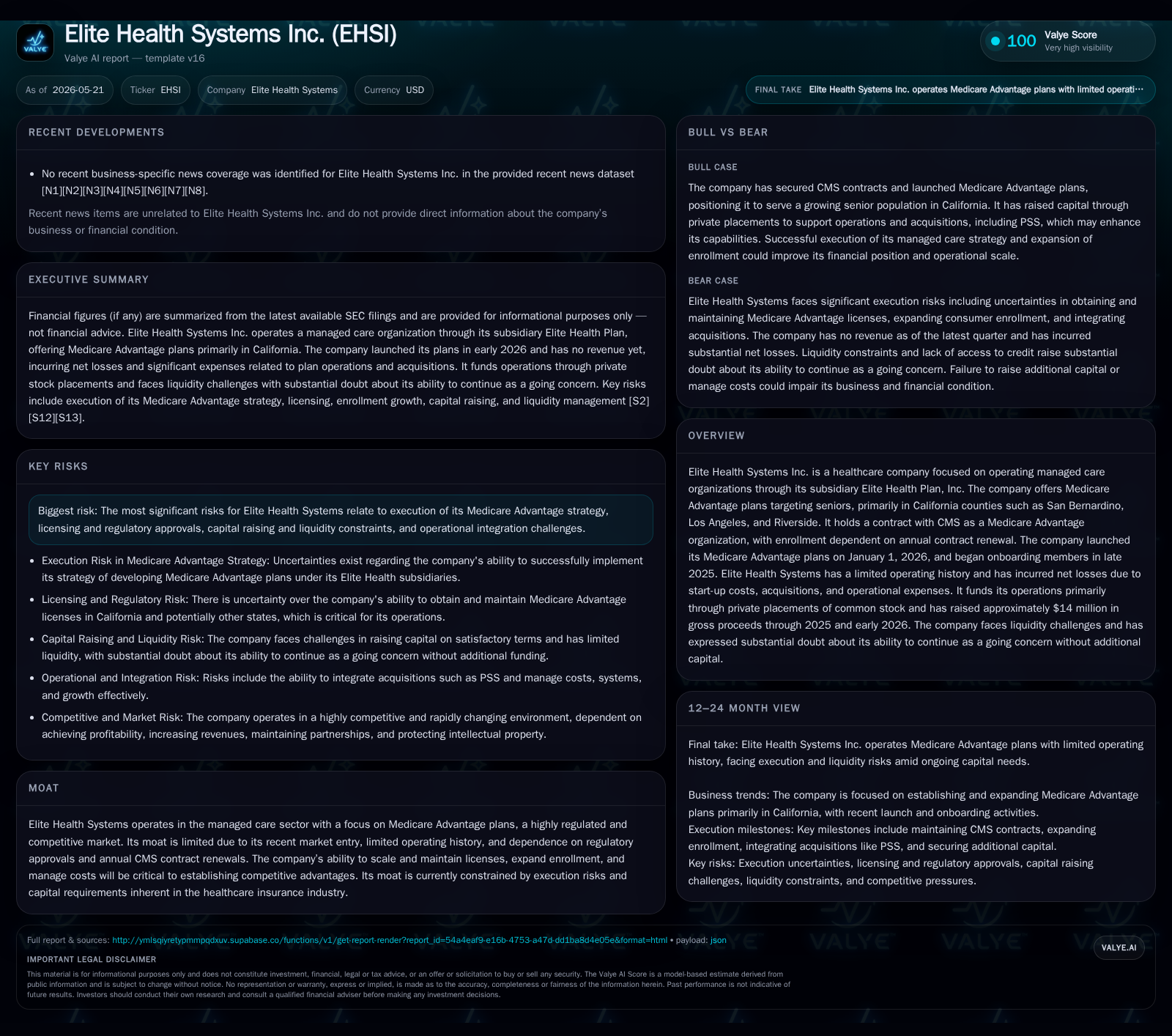
Elite Health Systems Inc. has begun operations of its Medicare Advantage (MA) plans in early 2026, marking a critical phase for this young managed care organization focused on seniors in California. The latest quarterly report reveals substantial operating losses and heightened administrative expenses driven by integration of an acquisition and startup costs. Financially, the company relies heavily on equity funding amid cash constraints without access to credit facilities. Its position in the highly regulated and competitive MA market is nascent, with growth hinging on contract renewals, enrollment expansion, cost management, and successful operational scaling. Execution risks and capital needs remain significant headwinds for the company's path to profitability.
Recent Operating Update
Elite Health Systems Inc. (EHSI) issued its latest quarterly filing on May 20, 2026 [S2], reflecting crucial developments since launching its Medicare Advantage plans on January 1, 2026. This marks the beginning of the company’s transition from a pre-revenue start-up phase to active managed care operations under the subsidiary Elite Health Plan (EHP). The quarter saw intensified selling, general & administrative expenses surging by 148% year-over-year to $1.165 million. This expense jump stems largely from integrating the Physician Support Systems (PSS) acquisition completed last year plus added operational costs now that EHP is running health plans.
Financially, the company reported a net loss of $1.355 million for Q1 2026 versus $424,000 a year prior. This widened loss highlights the impact of start-up expenditures associated with plan launch and acquisition-related activities [S2]. Meanwhile, cash reserves declined to roughly $2.6 million as of March-end [F1], with no lines of credit or alternate liquid capital sources available [S20]. The working capital position decreased alongside cash but remains above current liabilities with a current ratio near 2.4 [F1]. Notably, EHSI capital raised through private equity transactions approaches $14 million since inception but continues requiring additional funding to sustain operations through scaling [S20].
Business Model
Elite Health Systems operates by establishing managed care organizations (MCOs) specializing in Medicare Advantage plans tailored for seniors—a population expanding due to demographic trends. The company’s core offering is administered via its subsidiary EHP which holds contracts with CMS allowing it to provide MA plans primarily across California counties like San Bernardino, Los Angeles, and Riverside [S24]. Revenue is driven primarily by CMS capitation payments determined by enrolled members’ risk profiles and adjusted annually based on bids submitted by EHP.
Customers paying for coverage include Medicare beneficiaries opting into private MA plans rather than traditional fee-for-service Medicare. These contracts typically offer managed benefits including prescription drug coverage (MA-PD) with substantial regulatory oversight dictating plan networks, premiums, copays, quality standards (Star Ratings), and service mandates.
Margins are influenced by utilization management efficiency, negotiated provider network costs, regulatory compliance expenses, marketing spend for member acquisition/retention, and claims adjudication systems robustness. Given its recent market entry starting January 2026 with limited enrollment initially onboarded late in 2025 [S1], revenue recognition remains nascent while fixed cost absorption pressures amplify net losses during scale-up.
Industry Structure and Competitive Position
The Medicare Advantage sector is intensely competitive with established insurers leveraging deep provider networks, brand recognition, advanced analytics capabilities, and economies of scale to manage risk-adjusted capitation revenues profitably. New entrants like EHSI face high barriers including regulatory licensing requirements from both CMS and state insurance departments plus significant upfront investments in IT infrastructure for member services and claims processing.
EHSI’s moat is currently constrained by:
- Limited operating history since launch January 2026,
- Dependence on annual CMS contract renewal subject to performance measures,
- Modest scale relative to entrenched peers,
- Need for ongoing capital infusion amid negative EBITDA,
- Execution risks integrating acquisitions such as PSS and initiating effective operational controls.
The firm’s geographic focus on certain California counties positions it against regional MA providers but broad expansion ambitions remain unproven [S24]. Operational capabilities developed during early quarters will be critical determinants of competitive viability.
Growth Drivers
Elite Health Systems aims to capitalize on taxonomic growth trends:
- Aging senior population driving natural increases in Medicare enrollment,
- California’s large and growing senior demographics concentrated within targeted counties,
- Opportunity to expand membership bases post initial launch via marketing initiatives,
- Potential geographic extensions into adjoining counties or nearby states pending regulatory approval,
- Broadening product lineup beyond Medicare Advantage into other managed care or ancillary healthcare services,
- Leveraging PSS acquisition synergies potentially improving provider relationships or service offerings.
Fundamentally growth is volume-driven—more members generate higher capitation payments—and operational leverage depends on managing per-member costs effectively while meeting CMS quality score thresholds.
Risks / Watchpoints / Growth Constraints
Major risks stem from:
- Regulatory: Annual CMS contract renewals coupled with bid approvals present ongoing uncertainties impacting ability to operate MA plans uninterrupted [S24]. Non-compliance or poor quality ratings could threaten contracts.
- Capital: Reliance solely on equity raises raises liquidity concerns given absence of credit access; continued capital sufficiency is uncertain despite recent private placement success [S20].
- Execution: Integration complexity with PSS acquisition imposes operational risk; monitoring ability to control costs amid launch expenses is essential [S2].
- Market Competition: Competing against large incumbents with superior economies of scale may limit margin improvement or market share gains.
- Customer Adoption: Slower-than-expected member onboarding could constrain top-line growth impacting long-term sustainability.
These constraints require focused management attention balancing growth ambition against prudent financial stewardship.
What To Watch Next
Key forthcoming indicators include:
- Enrollment growth figures demonstrating ability to scale Medicare Advantage memberships beyond initial levels;
- CMS contract renewal status for subsequent years including bid approval outcomes;
- Quarterly financial performance focusing on expense management trends and loss improvement trajectory;
- Progress on IT/system upgrades facilitating claims adjudication efficiency;
- Additional equity or capital raises planned or executed addressing liquidity gaps;
- Expansion announcements regarding new regions or diversified product offerings;
- Integration milestones relating to PSS completing successfully without disrupting operations.
Management commentary around these points will be particularly telling of execution momentum.
Financial Profile Summary (Latest Quarter)
As of March 31, 2026 [F1], Elite Health reported:
- Cash & cash equivalents at $2.6 million,
- Total debt around $2.75 million leading to approximate net debt near $143 thousand,
- Current assets totaling approximately $3.27 million against current liabilities of about $1.36 million yielding a healthy current ratio near 2.4,
- Despite liquidity buffers at quarter-end, absence of line-of-credit facilities emphasizes dependency on equity capital markets for funding operations [S20].
Net losses widened concurrently reflecting increased SG&A burden linked to the PSS acquisition and initiation of health plan operations [S2]. The company’s operating leverage remains negative as fixed costs ramp before meaningful revenue accruals cement profitability pathways.
Disclaimer
This analysis does not constitute investment advice but serves as an industry-informed assessment anchored solely in publicly filed financial disclosures and related documents as cited herein.
Disclaimer: This is research-only, informational analysis and not investment advice. It may include AI-generated interpretation and general industry context. Always verify important details using primary sources.

Comments