
e.l.f. Beauty Positions for Market Expansion Backed by Strategic Acquisitions and Digital Reach
The company leverages its multi-brand portfolio, strong retail partnerships, and digitally driven marketing to reinforce growth in a competitive, clean-beauty market.
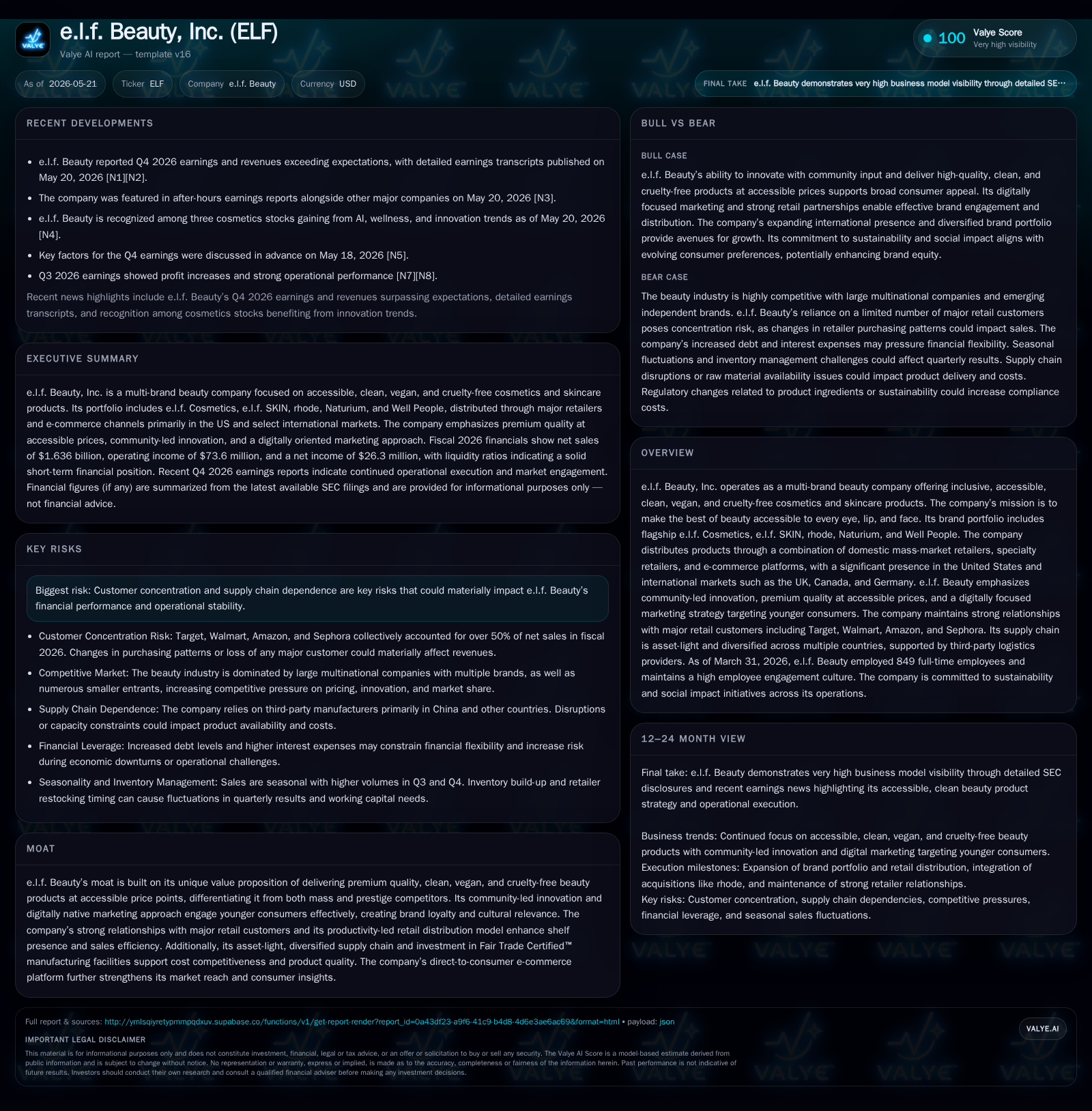
In its latest quarter ending March 31, 2026, e.l.f. Beauty reported operational momentum fueled by accretive acquisitions—rhode and Naturium—while navigating increased marketing spend and supply chain cost pressures. The company’s multi-brand strategy, combining accessible price points with premium clean and vegan credentials across cosmetics and skincare segments, underpins a distinctive competitive position. Growth is driven by innovation, community engagement, and international market expansion, yet risks remain from customer concentration and tariff-related supply chain challenges. The solid liquidity position and manageable leverage provide financial flexibility as e.l.f. pursues execution of its evolving portfolio.
Latest Quarterly Results: Operational Momentum and Challenges
In the fiscal third quarter ended March 31, 2026 ([S2]), e.l.f. Beauty demonstrated solid operational momentum marked by increased net sales primarily driven by pricing improvements and enhanced product mix following the rhode acquisition completed in August 2025. Despite volume headwinds reducing top-line expansion modestly by about $10 million compared to prior year levels ([S25]), the company reported a gross profit increase of $221.7 million year-over-year to $1.16 billion with a slight gross margin contraction of approximately 50 basis points. This margin pressure reflected tariff impacts subsequent to the U.S. Supreme Court ruling invalidating prior IEEPA tariffs but offset partially by adjusted pricing strategies ([S21], [S25]).
SG&A expenses increased materially by 32% YoY to $1.03 billion predominantly attributable to higher marketing spend aligned with the company's community-led innovation approach and substantial amortization/depreciation related to recent acquisitions including rhode and Naturium ([S25]). Operating income remained positive but net income reflected charges related to fair value adjustments on contingent consideration from rhode's outperformance as well as acquisition-related expenses ([S25]). These dynamics underscore a transitional phase where growth investments are being made amid integration complexity.
Multi-Brand Business Model: Inclusive, Clean Beauty at Accessible Prices
e.l.f. Beauty operates a strategically diversified beauty portfolio that caters broadly across cosmetics and skincare categories while adhering firmly to clean, vegan, cruelty-free credentials certified by Leaping Bunny and PETA ([S1], [S27]). Its brands include:
- e.l.f. Cosmetics: Flagship mass-market brand focusing on premium quality at accessible price points with Fair Trade Certified™ manufacturing commitment.
- e.l.f. SKIN: Skincare line emphasizing efficacious formulas with broad consumer appeal maintaining accessibility.
- rhode: Acquired in August 2025 for $897.5 million; a lifestyle beauty brand founded by Hailey Bieber centered on science-backed high-performance skincare ingredients formulated for varied skin types ([S1]).
- Naturium: Acquired in October 2023 for $333 million; dermatologist-tested botanical skincare blending natural actives with affordability ([S1]).
- Well People: A pioneer in plant-powered clean beauty focused on EWG Verified® color cosmetics.
This multi-brand architecture allows e.l.f. Beauty to address differentiated consumer needs spanning cosmetics to performance skincare while reinforcing its mission of inclusivity and accessibility through sustainable product formulations. Community-driven innovation underpins product development with an emphasis on digital engagement channels favored by younger consumers ([S27]).
Retail Distribution and Customer Concentration: Strengthening Key Partnerships
e.l.f.’s products reach consumers via a productivity-led retail distribution model emphasizing SKU productivity on retailer shelves across mass-market players such as Target (18% of fiscal year net sales), Walmart (13%), Amazon (11%), and specialty retailer Sephora (10%) ([S12], [S29]). Together these customers account for over 50% of net sales highlighting significant customer concentration risk albeit balanced by strong longstanding relationships that facilitate expanded linear footage and category penetration.
E-commerce channels accounted for roughly 24% of net sales in FY2026 indicating a meaningful digital direct-to-consumer presence complementing brick-and-mortar footprint ([S12]). International markets including the UK, Canada, and Germany contributed approximately 21% of net sales demonstrating geographic diversification though the U.S. remains dominant at nearly 80%. Distribution centers operated through leading third-party logistics providers support this hybrid global reach ([S12]).
Competitive Positioning within the Cosmetics Industry
e.l.f.'s moat derives from its ability to deliver double-certified clean beauty at mass-accessible price points while maintaining premium quality through Fair Trade Certified™ production facilities—a combination rarely matched simultaneously in the sector ([S1], [S27]). Its digitally-native marketing engine creates authentic engagement among Gen Z consumers via social media-driven community loyalty fostering lower customer acquisition costs compared with legacy brands reliant on traditional media ([N6], [S27]).
The company’s shelf productivity approach optimizes SKU assortment while leveraging robust retailer partnerships to navigate category growth at scale. Supply chain diversification—with multiple third-party manufacturers primarily in China supplemented by units in the U.S., Italy, South Korea—provides flexibility though geopolitical tariffs present ongoing challenges impacting cost structure ([S12], [S21]). Switching costs are moderate but brand loyalty fostered through continuous innovation enhances retention.
Growth Drivers: Innovation, Community Engagement, and International Expansion
e.l.f.'s growth strategy integrates several measurable drivers:
- Innovative Product Launches: rhode has been recognized among Fast Company's Most Innovative Companies of 2026 for its science-based skincare formulations targeting efficacy demands within the millennial/Gen Z cohort ([S1], [N1]). The flagship e.l.f. Cosmetics similarly dominated mass cosmetics new product rankings in recent years demonstrating repeat successful introductions.
- Digitally-Led Marketing: With
$400 million spent on marketing/digital (24% net sales), this investment aims for ongoing community activation fueling accelerated customer acquisition alongside social commerce capabilities ([S27]). - Retail Space Expansion & Ecommerce Growth: Continuous expansion within existing key retailers' footprint plus targeted ecommerce penetration supports volume growth; ecommerce contributes nearly one-quarter of revenues highlighting shifting consumer purchase preferences ([S12]).
- International Market Development: Focused expansion in established regions such as UK, Canada, Germany leverages existing retail networks to drive incremental revenue ([S12]).
Monitoring relevant KPIs like sales per square foot gains at major retailers, ecommerce order volume trends and digital engagement metrics will be crucial for assessing trajectory.
Risks and Constraints: Customer Dependence and Supply Chain Vulnerabilities
Customer concentration poses material business risk given that four retailers constituted about half of FY2026 revenue without contractual purchase obligations ([S12], [S21]). Fluctuations in orders or inventory management by these large customers could disrupt sales visibility.
Supply chain dependence—primarily on Chinese contract manufacturers—and exposure to geopolitical tariff regimes have introduced cost volatility reflected in compressed gross margins despite pricing actions ([S21]). The recent legal uncertainties around tariffs may lead to retrospective adjustments but underscore regulatory risks.
Acquisition integration risks also merit attention as rhode represents a sizeable investment ($897.5 million) involving contingent earnouts affecting future earnings volatility marked by recorded fair value adjustments in FY26 ([S1], [S25]). Execution on scaling these newer brands without diluting focus or efficiency will influence medium-term profitability.
Investor Watchpoints: Upcoming Milestones and Market Signals
Critical near-term milestones include:
- Q1 FY2027 earnings performance evidencing continued uptake and margin synergy realization from rhode/Naturium acquisitions.
- Progress in securing expanded retail shelf space especially within Target/Walmart/Sephora environments.
- Digital channel growth metrics reflecting success in enhancing direct-to-consumer engagement.
- Sustainability reporting updates aligned with packaging intensity reduction goals and renewable ingredient sourcing commitments outlined in annual filings ([S1]).
- Management commentary addressing navigating tariff outcomes post-June 2026 given judicial decisions impacting import duties.
This analysis is based solely on publicly available SEC filings as of May 2026 combined with industry contextual interpretation; it does not constitute investment advice.
Disclaimer: This is research-only, informational analysis and not investment advice. It may include AI-generated interpretation and general industry context. Always verify important details using primary sources.

Comments