
Enveric Biosciences Advances Psychedelic-Inspired Neuroplastogen Pipeline with Strategic Capital Infusion
Enveric boosts its EB-003 neuroplastogen preclinical advancement and fortifies financial position through a $13.9 million private placement.
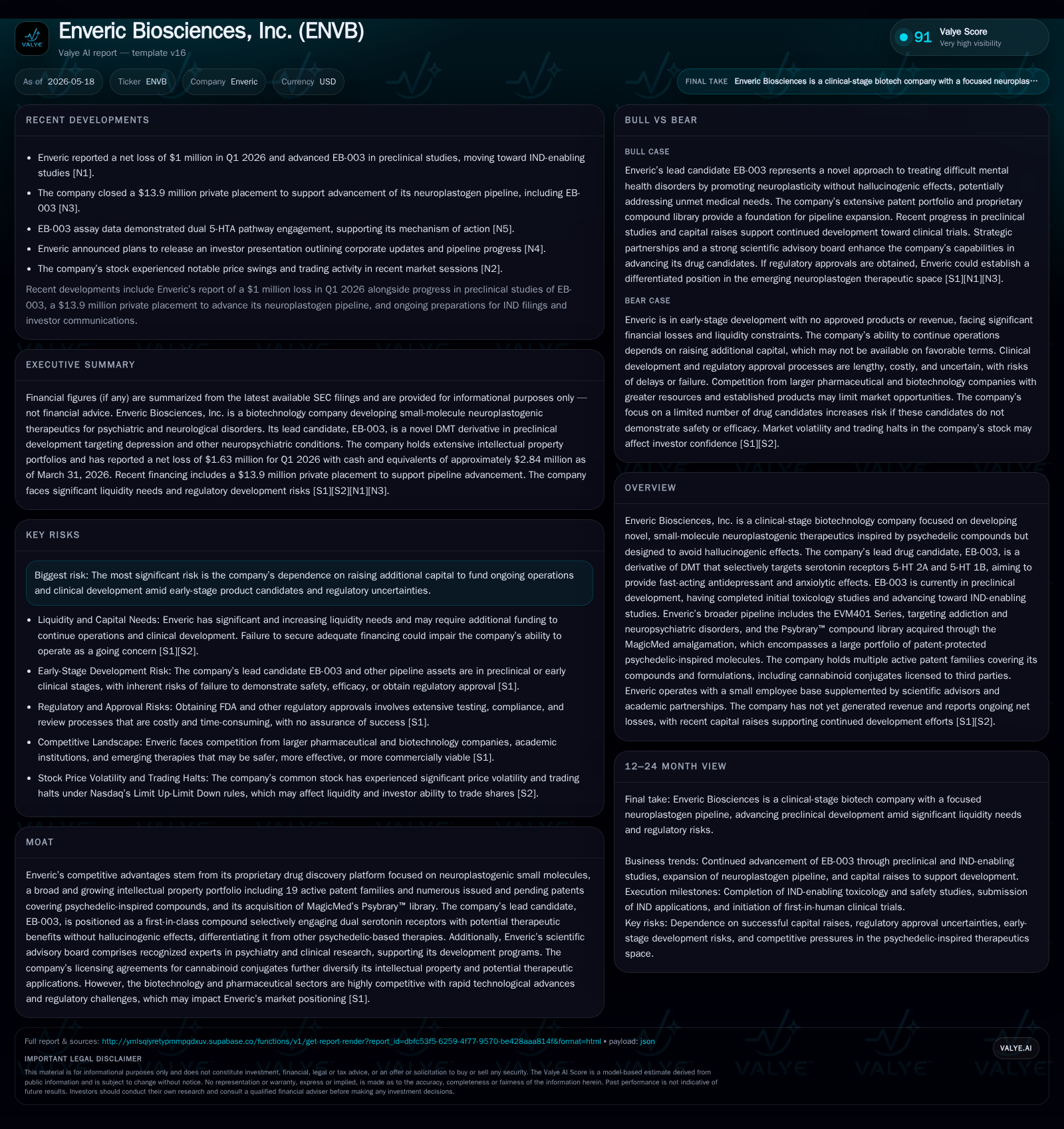
In its Q1 2026 filing, Enveric Biosciences reported continued progress on its lead compound EB-003, moving from dose-ranging toxicology toward IND-enabling studies, signaling near-term clinical milestones. Concurrently, the company closed a $13.9 million private placement aimed at extending its development runway amid a volatile share trading environment. Enveric’s business model centers on small-molecule neuroplastogens inspired by psychedelics but designed to avoid hallucinogenic effects, differentiating it within a nascent but increasingly competitive psychedelic-inspired biopharma sector. Despite promising intellectual property depth and a broad compound library acquired from MagicMed, significant risks persist from regulatory uncertainties, capital requirements, and early-stage clinical execution challenges.
Latest Operating Update: Preclinical Progress and Capital Raise
Enveric Biosciences’ latest quarterly report filed May 15, 2026 ([S2]) highlights meaningful strides in advancing its lead drug candidate, EB-003. The program has successfully completed short-term dose-range finding toxicology studies and is now poised to initiate GLP-compliant IND-enabling safety pharmacology, ADMET profiling, and longer-term toxicology studies necessary to support an Investigational New Drug (IND) application. These preclinical activities position EB-003 closer to the regulatory threshold needed for first-in-human trials.
Complementing this technical progress, Enveric closed a $13.9 million private placement in April 2026 ([N3]), a strategic capital infusion critical to sustaining its R&D momentum amid the capital-intensive nature of biotech development. This financing supports not only the EB-003 program but also broader pipeline activities including the EVM401 series. The capital raise arrives against a backdrop of historically elevated volatility in Enveric’s stock price leading to temporary trading halts per Nasdaq’s Limit Up-Limit Down rules ([S2]), underscoring equity market challenges typical for clinical-stage biotechnology firms with early-stage assets.
Business Model and Core Product Innovation
Enveric operates as a clinical-stage biopharmaceutical company focusing on small-molecule neuroplastogenic therapeutics derived from psychedelic compounds but engineered explicitly to omit hallucinogenic properties ([S1], Valye Report Excerpt). The cornerstone of its product offering is EB-003, a novel derivative of N,N-Dimethyltryptamine (DMT), designed to selectively engage serotonin receptors 5-HT2A and 5-HT1B. This dual receptor engagement aims to catalyze neuroplasticity mechanisms resulting in rapid-onset antidepressant and anxiolytic effects while maintaining outpatient dosing convenience.
The business model primarily constitutes discovering novel therapeutics via a proprietary platform enriched by intellectual property generated internally and through acquisitions such as MagicMed's Psybrary™, which broadens molecule diversity with over one thousand synthesized compounds screened across hundreds for receptor binding activities ([S1], Valye Report Excerpt). In addition to EB-003 within the EVM301 series, Enveric is cultivating the EVM401 Series targeting addiction and other neuropsychiatric conditions that remain underserved clinically.
Revenue generation remains prospective at this stage given Enveric's early clinical status; future income will depend on regulatory approvals followed by commercialization or partnering/licensing arrangements related to these candidates. Intellectual property protection—including 19 active patent families—constitutes an essential barrier against generic competition while expanding formulation alternatives and reinforcing pipeline breadth.
Competitive Landscape in Psychedelic-Inspired Neurotherapeutics
Within the rapidly evolving domain of psychedelic-inspired medicines, Enveric distinguishes itself by prioritizing non-hallucinogenic small molecules tailored to accelerate neuroplastic processes without inducing perceptual distortions (). This uniquely positions ENVB relative to competitors predominantly developing classic hallucinogenic compounds or relying on psychotherapy adjuncts.
The company's robust intellectual property estate covering phenylalkylamine and indolethylamine derivatives enhances its competitive moat by establishing extensive coverage around molecular structures fundamental to neuroplastogens ([S1]). Its scientific advisory board includes psychiatric and neuroscience experts augmenting credibility around clinical strategy execution.
Given the nascent regulatory environment for these therapeutic categories characterized by ambiguous classification and approval pathways ([S6]), companies like Enveric face heightened risk but also potential first-mover advantages should they navigate approval frameworks effectively compared to peers lacking comparable molecular focus or IP depth.
Growth Catalysts: Pipeline Expansion and Regulatory Outlook
Planned filings of IND applications represent tangible growth catalysts for Enveric, notably for EB-003 as it moves beyond preclinical safety toward human trials ([S1], [S2]). Simultaneously, the ongoing expansion of Enveric's compound repository via MagicMed's Psybrary™ enables identification of new candidates potentially addressing addiction disorders within the EVM401 series.
The regulatory environment’s gradual maturation around psychedelic therapies provides incremental clarity potentially facilitating expedited development pathways under psychiatric unmet medical need designations ([S6]). Coupled with increasing social acceptance favoring outpatient-friendly small molecules over traditional psychedelics or SSRIs, these factors create robust commercial stimuli underpinning investor interest evidenced by recent fundraising success ([N3]).
Success in licensing cannabinoid conjugate technologies further diversifies revenue avenues while expanding therapeutic scope beyond serotonin receptor modulators.
Risks and Operational Challenges For Early-Stage Psychedelic Biotechs
Operating risks loom large given the early developmental phase of Enveric's product candidates combined with fluid regulatory standards governing psychedelic-inspired drugs ([S1], ). Key concerns include:
- Continuous capital requirements amidst operating losses exceeding $8 million annually necessitate dependable future financing capability to avoid derailing clinical programs ([F1], [S2]).
- Clinical trial setbacks or delays could materially impair timelines given dependency on successful IND applications followed by positive trial data.
- Emerging competition leveraging AI-driven discovery platforms may accelerate rival pipelines potentially eclipsing Enveric's offerings if not mitigated adequately ([S1]).
- Market volatility reflected in trading halts could hamper shareholder liquidity restricting access for additional equity raises required for operational continuity ([S2]).
- Legal risks originate from controlled substance laws variably enforced across jurisdictions that may impose unexpected compliance costs or restrict geographic market penetration ([S4], [S6]).
These operational hurdles must be navigated decisively alongside delivering clinical proof points that validate product efficacy without hallucinogenic drawbacks.
Key Near-Term Milestones and Investor Watchpoints
Investors should track several upcoming value inflection points including:
- Completion of GLP-compliant IND-enabling safety pharmacology and longer-term toxicology studies for EB-003 expected imminently reflecting advancement readiness for first-in-human studies ([S2], [S3]).
- Any announcements regarding IND submission timing or FDA feedback providing clarity on regulatory pathways.
- Updates on MagicMed-derived assets entering clinical phases which would indicate pipeline diversification into additional indications beyond depression/anxiety.
- Progress or execution of out-license agreements related to cannabinoid conjugate intellectual property potentially generating non-dilutive revenues ([S24]).
- Monitoring management commentary surrounding funding sufficiency post-private placement combined with any signs of further capital needs or operational scaling plans.[N3]
These milestones will serve as proxies for technical validation alongside operational discipline crucial in a highly speculative sector.
Financial Position Supporting Development Momentum
According to SEC disclosures as of March 31, 2026 ([F1], [S2]), Enveric maintains a strong liquidity buffer with approximately $5.4 million in current assets against $460 thousand in current liabilities yielding an exceptionally healthy current ratio near 11.7x. Total debt sits modestly at just over $750 thousand reflecting minimal leverage.
This financial footing underpins ongoing research expenditures although operating expenses continue reflecting annual losses approaching $8.77 million per latest annual data ([F1]). The recent $13.9 million capital injection materially extends runway flexibility enabling sustained investment across core programs without immediate cash constraint pressures.[N3]
However, continued access to capital markets remains indispensable given early-stage status without commercial revenue generation thus far.
This analysis bases all assessments strictly on verified SEC filings dated through May 15, 2026, supplemented by Nasdaq News releases as cited. It does not constitute investment advice but aims to provide an informed industry perspective anchored on publicly disclosed operating facts about Enveric Biosciences’ development trajectory within the psychedelic-inspired neurotherapeutics sector.
Disclaimer: This is research-only, informational analysis and not investment advice. It may include AI-generated interpretation and general industry context. Always verify important details using primary sources.

Comments