
Enovix Corp’s Scaling Challenges Temper Growth Amid Advanced Silicon-Anode Battery Innovations
Enovix advances proprietary silicon-anode battery technology while managing operational scaling and customer concentration risks.
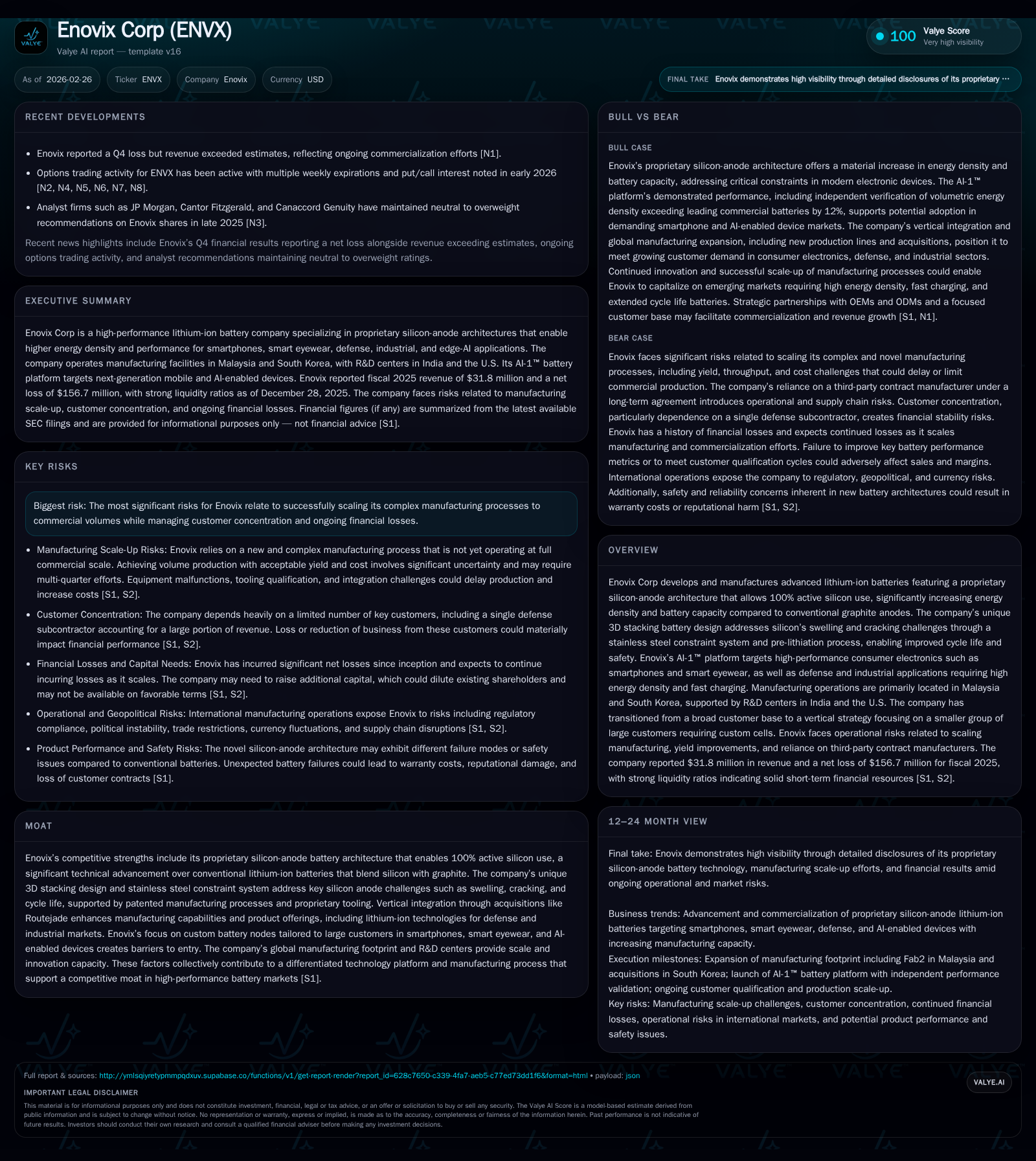
Enovix Corporation has built a distinct competitive advantage through its proprietary 100% active silicon-anode lithium-ion battery architecture, enabling higher energy densities critical for smartphones, smart eyewear, defense, and edge-AI markets. The company has shown steady revenue growth from $7.6 million in 2023 to $31.8 million in 2025 [F1], driven by selective vertical market focus and customer engagements. However, profitability remains elusive as Enovix continues incurring substantial losses on the path to scale manufacturing — posting a net loss of $156.7 million in 2025 [F1]. Its future growth hinges on successful commercialization and volume ramp-up while navigating significant operational, financial, and supply chain risks related to its complex manufacturing processes and customer concentration [S1-S3][S4][S18].
Company Background and Technology
Enovix Corporation focuses exclusively on high-performance lithium-ion batteries architected around its proprietary silicon-anode technology that uniquely achieves full (100%) active silicon utilization without blending with graphite — a long-sought breakthrough that significantly raises energy density beyond conventional Li-ion cells [S1][S12]. The challenge historically impeding silicon anodes has been the material's tendency to swell and crack during charge-discharge cycles, leading to safety risks and rapid performance degradation. Enovix’s patented 3D stacking design coupled with a stainless steel constraint system manages this swelling effectively, enabling extended cycle life exceeding 1,000 full-depth charge cycles while maintaining safety profiles suitable for sensitive consumer electronics like smartphones.
The AI-1™ platform exemplifies this architecture tailored to demanding applications requiring compact forms with rapid charging capability—initially targeting premium smartphone manufacturers before expanding into other AI-powered devices such as smart eyewear and industrial/defense markets where high energy density in restricted space is critical.
Historical Financial Performance
Enovix is still emerging commercially. Revenue grew strongly but from a small base: from approximately $7.6 million in fiscal 2023 to $23.1 million in fiscal 2024, then fast-forwarding to $31.8 million in fiscal year 2025 — representing nearly a fourfold increase over two years, or an approximate compound annual growth rate of ~95% [F1]. This reflects advancement of customer program validations primarily within smartphones initially, plus expanded revenue contribution from defense-related contracts following the Routejade acquisition which enhanced vertical integration capabilities.
However, the company has incurred sizeable operating losses throughout this period, highlighting the inherent costs of scaling novel battery manufacturing. Operating loss narrowed from -$242.7 million in 2024 to -$177.3 million in 2025 (improving roughly 27%), paralleled by net losses improving from -$222.2 million to -$156.7 million YoY respectively—still sizable deficits underscoring the high fixed costs and operating leverage yet unabsorbed by current volumes [F1]. Operating cash flow remains negative at -$95.3 million in FY25 but showed some improvement over prior years.
Capex spending fell sharply from $76.2 million in 2024 to $18.2 million in 2025 — likely reflecting completion or near-completion of major capacity build-outs ahead of further scale-up phases under evaluation [F1][S29]. Equity declined slightly due to losses but remains above $271 million at year-end FY25 providing a buffer against near-term liquidity pressures.
Historical performance (annual)
| FY | Rev ($mm) | Net ($mm) | CFO ($mm) | OpInc ($mm) | Rev YoY | Net YoY |
|---|---|---|---|---|---|---|
| 2025 | 32 | -157 | -95 | -177 | +37.9% | +29.5% |
| 2024 | 23 | -222 | -109 | -243 | +201.9% | -3.8% |
| 2023 | 8 | -214 | -105 | -230 | -314.7% | |
| 2022 | -52 | -83 | -132 |
Source: SEC companyfacts cache [F1].
Capital returns and efficiency (annual)
| FY | Buybacks ($mm) | FCF ($mm) | ROE% |
|---|---|---|---|
| 2025 | 58 | -114 | -57.8 |
| 2024 | 0 | -185 | -90.1 |
| 2023 | 0 | -166 | -82.9 |
| 2022 | 0 | -119 | -14.5 |
Source: SEC companyfacts cache [F1].
Note: The Buybacks figure for FY25 includes an unusually large $58M repurchase event relative to prior years.
Future Growth Prospects
Enovix’s pathway depends heavily on successfully scaling manufacturing efficiencies while extending market penetration across a narrow set of high-value applications where its silicon-anode advantages matter most — notably advanced smartphones followed by smart eyewear and defense/industrial segments needing ruggedized performance lithium-ion packs with higher power density.
Though revenues have grown robustly percentage-wise over recent years [F1], absolute sales remain modest relative to direct competitors who operate at gigawatt-hour scales globally. As documented in filings [S2][S18], Enovix confronts significant production complexity due to its proprietary cell construction necessitating specialized manufacturing processes distinct from commoditized Li-ion production lines—which contributes both to current unit costs and operational risks.
A critical milestone will be achieving volume qualification with marquee smartphone customers that enforce stringent cycle life and safety standards; successful adoption would validate the broader applicability of the AI-1™ platform across other markets requiring compact form factors with higher charge rates [S12][N1]. Conversely failure or delays here could sharply curb addressable market size given competitive alternatives continue improving.
Customer concentration remains concentrated: For instance a South Korean defense subcontractor accounted for approximately half of total revenue during fiscal year ended December 2024—and increased to roughly sixty percent through Q3’25—highlighting dependence on relatively few large accounts that could materially impact results if disrupted [S4][S13]. Sales cycles remain lengthy due to extensive testing and certification protocols imposed by enterprise customers especially defense entities.
Returns and Capital Allocation
Return metrics remain negative reflecting early-stage commercial deployment amid heavy investment phases: With net income trailing equity bases significantly enshrined by accumulated deficits near $943 million as of September ‘25 [F1], return on equity was approximately -58%, indicating ongoing negative returns but consistent with typical innovation cycle dynamics for deep-tech hardware startups.
Operating cash flow generation remains weak (-$95M FY25) against capital expenditures ($18M FY25), producing free cash flow still massively negative (~-$113M), reinforcing continued funding needs ahead of sustainable profitable operations [F1]. However Enovix maintains liquidity buffers including approximately $106M cash on hand at end-2025 along with capital raised via $360M convertible senior notes issued mid-2025 providing runway into coming commercialization phases absent major unexpected events or expenditure overruns [F1][S25].
Capital deployment thus far has favored scaling manufacturing capabilities plus R&D focused on sustaining technological leadership through continuous improvements of process yield rates and material incorporation flexibility ([S12][S29]). Notably the company executed a sizeable share buyback ($58M) in FY25 despite prevailing financial losses—a move possibly designed to signal confidence or manage dilution stemming from warrant exercises executed during the same period ([F1]).
Industry Context & Competitive Positioning (Analysis)
Lithium-ion battery markets continue evolving rapidly driven by urgent demand across mobile electronics and electric vehicles where energy density enhancements are paramount against size-first design constraints. Silicon anodes have been regarded as breakthrough tech but practical application requires overcoming severe mechanical degradation issues—an area where Enovix claims material differentiation through its stacked architecture addressing silicon expansion stresses uniquely ([S12],[S15]).
Competition includes major incumbents developing blended silicon-graphite chemistries attempting marginal gains but often constrained by industry-standard flat electrode geometries lacking constraint systems like Enovix’s stainless steel stack design ([S5],[S15]). Also significant is growing state-backed investment particularly in Asia creating pricing pressure that could disadvantage suppliers lacking scale or governmental support ([S15]).
Continuous innovation will be required as rivals seek either new materials paradigms or proprietary chemistry breakthroughs potentially narrowing Enovix’s current energy density premium ([S15],[N3]). Thus sustained R&D coupled with successful credentialing among leading OEM partners is essential for staying competitive.
Risk Considerations
Key risk areas identified by management encompass:
- Manufacturing scale-up complexities owing to new technology requiring high yields at controlled cost points plus reliance on third-party contract manufacturers especially in Malaysia whose disruption could stall operations ([S2],[S18]).
- Customer concentration heightening exposure if large purchasers alter purchase volumes unfavorably or renegotiate pricing terms ([S4],[S13]).
- Product safety liabilities intrinsic to newer designs given limited commercial history potentially catalyzing costly recalls or damage claims ([S17],[S23],[S24]).
- Extended qualification timelines slowing revenue ramp given rigorous demands particularly in defense sectors where contracts govern strict compliance ([S21]).
- Geopolitical tensions influencing supply chains or regulatory environments given global footprint spanning U.S., Malaysia and South Korea ([S20],[S23]).
- Ongoing financing requirements with potential dilutive capital raises impacting shareholder value despite current liquidity cushions ([F1],[S16],[S27]).
- Cybersecurity oversight established recently at board level recognizing emerging threat environment applicable across manufacturing IT systems ([S1]).
Overall risk factors reflect typical early-stage hardware innovators navigating commercialization hurdles amid volatile market landscapes demanding both technical excellence and prudent financial stewardship.
What To Watch Next (Analysis)
Upcoming milestones pivotal for validating Enovix’s commercial trajectory include:
- Public updates regarding volume shipments or contract term extensions particularly involving key smartphone OEMs validating AI-1 platform specs.
- Manufacturing yield improvements evidencing progress toward scalable cost structures crucial for margin expansion.
- Diversification of customer base reducing concentration risk as new strategic partnerships mature across defense/industrial verticals.
- Capital raises or deleveraging efforts clarifying funding runway beyond initial facility deployments.
- Technological progress announcements showcasing superior cycle life or fast charge characteristics sustaining differentiation against incumbent chemistries.
In absence of explicit forward guidance outside routine quarterly updates [N1], these markers provide context for assessing whether operational execution aligns with strategic ambitions.
Conclusion
Enovix presents a compelling case as a pioneering battery innovator leveraging unique silicon-anode architectures promising substantial gains essential for next generation mobile devices requiring enhanced energy density within space-constrained designs. Its recent revenue acceleration confirms initial market validation but persistent large losses underscore transitional challenges converting advanced R&D successes into scalable manufacturability — complexity compounded by a narrow customer base exerting outsized commercial influence.
The firm’s ability over the next few years to ramp production efficiencies while expanding qualified customers amid stiff competition will determine if it can solidify a durable foothold within an intensely dynamic lithium-ion ecosystem increasingly shaped by geopolitical influences and fast-paced technological evolution.
This report is for informational purposes only and does not constitute investment advice or recommendations.
Disclaimer: This is research-only, informational analysis and not investment advice. It may include AI-generated interpretation and general industry context. Always verify important details using primary sources.

Comments