
Essential Properties Realty Trust’s Stable Growth Anchored by Diversified Net-Lease Portfolio
EPRT's Q2 2026 update highlights continued portfolio expansion, long lease durations, and strategic capital management amid interest rate challenges.
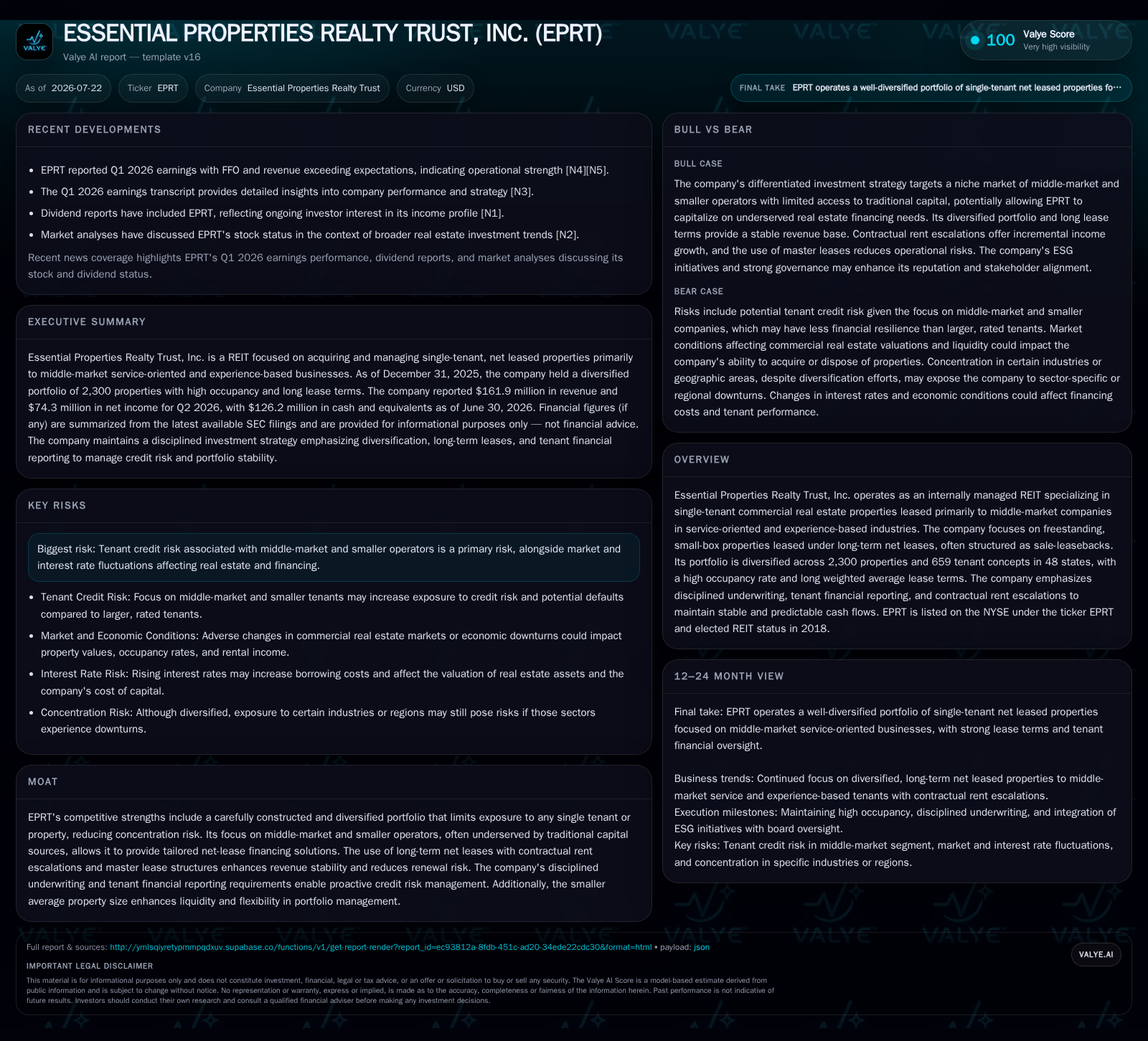
Essential Properties Realty Trust reported sustained growth in its single-tenant net lease portfolio with 2,300 properties across 48 states as of mid-2026. The company maintains high occupancy at 99.7%, a weighted average lease term exceeding 14 years, and broad tenant diversification, underpinning stable rental revenue streams. Recent quarterly disclosures reveal disciplined capital deployment primarily through sale-leaseback acquisitions targeting middle-market service-oriented tenants. While interest expenses rose due to increased debt levels and higher rates, EPRT's balanced financial position and contractual rent escalations support cash flow resilience.
Recent Operating Update
In its latest quarterly filing for Q2 ending June 30, 2026, Essential Properties Realty Trust (EPRT) reaffirmed its disciplined growth strategy centered on single-tenant net lease commercial properties primarily leased to middle-market service-oriented operators [S2][S3]. The company’s portfolio comprises approximately 2,300 properties distributed across 48 states, maintaining an exceptional occupancy rate of 99.7% as of mid-2026 [S2]. This scale reflects a substantial increase over prior years driven largely by acquisitions structured as sale-leasebacks, which enable operators to monetize real estate assets while retaining operational control [S1]. Despite macroeconomic uncertainties and rising interest rates, EPRT’s weighted average lease term (WALT) remains robust at approximately 14.4 years based on annualized base rent, insulating near-term revenue stability from lease expirations and rollover risk [S1].
Business Model Analysis
EPRT operates as an internally managed REIT specializing in freestanding small-box commercial properties leased under long-term net leases. The company’s primary revenue stream is rental income derived from triple-net lease contracts, where tenants are responsible for property taxes, insurance, and maintenance costs, thereby reducing landlord operating expense volatility and enhancing net operating income (NOI) predictability [S1]. This model also includes direct financing leases and mortgage loans receivable that supplement income via interest [S1].
A distinctive feature of EPRT’s strategy is its predominant use of sale-leaseback transactions, which accounted for approximately 95% of investments during the full year ended December 31, 2025 [S1]. This approach allows EPRT to acquire properties with established tenants engaged in essential, service-oriented businesses such as car washes, medical and dental services, quick-service restaurants, automotive services, and other experience-based sectors. These industries tend to be more insulated from e-commerce disruption and exhibit lower cyclicality compared to traditional retail [S1].
Lease agreements typically include contractual rent escalations averaging about 1.8% annually across nearly all leases based on annualized base rent, providing organic rental revenue growth that helps offset inflationary pressures [S1]. Additionally, master lease structures cover approximately 67% of the portfolio’s annualized base rent, enhancing administrative efficiency and reducing tenant renewal risk by consolidating lease management under fewer agreements [S1].
EPRT targets smaller investment sizes per property, with an average investment of $3.1 million as of year-end 2025 [S1]. This strategy fosters portfolio liquidity and limits exposure to individual property idiosyncrasies or obsolescence risks. The company’s focus on smaller, fungible single-tenant properties supports flexibility in asset disposition and reduces concentration risk
Tenant diversification is a core risk mitigation strategy. The portfolio includes tenants across more than 659 distinct brands or concepts, with no single tenant contributing more than approximately 3.4% of annualized base rent, well below the company’s long-term threshold target of under 5% per tenant. Similarly, no individual property accounts for more than about 1% of total rental income, which helps to spread credit risk and reduce volatility in cash flows [S1]
Industry Structure and Competitive Position
EPRT operates within the single-tenant net lease REIT sector, focusing on middle-market tenants in service-related industries. Comparable peers include Realty Income Corporation (O), National Retail Properties (NNN), and STORE Capital (STOR), which also maintain diversified portfolios of single-tenant properties across multiple geographies [S1]. However, EPRT differentiates itself through its emphasis on smaller, middle-market operators and smaller average property investments, which enhances portfolio fungibility and reduces concentration risk relative to some peers that focus on larger national tenants or multi-tenant retail centers
The company’s long WALT of approximately 14.4 years compares favorably within the peer group, where lease terms typically range from 10 to 15 years depending on portfolio strategy. This extended lease duration supports revenue stability and reduces near-term rollover risk. Contractual rent escalations embedded in leases provide a hedge against inflation and support sustained cash flow quality over time.
Growth Drivers
Portfolio expansion through acquisitions remains the primary growth engine, with a focus on sale-leaseback transactions involving established operators seeking liquidity without operational disruption [S1][S2]. This acquisition strategy taps into demand from essential service industries that historically demonstrate lower volatility and resilience in economic downturns.
High occupancy rates near full capacity reflect strong demand for well-located, single-use properties serving experiential or service-based customer needs [S2][S3]. Contractual rent escalations embedded in nearly all leases deliver organic rental revenue growth independent of new leasing activity, supporting steady cash flow increases [S1].
EPRT’s disciplined underwriting and proactive tenant financial monitoring mitigate credit risk, enabling selective capital deployment for accretive acquisitions. The company also pursues strategic disposition of non-core or underperforming assets to recycle capital into higher-return investments, consistent with improving net operating income margins observed in comparable REITs [S1]
Access to capital markets, including equity offerings such as a forward share sale completed in early February 2026, enhances EPRT’s capacity to fund growth investments while managing leverage prudently [S15][S23]
Risks and Watchpoints
Tenant credit risk remains a key consideration given EPRT’s focus on middle-market operators, who may be more sensitive to economic cycles than large institutional-grade tenants [S2]. Although tenant diversification materially reduces single-name exposure, systemic stress affecting multiple smaller operators could exert downside pressure on rental income and occupancy.
Interest rate fluctuations impact financing costs, particularly given the company’s leverage profile. As of June 30, 2026, total debt stood near $2.93 billion against $126 million in cash, resulting in net debt of approximately $2.8 billion [F1][S2]. Rising interest expenses, driven by both higher principal balances and increased rates on SOFR-indexed borrowings, could pressure distributable cash flow if not offset by rental growth or acquisition yield spreads [S22].
Tax protection agreements associated with certain property acquisitions impose operational constraints that may limit asset disposition flexibility or require indemnification payments to protected unitholders if taxable gains are triggered. These agreements could delay portfolio optimization transactions or impact financial results [S2].
Vacancy risk remains low given current occupancy levels, but macroeconomic headwinds could increase tenant bankruptcies or non-renewals. The long WALT and tenant diversification provide some mitigation against such risks.
Potential impairments or write-downs could arise if shifts in industry dynamics reduce demand for certain asset types. However, EPRT’s focus on smaller, fungible properties reduces the risk of obsolescence and supports asset liquidity [S1]
What to Watch Next
Key indicators to monitor include maintenance or improvement of occupancy rates above current near-full levels and sustaining long WALT through successful lease renewals and accretive acquisitions. Trends in rental revenue growth driven by contractual escalations will provide insight into organic income stability amid inflationary pressures.
Tenant credit quality, especially within middle-market cohorts, should be closely watched for early signs of default risk under economic stress scenarios. Upcoming refinancing events, such as the February 2027 term loan maturity, will reveal the company’s access to capital markets and borrowing cost conditions in the prevailing interest rate environment.
Disclosures related to tax protection agreements will be important to assess potential impacts on asset disposition strategies and financial flexibility. Relative positioning versus peers on debt metrics like interest coverage ratios will also be informative regarding financial resilience.
Financial Profile Discussion
As of June 30, 2026, Essential Properties Realty Trust reported $126 million in cash and equivalents against total debt of approximately $2.93 billion, producing a net debt position near $2.8 billion, reflecting capital-intensive acquisition activity leveraged through its operating partnership structure [F1][S2]. Interest expense has increased commensurately due to higher principal amounts outstanding and prevailing interest rates impacting SOFR-indexed borrowings in revolving credit facilities and term loans [S22].
General and administrative expenses have risen moderately, aligned with expanded operations supporting portfolio growth, including increased salary and professional fees related to underwriting, asset management, and investor relations functions [S1]. Depreciation and amortization expenses scale predictably with the growth in real estate investment value, reflecting acquisitions carried at cost plus transaction fees.
Provisions for impairment have trended lower year-over-year, evidencing stable asset valuations across most holdings, though reserves remain prudent against isolated property risks [S1]. Gains on disposition income increased, reflecting selective sales activity yielding above carrying values, supporting capital recycling and enhancing shareholder returns [S1].
Liquidity metrics indicate adequate coverage to meet short-term liabilities; however, upcoming refinancing timelines warrant attention given potential market volatility and borrowing cost fluctuations [F1][S22]
This analysis synthesizes EPRT’s recent filings with broader industry context, reflecting typical operating dynamics for a specialized single-tenant net lease REIT focused on mid-sized service-oriented businesses. It clarifies business fundamentals, competitive positioning, risks, growth levers, and financial stewardship as presented through publicly available disclosures without offering investment research views.
Disclaimer: This is research-only, informational analysis and not investment advice. It may include AI-generated interpretation and general industry context. Always verify important details using primary sources.

Comments