
Empire State Realty OP Executes Tenant-Centric Growth in a High-Leverage Environment
Empire State Realty OP balances steady leasing momentum and strategic acquisitions with rising operating expenses and a leveraged capital structure in 2025.
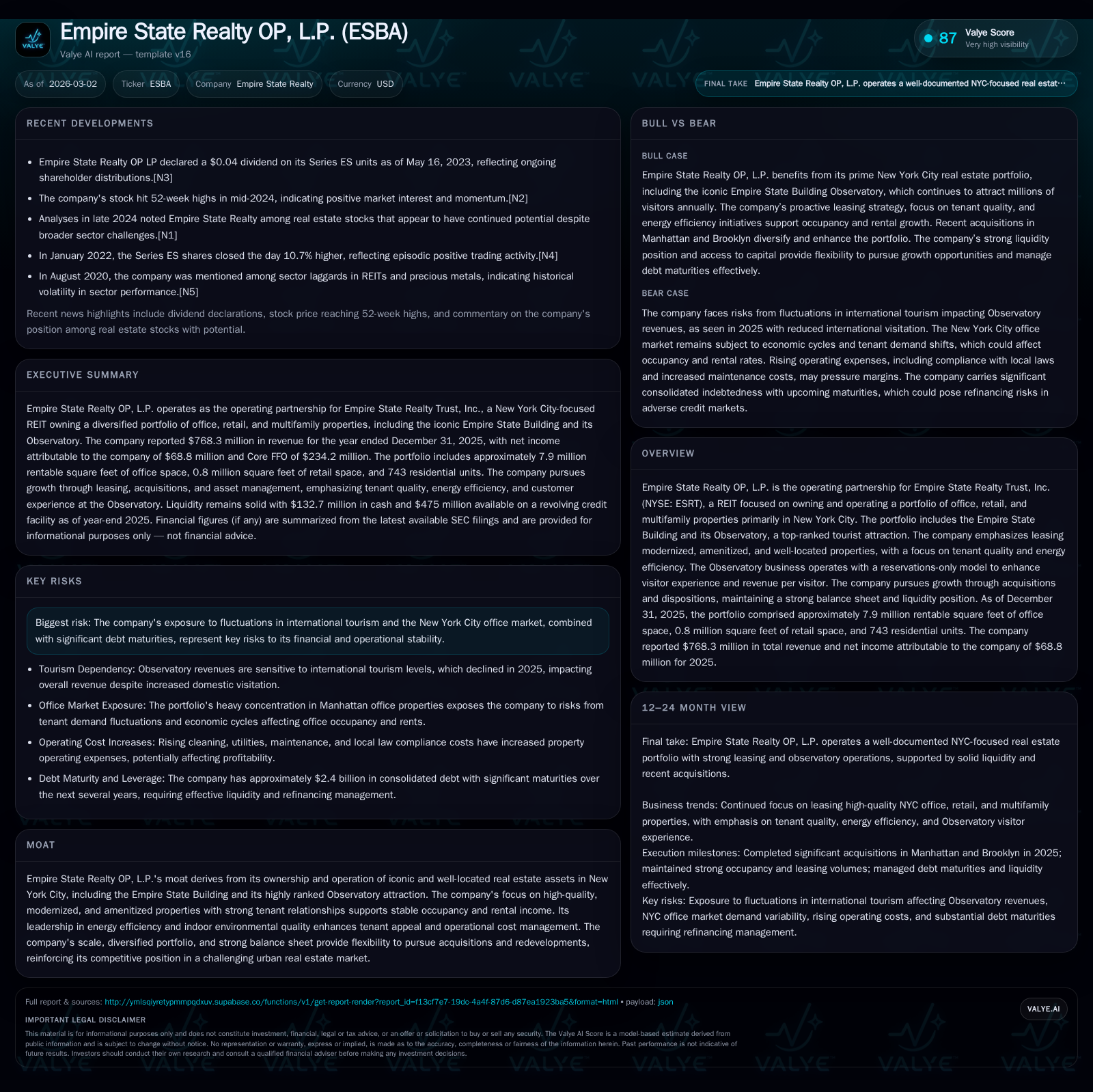
In 2025, Empire State Realty OP delivered stable revenue growth driven by strong leasing performance and targeted acquisitions that expanded its footprint in Manhattan and Brooklyn. While rental revenues increased modestly, operating income declined due to higher property operating costs, real estate taxes, and capex-driven depreciation. The company’s portfolio modernization and tenant flight-to-quality focus support near 90% occupancy and long-term lease renewals. However, elevated leverage with $2.4 billion in consolidated debt poses refinancing risks amid volatile office and retail markets. Cash flow generation remains solid with prudent dividend payments and limited buybacks. Key milestones to monitor include lease renewal spreads, occupancy trends post redevelopment, and debt maturity management.
Historic Revenue Stability and Leasing Momentum
Historical performance (annual)
| FY | Rev ($mm) | CFO ($mm) | OpInc ($mm) | Capex ($mm) | Rev YoY |
|---|---|---|---|---|---|
| 2025 | 768 | 249 | 136 | +0.0% | |
| 2024 | 768 | 261 | 159 | +3.8% | |
| 2023 | 740 | 232 | 147 | 169 | +1.7% |
| 2022 | 727 | 211 | 127 | 86 |
Source: SEC companyfacts cache [F1].
Capital returns and efficiency (annual)
| FY | Div ($mm) | Buybacks ($mm) | FCF ($mm) |
|---|---|---|---|
| 2025 | 39 | 8 | |
| 2024 | 38 | 0 | |
| 2023 | 37 | 13 | 63 |
| 2022 | 39 | 90 | 125 |
Source: SEC companyfacts cache [F1].
Empire State Realty OP’s topline held steady at approximately $768 million for fiscal year 2025, marginally up from $768 million in 2024 [F1]. Rental revenue growth of 1.9% was powered by increased base rents and higher tenant reimbursements totaling an additional $7.6 million; however, this was offset somewhat by reduced observatory revenues which declined nearly 6% due to lower international visitation post-pandemic recovery [S1].
The company's leasing engine remains vigorous — ESBA signed new leases, renewals, and expansions covering over 1 million rentable square feet for the year. This robust activity contributed to Manhattan office occupancy rising by 90 basis points to approximately 89.9%, excluding properties under active redevelopment or non-office uses such as storage or broadcasting facilities [S1][S5]. The leasing result reflects effective absorption momentum amidst NYC's competitive market.
Operating income contracted roughly 14.5% year-over-year to $136 million, pressured chiefly by rising property operating costs including inflationary pressures in cleaning payrolls, utilities consumption linked to higher building usage, preventive maintenance outlays, as well as heavier real estate tax burdens up about 3% over prior year levels [F1][S8]. In spite of stable top-line revenues, these cost headwinds highlight mounting expense pressure typical of managing an urban core portfolio refined via regulatory compliance demands.
Leasing Quality and Tenant Relationships as Growth Engines
ESBA’s growth strategy centers on tenant flight-to-quality — attracting creditworthy tenants seeking well-located assets enhanced with modern amenities such as upgraded HVAC systems promoting indoor environmental quality alongside energy efficiency measures that reduce utility pass-through costs [S5]. This strategy supports consistent occupancy absorption across economic cycles and underpins sustainable rental growth.
Key to this approach is the proactive cultivation of broker networks and early lease renewals executed more than two years ahead of expiration dates (‘Early Renewals’), fostering longer tenant tenure and minimizing vacancy gaps [S5]. Since the IPO inception, ESBA has expanded leases totaling over 3.2 million square feet with existing tenants through upsizing or extensions.
Tenant diligence processes involve meticulous credit analysis focused on solvency forecasts and growth viability enabling high confidence in renewing quality clients while limiting exposure to riskier counterparties. This tenants-first ethos is embedded throughout asset management practices including consistent communication channels and bespoke tenant improvements aimed at maintaining high satisfaction levels.
Portfolio Acquisitions Amplify Market Position
ESBA selectively bolstered its commercial footprint through acquisitions aimed at premier submarkets beyond historic core holdings concentrated mainly in lower Manhattan. In June 2025, the company closed on two retail properties on North 6th Street in Williamsburg for $31 million, broadening reach into one of Brooklyn’s fastest-growing neighborhoods dominated by mixed-use developments [S1][S4].
Subsequently, December saw closing on the acquisition of 130 Mercer Street located in Manhattan’s SoHo neighborhood for a substantial purchase price of $386 million, adding strategically diversified commercial office plus retail space assets positioned within a highly sought-after submarket distinguished by creative sector tenants [S1][S4]. These acquisitions signal reinforcement of ESBA’s footprint targeting markets benefiting from innovation clusters intertwined with lifestyle retail.
Operating Income Pressures Amid Rising Expenses
Despite nominal top-line gains driven predominantly by rent escalations and ancillary reimbursements, operating income retreated due mainly to increasing property operating expenses—they rose about 3.1% fueled primarily by wage inflation affecting cleaning staff compensation alongside utilities costs heightened by fuller occupancies [F1][S8]. New local laws mandating stricter building compliance further lifted maintenance standards incurring additional unplanned expenses.
Real estate taxes climbed approximately 3% attributable to higher assessments on multiple portfolio properties where appraisal values reflected tightening NYC real estate capital markets fundamentals [S8]. Concurrently depreciation expense increased reflecting capitalized expenditures on tenant improvements tied directly to strong leasing activity pushing amortization schedules higher than previous years.
This expense dynamic underscores how intensified capital deployment aimed at sustaining asset premium status produces near-term margin compression before yielding full rent roll benefits.
Capital Structure Profile Highlights Debt Maturities and Liquidity Buffers
As of December 31, 2025, ESBA reported consolidated indebtedness around $2.4 billion bearing weighted average interest cost near 4.48% with median maturity close to five years indicating moderate duration risk concentrated between 2026-2030 horizon [F1][S3][S4]. Scheduled maturities include approximately $54 million due in 2026 followed by larger tranches exceeding $150 million annually through subsequent years until reaching over $500 million maturing in 2030 alone.
Liquidity buffers remain healthy featuring about $133 million cash availability augmented by an unused revolving credit line capacity totaling roughly $475 million, providing cushion against short-term funding requirements or opportunistic capital deployment needs [F1][S4].
No charter-mandated leverage caps constrain ESBA but current market pressures on office/retail asset valuations cause heightened scrutiny from lenders prompting emphasis on prudent refinancing strategies ahead of sizeable refinancings near term.
Intensive Capital Investment Supporting Modernization and Compliance
Capital expenditure intensity nearly doubled from prior year levels—rising approximately 97% year-over-year, reflecting a multiyear program targeting building modernization via tenant improvements including pre-builds designed for swift occupancy turnaround alongside green technology retrofits aligned with industry-leading energy-efficiency benchmarks championed by ESBA [F1][S5][S10].
Significant capex also addressed local code compliance updates remedial works coupled with redevelopments enhancing space utilization flexibility critical for appealing to evolving tenant preferences facilitating both retention and attraction efforts.
Such capex-heavy investment cycles are common among urban landlords committed to maintaining leading-edge building profiles amid rising ESG considerations across capital markets landscape.
Dividend Policy, Share Buybacks, and Returns Analysis
The company maintained steady quarterly dividend distributions culminating in about $38.9 million total payout for FY2025 consistent with REIT payout mandates designed to distribute minimum taxable income yearly [F1]. Meanwhile share repurchase activity was modest—roughly $8.12 million—a cautious approach likely reflecting management’s prudent liquidity stewardship under elevated leverage conditions limiting aggressive capital return programs.
Operating cash flow generation remained sound at over $249 million, yielding approximate free cash flow near $79.9 million after subtracting capex intensity supporting ongoing shareholder returns alongside reinvestment priorities without compromising balance sheet health materially [F1].
Outlook: Opportunities within Constraints
Looking ahead, ESBA faces evolving risks primarily from NYC’s office market cyclicality exacerbated by hybrid work adoption dampening space demand alongside fluctuations in international tourism impacting Empire State Building Observatory visitation patterns which declined visibly during calendar year 2025 compared to prior years despite domestic visitation upticks [S1][S7].
Balancing these challenges requires continued execution of tenant-focused leasing emphasizing credit quality combined with disciplined capital structure management especially around addressing significant debt maturities forecasted within coming five years period.
Key performance indicators warranting monitoring include sustained occupancy levels post-redevelopment completions aiming above current ~90%, lease renewal spreads relative to expiring rents signaling rental rate traction trends plus successful refinancing outcomes mitigating interest burden volatility that could constrain cash flow available for dividends or reinvestment.
Overall Empire State Realty OP leverages signature asset stature intertwined with operational rigor rooted in tenant relationship depth positioning it favorably within a complex NYC real estate ecosystem marked equally by opportunity and financial discipline imperatives.
This analysis is prepared for informational purposes only based on public filings dated March 2, 2026 ([F1], [S#]) and does not constitute investment advice or recommendations.
Disclaimer: This is research-only, informational analysis and not investment advice. It may include AI-generated interpretation and general industry context. Always verify important details using primary sources.

Comments