
ESG Inc. Restructures by Splitting China Operations to Focus on North American Mushroom-Based Food Commercialization
Following a strategic split-off of its China-based business, ESG Inc. is advancing early-stage product development and commercialization in North America amidst liquidity and regulatory challenges.
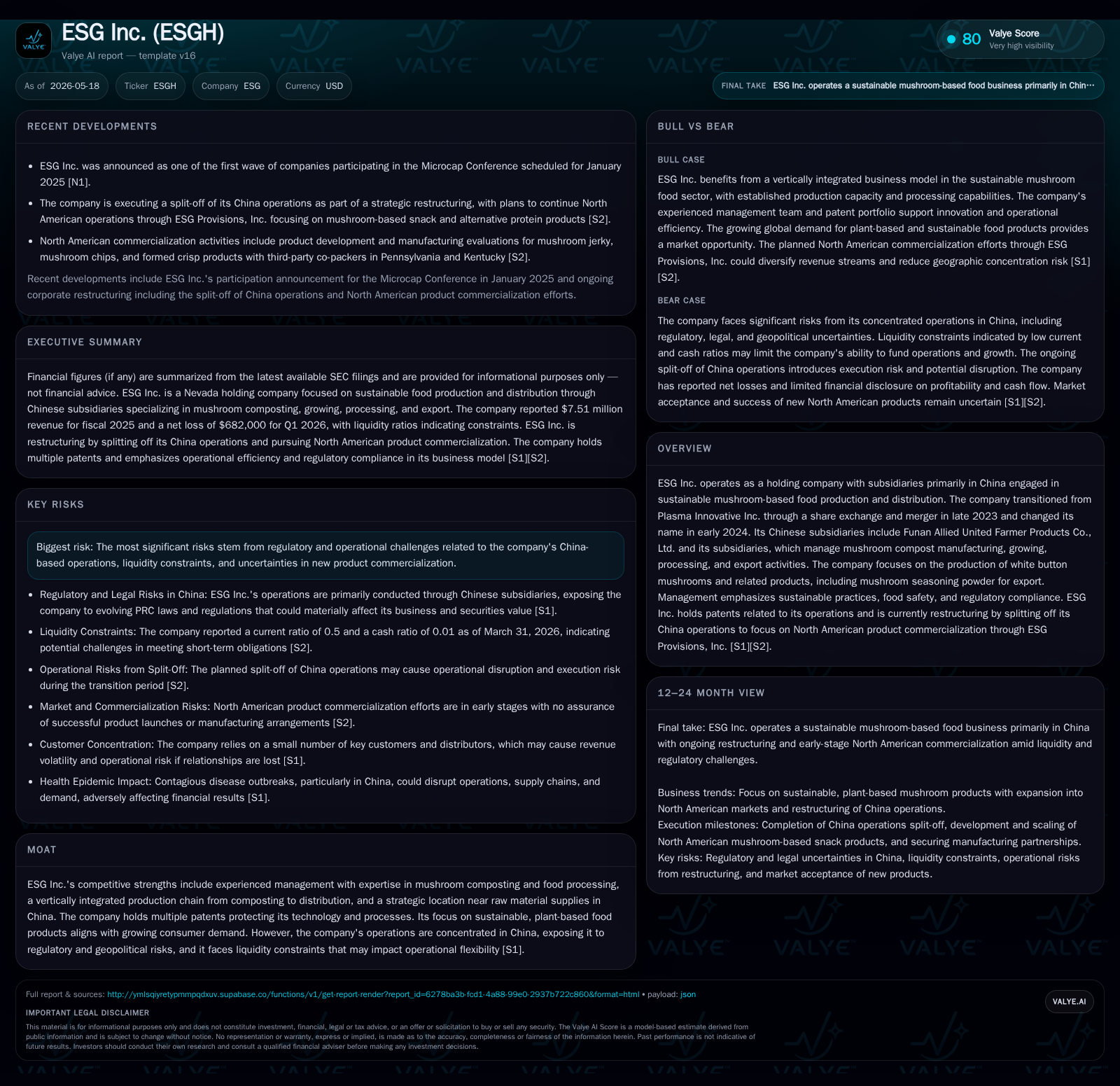
In its latest quarterly filing dated May 15, 2026, ESG Inc. announced the formal split-off of its China operations to refocus on North American food product commercialization through its subsidiary ESG Provisions, Inc. The company’s historical vertical integration in China centered on sustainable mushroom production, but ongoing geopolitical and liquidity pressures have driven this restructuring. North American activities concentrate on mushroom-based snacks and alternative protein products with product scale-up efforts underway in Pennsylvania. Despite potential growth from aligning with plant-based consumer trends, ESG faces notable risks including liquidity constraints, reliance on co-packers, and uncertainty in new product launches.
Recent Operating Update
On May 15, 2026, ESG Inc. filed its latest quarterly report (10-Q) highlighting material developments in its corporate structure and operational focus [S2]. The most significant change was the execution of a Split-Off and Share Exchange Agreement dated April 10, 2026, whereby ESG distributed all shares of its China-based subsidiary ESG China Limited to DCG China Limited and related parties. This transaction involved the surrender and cancellation of over ten million shares of ESG common stock held by those stakeholders as consideration [S3][S4][S5]. Critically, liabilities associated with the China operations remain with the spun-off entity or related operators rather than with ESG or its non-China affiliates, aiming to isolate financial risk.
Following this separation, ESG announced it would continue its operating business solely through ESG Provisions, Inc., focusing on the North American market. Current activities include development and potential commercialization of mushroom-based snack foods—specifically mushroom chips, jerky, formed crisps, and other prepared mushroom products—with partnerships established or under evaluation with co-packers based in Pennsylvania for production scale-up [S3][S6]. Management conveyed cautious optimism about these initiatives but emphasized no assurance regarding timing or success.
The quarterly filing also restated persistent liquidity constraints impacting ESG's flexibility amid this transition phase [S2][S7]. The prior reporting period's risk disclosures were largely reiterated except for updates reflecting the evolving operational geography and early-stage North American commercialization efforts
Business Model
ESG Inc.'s business model has historically been anchored in vertically integrated sustainable mushroom production primarily executed through Chinese subsidiaries [S1]. This integration includes manufacturing mushroom compost—a blend of wheat straw and animal manure—mushroom cultivation (notably white button mushrooms), downstream processing into fresh and packaged products such as mushroom seasoning powder for export, and distribution channels tied closely to domestic Chinese markets
The revenue mechanics hinge on sales volumes driven by harvest yields filtered through pricing dictated by both local market conditions and export demand cycles. Product mix has included fresh mushrooms (a lower-margin commodity-like product) alongside higher-margin processed items like mushroom seasoning powder.
Intellectual property comprising multiple patents related to composting processes helps provide some technological differentiation within their niche [S1]. However, the model is heavily reliant on access to abundant raw materials near production facilities (notably Funan in Anhui province) which historically controlled unit economics.
Following the separation of their China operations via the recent split-off agreement — a move prompted by both regulatory complexities in China’s evolving food safety landscape and geopolitical considerations — ESG is reshaping its model around branded novel food products targeting North American consumers through ESG Provisions. Here revenue would come from retail channel sales or contracts with food service providers purchasing alternative protein snack items developed primarily from mushrooms. Pricing power may improve if they successfully differentiate via taste profiles or health attributes versus competitors.
Contracts with third-party manufacturers (co-packers) introduce outsourcing into what had been an integrated chain — reducing capital intensity but increasing dependency on partner reliability. Bench sampling results have led to pilot trial agreements signaling progress in operational scaling though these remain at an early stage without confirmed commercial launches yet [S3][S6]
Industry Structure and Competitive Position
The sustainable plant-based food sector is experiencing rising consumer interest driven by dietary preferences shifting toward health-conscious, environmentally friendly alternatives. Mushrooms as an ingredient are attractive because they offer umami flavor profiles combined with nutrient density.
Within this context, ESG’s prior vertically integrated model provided control over quality and supply chain costs uncommon among smaller specialty food producers. However, fragmentation exists across geographies—Chinese producers primarily serve Asian commodity markets whereas North American competitors include diversified meat-alternatives firms incorporating mushrooms alongside pea protein or soy bases.
ESG’s competitive moat partially arises from IP-backed composting technology improving cultivation efficiencies—a key variable input cost driver—and legacy relationships managing regulatory compliance in China’s complex environment [S1]. Post-split the company relinquishes this vertical ownership but gains flexibility by focusing on innovation-led branded products aligned with consumer trends.
Competition in North America spans established plant-based snack brands heavily marketing protein content, texture innovation, clean labels, and distribution breadth. Without large-scale manufacturing capacity internally owned after divestiture of Chinese ops, ESG will compete by leveraging co-packers' capabilities alongside brand marketing efforts tied to "Moku" mushroom jerky rights acquired previously [S3]
The lack of broad product diversification remains a structural vulnerability but can be mitigated if initial offerings demonstrate compelling sensory appeal or functional advantages driving repeat purchase behavior.
Growth Drivers
Transition to Branded Consumer Products
The planned commercial expansion via ESG Provisions targets a valuable niche tapping increased demand for sustainable snacking options containing alternative proteins. Specialty formats like mushroom chips or jerky offer growth leverage beyond traditional fresh produce sales where margins are tighter.
Co-Packing Partnerships Accelerating Scale-Up
Collaborations underway with Pennsylvania contract manufacturers afford technical scale validation without incurring heavy fixed asset investments upfront—essential for capital conservation amidst cash flow pressures [S3][S6]. Successful pilot outcomes can clear path for larger production runs supporting retail entry.
Intellectual Property Portfolio
Patents governing elements of composting technology not only raise entry barriers in upstream supply but may eventually feed into proprietary formulations or process enhancements for finished goods enhancing quality or shelf life.
Consumer Trends Favoring Plant-Based Foods
Structural tailwinds supporting growth include increased adoption of flexitarian diets encouraging mushroom inclusion as meat substitutes or flavor enhancers offering clean-label benefits attractive primarily among Millennials and Gen Z demographics.
Risks / Watchpoints / Growth Constraints
Liquidity Constraints & Balance Sheet Pressure
As of Q1 2026 data shows current liabilities exceeding current assets by nearly triple (current ratio ~0.5) along with net debt approximating $1.1 million creates operational risk during transition phases requiring working capital infusion or refinancing support [F1][S2]
Execution Risk for New Product Commercialization
New product initiatives remain at bench sampling or pilot testing stages with no guarantees on customer acceptance or scaling timelines hindering near-term revenue recognition [S3][S6]
Dependency on Co-Packers & Manufacturing Partners
Outsourced production introduces risks surrounding capacity availability, quality control deviations, lead times delays—all factors difficult to fully control especially for an early-stage operation still validating formulations.
Regulatory & Geopolitical Exposure Previously Concentrated in China Operations
Although the recent split-off isolates legal risk somewhat from parent company finances there remains residual reputational risk as well as loss of operating scale that helped amortize fixed costs; regulatory landscape changes could still indirectly influence supply agreements or IP rights previously owned [S1][S7]
Customer Concentration History & Market Uncertainty Post-Separation
Legacy revenue came predominantly from few customers/distributors concentrated geographically; changing customer mix in new markets could produce volatility while required brand building demands capital.
What to Watch Next
- Completion milestones of product development trials at Pennsylvania co-packing facilities including any public announcements regarding commercial manufacturing arrangements.
- Early sales traction indicators post-launch involving channels tested (retail distribution agreements or e-commerce avenues).
- Progression of working capital management including debt refinancing efforts if any to alleviate liquidity bottlenecks reported at Q1 end.
- Regulatory filings or statements clarifying residual relationship with spun off Chinese entities especially concerning IP licensing or cross-border business initiatives.
- Updates on potential acquisitions or partnerships that could broaden product portfolio or accelerate geographic rollout beyond initial North America focus.
- Monitoring retentions/turnover among management team members pivotal during critical commercialization phase.
- Any revised financial guidance expected aligned with restructuring completion post-split.
Financial Profile Overview
Financially, fiscal year ended December 31, 2025 figures reveal $7.51 million in total revenue concentrated mainly in fresh white button mushrooms plus newly initiated processed product lines but accompanied by operating losses exceeding $2 million indicating ongoing investment phase [F1]. Liquidity is constrained—with cash reserves at roughly $43 thousand versus total debt north of $1.13 million—as well as seasonal nature of agricultural sales impacting working capital requirements reflected by a depressed current ratio around 0.5 through Q1 2026 period-end [F1][S2].
This fragile balance sheet alongside early-stage revenues underscores a critical need for effective capital management aligned closely with commercialization success metrics described above going forward.
This analysis is intended solely to provide an informed overview based strictly on disclosed public filings as cited without expressing investment opinion or research views.
Financial position in context
As of 2025-12-31, companyfacts shows $42978 in cash and equivalents and $1139629 of total debt [F1]. The same snapshot implies net debt of roughly $1096651, keeping balance-sheet context relevant but secondary to the operating story [F1]. Current assets of $7mm and current liabilities of $14mm imply a current ratio near 0.5x for 2026-03-31 [F1].
Disclaimer: This is research-only, informational analysis and not investment advice. It may include AI-generated interpretation and general industry context. Always verify important details using primary sources.

Comments