
Estrella Immunopharma Pushes EB103 Into Phase II Amid Capital and Compliance Headwinds
Estrella Immunopharma advances its STARLIGHT-1 trial into Phase II after positive safety review but faces acute liquidity and Nasdaq compliance challenges.
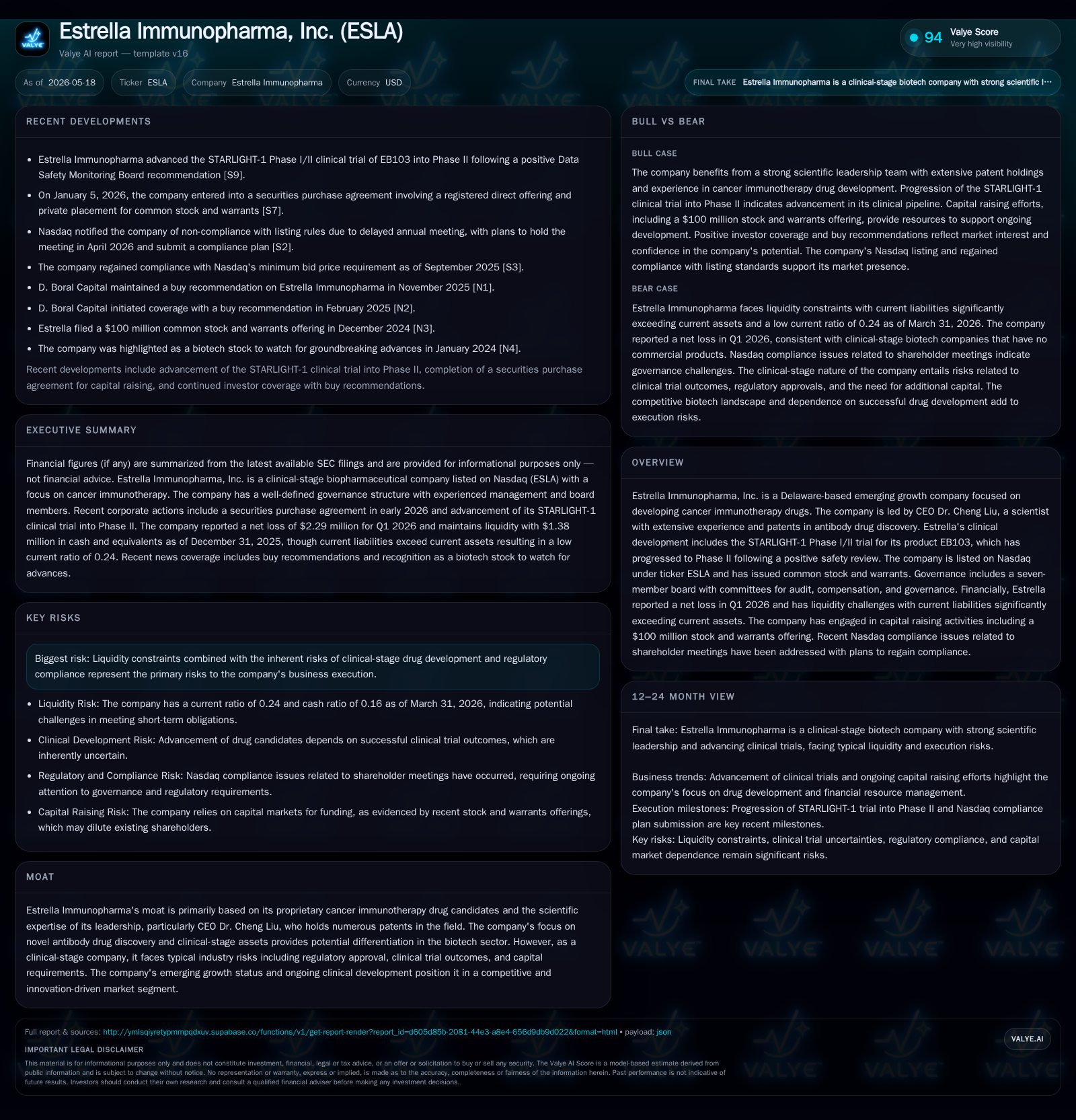
Estrella Immunopharma reported in its May 2026 10-Q that its lead immunotherapy candidate, EB103, has advanced to Phase II following a positive Data Safety Monitoring Board (DSMB) review, marking a crucial development milestone. However, the company continues to grapple with severe liquidity constraints, evidenced by a current ratio of 0.24 with current liabilities vastly outstripping assets, and ongoing Nasdaq compliance issues related to governance timing. As a clinical-stage biotech focused on cancer immunotherapy, Estrella’s value proposition rests on pipeline innovation and clinical outcomes, while its near-term execution is tightly coupled to capital availability and regulatory adherence. Upcoming data readouts and regulatory filings will be key indicators of progress amid these operational headwinds.
Latest Quarterly Operating Highlights: Advancing Clinical Trials
In the latest 10-Q filing dated May 18, 2026 [S2], Estrella Immunopharma confirmed that its STARLIGHT-1 Phase I/II clinical trial for EB103 has successfully transitioned into the Phase II portion following a favorable research view from the independent Data Safety Monitoring Board (DSMB) issued in late 2025 [S3][S8]. This advancement marks a pivotal operational milestone demonstrating both an encouraging safety profile and initial signals supporting further efficacy evaluation. The transition from dose-escalation early-stage study to expanded cohort evaluation widens patient exposure and increases the data volume necessary for pivotal decision-making.
This development injects momentum into the company’s otherwise challenged operating environment by validating its lead asset’s viability within the competitive cancer immunotherapy field. However, no commercial revenues have been generated yet given the preclinical status of all drug candidates.
Business Model and Clinical-Stage Product Focus
Estrella Immunopharma functions as an emerging growth biotech company primarily engaged in developing novel cancer immunotherapies centered around antibody drug discovery technology led by CEO Dr. Cheng Liu [S1]. The company’s revenue mechanics rely exclusively on progression through clinical trial phases, which constitute value inflection points for attracting capital investment or partnering opportunities.
Since it has no approved products or marketed therapies, Estrella depends entirely on external financing—equity offerings, private placements—and potential licensing deals contingent on trial milestones. Intellectual property protections related to Dr. Liu’s patents underpin the moat that attempts to create differentiation against other antibody-based immunotherapeutics under development.
The high R&D expense profile coupled with zero product-generated cash flow enforces a capital-intensive model where funding availability directly governs operational sustainability.
Competitive Positioning in Cancer Immunotherapy
Operating within the intensely competitive oncology biologics landscape, Estrella faces formidable peer competition including large-cap companies with approved checkpoint inhibitors or CAR-T therapies alongside multiple clinical-stage biotech firms advancing monoclonal antibodies or bispecific agents [S1]. Its asset EB103 remains early in development relative to commercial incumbents.
The company must establish compelling clinical efficacy and superior safety or combinatorial benefits during ongoing trials to position itself favorably for eventual market entry or strategic partnership. Pricing power will only materialize upon regulatory approval backed by robust clinical data demonstrating differentiation in treatment-resistant cancers or unmet needs.
The financing environment typical for similarly sized biotech entities at Phase I/II stages often fluctuates dramatically depending on trial results outlook and broader capital market conditions.
Pipeline Differentiation and Product Quality Assessment
EB103 represents a proprietary immunotherapy candidate built on unique antibody discoveries credited to CEO Liu's patent portfolio [S3]. The positive DSMB research view communicated during Q4 2025 confirms no significant safety concerns so far — a critical threshold before expanding dosing cohorts.
While efficacy signals remain under evaluation, this safety clearance allows progression into more extensive patient populations needed for statistically meaningful endpoints. In the context of antibody therapeutics targeting difficult-to-treat cancers, such tolerability often predicates commercial viability given severe side effect profiles seen with alternative modalities.
Despite these raises, depletion rates are likely rapid due to expensive clinical activities typical for complex biologic manufacturing and testing processes combined with SG&A costs related to regulatory compliance and corporate governance.
Additionally, Nasdaq listing communications from January 2026 report non-compliance due to delayed shareholder annual meeting scheduling but affirm management's intent to cure within prescribed deadlines [S14]. This illustrates added governance strain that could impact investor confidence alongside financial stress.
Growth Drivers: Clinical Milestones and Portfolio Expansion
Primary drivers for Estrella’s near-to-mid-term growth trajectory revolve around milestone achievements tied directly to EB103 development progress. Successful Phase II dose cohort completions with accompanying preliminary efficacy readouts could catalyze follow-on patient enrolment or partnership interest.
Expanding indication scope beyond initial cancer types studied or initiating supplementary assets would further enhance pipeline breadth — though currently unreported in filings — remaining speculative until disclosed [S3]
Management’s scientific leadership anchored by CEO Liu's expertise lends credibility toward refining pipeline innovation potentially attractive to biotech investors focused on differentiated immunotherapy candidates amid crowded treatment landscapes.
Risks and Growth Limitations: Funding Needs and Regulatory Oversight
Estrella operates within a high-risk domain where failure probabilities are notable given early trial stages combined with stringent FDA regulations governing biologic approvals [S2]. Safety setbacks or insufficient efficacy outcomes could derail timelines materially.
Moreover, Nasdaq compliance challenges related primarily to procedural timelines exacerbate reputational considerations which might deter institutional investors seeking stable governance standards [S14].
The compounded effect of these risks suggests vigilant monitoring of execution capabilities alongside market conditions is essential when assessing business continuity prospects at present juncture.
Key Near-Term Catalysts to Monitor
Investors and observers should focus on several actionable operating events over subsequent quarters:
- Completion status of higher-dose cohorts within STARLIGHT-1 Phase II segment.
- Interim efficacy data dissemination that could inform dose-response relationships or safety signals.
- Confirmation of annual shareholder meeting occurrence resolving Nasdaq compliance matters.
- Additional financing announcements required to extend cash runway beyond mid-2026 horizon.
- Any new partnerships or licensing agreements indicating external validation of platform science. Monitoring these milestones offers insight into whether Estrella can sustain developmental momentum despite structural pressures imposed by its nascent financial condition.
Financial Profile: Liquidity Snapshot And Structural Observations
As supported by companyfacts balance-sheet metrics ending March 31, 2026 [F1], Estrella holds $2.16 million in current assets predominantly as cash equivalents ($1.38 million at prior year-end), starkly contrasted by nearly $8.93 million in current liabilities creating a pressing shortfall situation. The net loss recorded at approximately $13 million for fiscal year ended December 31, 2025 underscores substantial operating expenditure commitments without offsetting revenues [F1].
Recent equity financings totaling roughly $8 million gross earlier this year have marginally alleviated funding constraints but remain insufficient for full-cycle clinical advancement absent further capital inflows [S15][S18]. In this context, solvency concerns dominate near-term outlook absent rapid infusion of resources or strategic partnerships capable of underwriting costly drug development phases.
Overall financial structure highlights acute working capital risk which must be navigated carefully alongside operational challenges occasioned by intensive R&D activities inherent in early biotech ventures.
This analysis is based exclusively on publicly available filings and reports provided through SEC disclosures up to May 2026 and does not constitute investment advice or endorsement. Readers should consider professional consultation before making decisions related to Estrella Immunopharma’s securities or business prospects.
Disclaimer: This is research-only, informational analysis and not investment advice. It may include AI-generated interpretation and general industry context. Always verify important details using primary sources.

Comments