
Estrella Immunopharma’s Clinical Ambition Meets Acute Funding and Listing Pressures
Estrella Immunopharma is a clinical-stage oncology company with proprietary T-cell therapies and an expanded STARLIGHT-1 trial footprint.
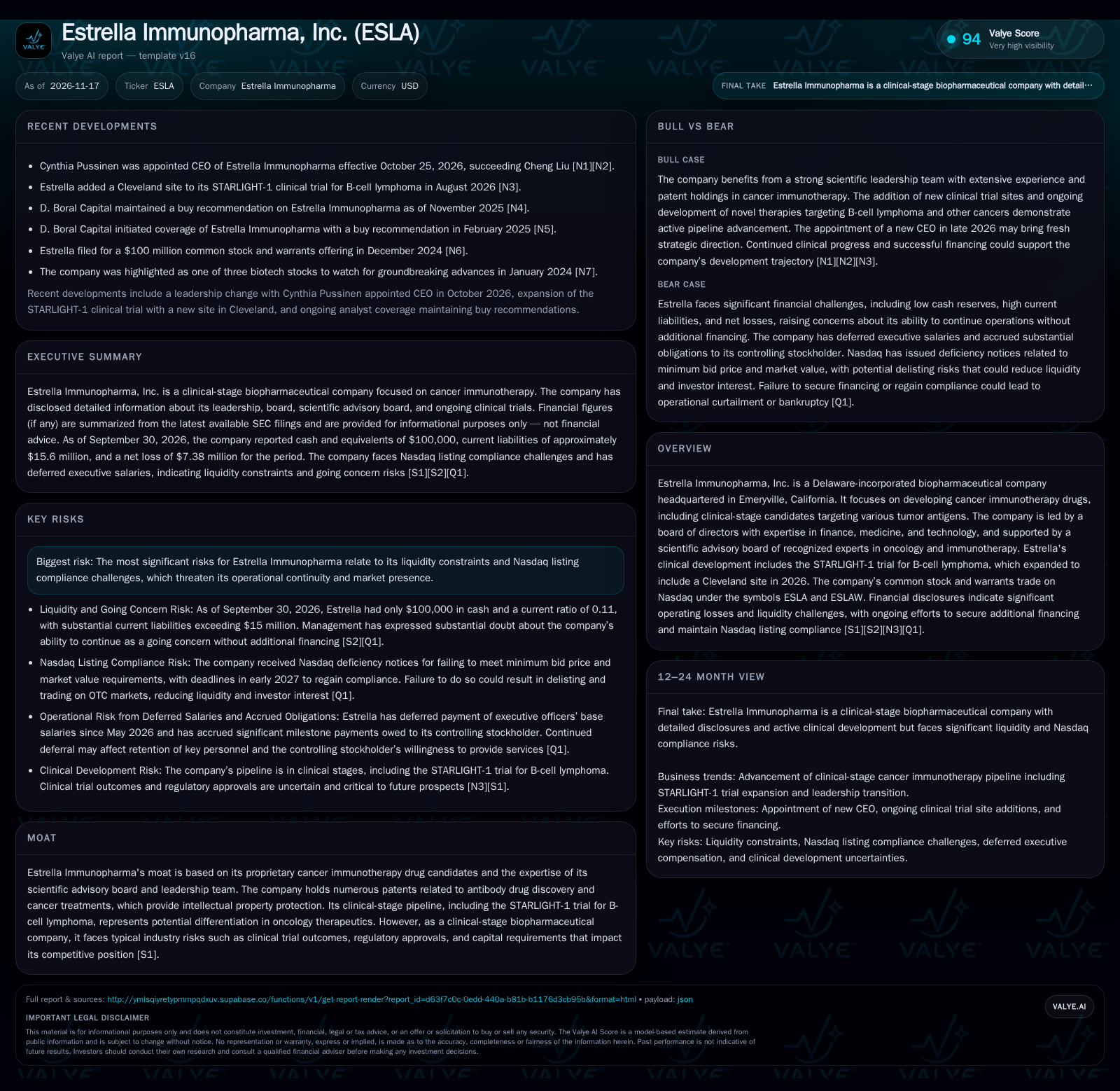
Estrella Immunopharma is a clinical-stage oncology company with proprietary T-cell therapies and an expanded STARLIGHT-1 trial footprint. However, as of September 2026, it faces severe liquidity shortfalls, high current liabilities, and Nasdaq compliance deadlines. A new CEO brings potential strategic reset, but the company’s survival hinges on rapid financing, successful trial progress, and retention of critical partnerships. [S1] [S2] [N1] [N2] [N3]
Estrella Immunopharma is racing the clock on multiple fronts: the company’s pioneering work in T-cell immunotherapies for cancer has produced a growing clinical pipeline, but a cash crisis and deferred compensation now threaten its operational continuity. With Nasdaq compliance hanging in the balance and a new CEO at the helm, Estrella’s next moves will determine whether it can secure the financing and credibility needed to translate scientific promise into commercial survival.
Liquidity Cliff, Leadership Transition, and Nasdaq Deadline Define the Immediate Outlook
Estrella Immunopharma’s most pressing facts as of November 2026 are stark: it reported just $100,000 in cash and equivalents versus $15.64 million in current liabilities as of September 30, 2026, resulting in a current ratio of 0.11 and a cash ratio of 0.01 [S2]. Executive salaries have been deferred since May 2026, and the company has accrued $15.1 million in milestone payments owed to its controlling stockholder, Eureka. Nasdaq issued deficiency notices for minimum bid price and market value in August and September 2026, with compliance deadlines in early 2027, threatening the company’s exchange listing. Meanwhile, Estrella appointed Cynthia Pussinen as CEO effective October 25, 2026, replacing founder Dr. Cheng Liu [N1] [N2]. The STARLIGHT-1 trial for B-cell lymphoma expanded to a Cleveland site in August 2026 [N3].
These facts matter because Estrella’s continued operation is contingent on near-term capital infusion, retention of key personnel and partners, and its ability to maintain investor access and visibility through its Nasdaq listing. The leadership transition adds a potential pivot point, but does not by itself resolve the acute liquidity and compliance challenges.
Underlying Cost Structure and Capital Needs in a Clinical-Stage Biotech Model
Estrella’s economic model follows the high-burn, high-risk archetype of clinical-stage biopharmaceutical firms: substantial upfront investment in R&D, clinical trials, regulatory submissions, and intellectual property, with little to no revenue until a therapy is approved and commercialized. The company’s net loss of $7.38 million for the period ending September 30, 2026, reflects this dynamic [S2]. Variable costs are dominated by clinical trial expenses (e.g., patient recruitment, site management, CRO contracts), while fixed costs include a lean but highly specialized workforce and ongoing licensing/milestone obligations to Eureka.
Operating leverage is negative at this stage: incremental trial spending does not generate near-term revenue, and deferred compensation suggests cash conservation measures are already exhausted. The absence of meaningful revenue or licensing income means immediate capital needs must be met through equity, debt, or partnership funding—each now complicated by the company’s precarious balance sheet and risk profile.
If Estrella’s lead programs (EB103/EB104) advance successfully, the economics could shift rapidly, with potential for milestone payments, out-licensing, or eventual product sales. However, current facts indicate a crisis-driven need for external capital merely to sustain ongoing trials and fixed obligations.
Intellectual Property and Pipeline as Differentiators—But Scale and Funding Gaps Persist
Estrella’s competitive positioning stems from its proprietary ARTEMIS® T-cell platform, targeting CD19 and CD22 antigens—validated targets in B-cell malignancies. The company’s scientific advisory board and leadership have deep immunotherapy credentials, and the expanded STARLIGHT-1 trial indicates ongoing clinical momentum [S1] [N3]. This intellectual property and clinical pipeline offer a potential moat versus generic or less-targeted immunotherapies.
However, the competitive field in oncology—especially CAR-T and TCR therapies—is crowded with well-capitalized incumbents and emerging biotech peers, many with broader pipelines, commercial infrastructure, or established pharma partnerships. Estrella’s dependence on Eureka for both IP and development services introduces concentration risk: any disruption in this relationship could cripple pipeline progress.
Capital scarcity and listing risk further erode Estrella’s competitive standing: potential partners or acquirers may perceive heightened execution risk, while investors may shy away from a company at risk of delisting and forced to trade OTC. Without sustained funding and visible clinical progress, IP alone may not secure a durable competitive advantage.
Rapid Capital Infusion and Clinical Milestones Ignite a Recovery Loop
The most favorable scenario for Estrella involves a timely and sufficient capital raise—through equity, strategic partnerships, or non-dilutive grants—that stabilizes operations, allows resumption of full executive compensation, and funds continued enrollment in the STARLIGHT-1 trial. Success at interim clinical milestones (e.g., safety, early efficacy signals) could restore investor confidence, attract additional funding, and potentially trigger interest from larger pharma partners seeking differentiated immunotherapy assets.
Confirmation of this scenario would require: public announcement of a completed financing round or strategic partnership; evidence of resumed executive compensation/payments to Eureka; positive trial updates (such as patient enrollment targets met, no severe adverse events, or signals of efficacy); and Nasdaq compliance regained before the stated deadlines.
A falsification would be continued delays in financing, further deferral of obligations, loss of Nasdaq listing, or negative clinical trial news.
Survival Mode: Minimal Funding Secured, Progress Slows, and Listing Remains at Risk
The most plausible near-term path is one of constrained survival: Estrella secures only enough capital—potentially via dilutive emergency financings, bridge loans, or incremental partner support—to temporarily fund payroll, core trial activities, and minimal operations. Executive and vendor obligations may continue to accrue, and progress on the pipeline slows as the company prioritizes only its lead program.
Clinical milestones may be delayed or downsized, and the risk of Nasdaq delisting remains high if share price or market value is not quickly restored. The company may begin to explore strategic alternatives, such as asset sales or merger discussions, but from a position of weakness.
Evidence for this scenario would include small-scale financing announcements, continued deferrals of payments, and clinical updates that reflect slower-than-expected progress. Falsification would require either a collapse into insolvency or a transformative capital event with operational ramp-up.
Capital Exhaustion Triggers Delisting, Layoffs, and Potential Bankruptcy
If Estrella is unable to secure additional funding before its cash is exhausted, the likely sequence is an imminent Nasdaq delisting, forced trading on OTC markets, and a rapid erosion of investor and partner confidence. Inability to pay executive and vendor obligations could lead to loss of key personnel, termination of clinical trials, and default on milestone payments to Eureka.
The company may be forced to liquidate assets, seek bankruptcy protection, or attempt a distressed sale of its pipeline. Any negative clinical trial developments or regulatory setbacks would accelerate this process.
Confirmation of this scenario would be missed Nasdaq compliance deadlines, public announcements of layoffs or halted trials, bankruptcy filings, or news of asset liquidation. A falsification would require a last-minute financing or acquisition that preserves operations and listing status.
Concrete Markers That Will Dictate Estrella’s Near-Term Survival or Failure
Disclosure of a completed financing transaction (equity, debt, or partnership), including terms, scale, and impact on cash runway.
Updates on Nasdaq compliance status, including any granted extensions, regained compliance, or formal delisting notifications.
Clinical progress on the STARLIGHT-1 trial: patient enrollment rates, interim safety/efficacy data, and expansion to additional sites if disclosed.
Resumption of regular executive compensation and payments to Eureka; a useful metric would be reduction in accrued obligations or reversal of salary deferrals if disclosed.
Changes in trial timelines or pipeline prioritization—such as delays, program discontinuations, or initiation of new studies.
Announcements of new strategic partnerships, licensing deals, or out-licensing of pipeline assets.
Turnover in key personnel or board members, particularly departures tied to funding or operational distress.
Material changes in the company’s relationship with Eureka, including amendments to licensing or services agreements, if disclosed.
Disclaimer: This is research-only, informational analysis and not investment advice. It may include AI-generated interpretation and general industry context. Always verify important details using primary sources.

Comments