
Launchpad Cadenza Acquisition Corp I: SPAC Ambitions, Sector Focus, and the Clock on Execution
Launchpad Cadenza Acquisition Corp I has raised $230 million to target a technology-driven acquisition in blockchain, fintech, or digital assets, leveraging an experienced sponsor team but facing sector competition and a fixed timeline to deliver shareholder value.
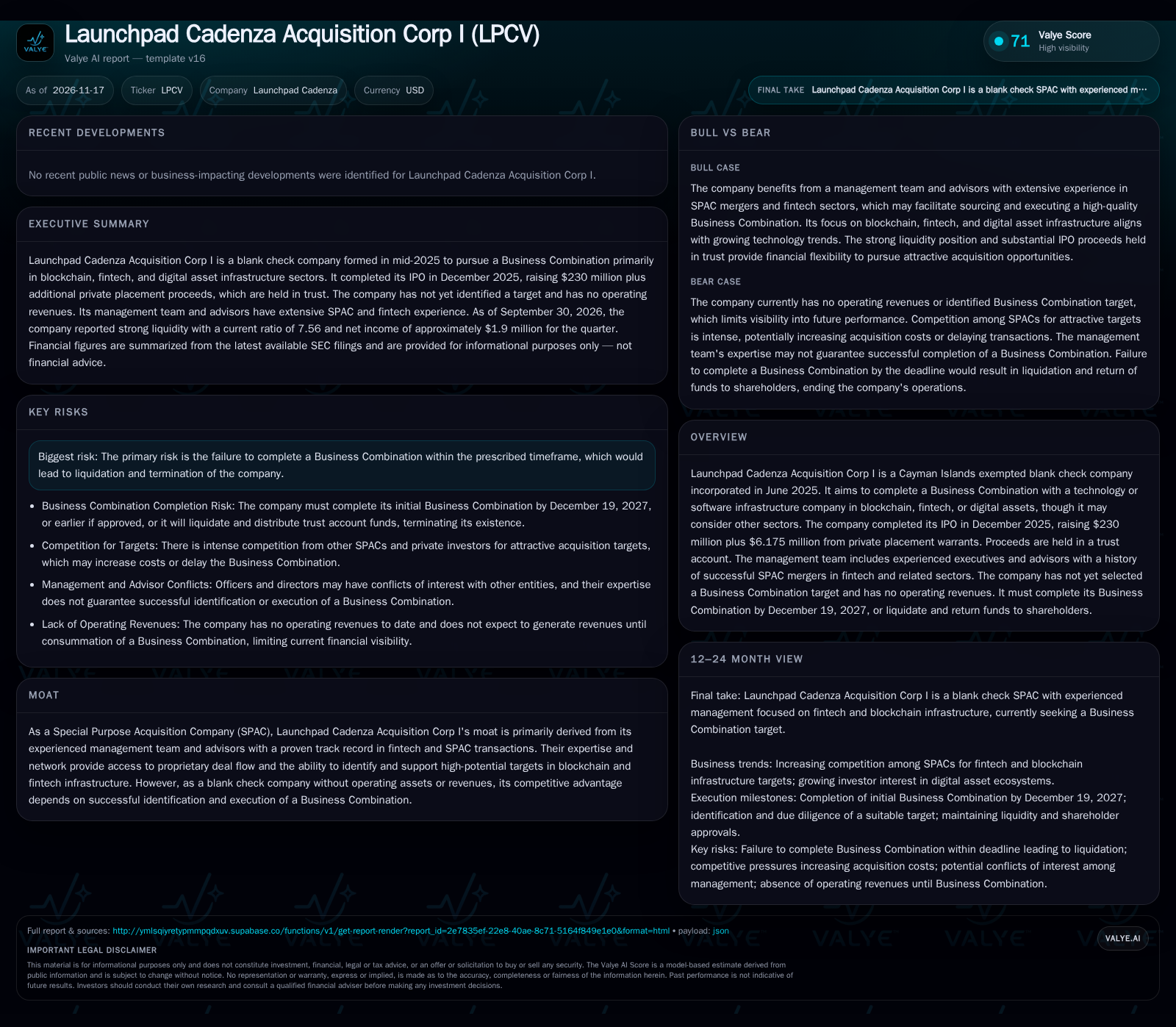
Launchpad Cadenza Acquisition Corp I is a SPAC with $230 million in trust, no operating revenues, and a focus on acquiring a growth-ready technology company in blockchain, fintech, or digital assets. The company's experienced management team and sector focus could provide deal flow advantages, but intense competition for targets, sector volatility, and a two-year deadline to complete a Business Combination create execution risk. Success depends on sourcing, negotiating, and closing a value-accretive deal before December 2027. [S2]
Launchpad Cadenza Acquisition Corp I is a blank check company with $230 million in IPO proceeds, aiming to acquire a technology-driven business in the rapidly evolving blockchain, fintech, or digital assets sectors. With a management team steeped in SPAC and fintech transactions, Launchpad Cadenza enters a crowded field where competition for quality targets is fierce and deal timelines are finite. The company's success hinges on its ability to source and close a compelling Business Combination before its December 2027 deadline, balancing sector opportunity against execution risk. [S2]
IPO Proceeds, Sector Mandate, and the Countdown to Business Combination
Launchpad Cadenza Acquisition Corp I completed its IPO in December 2025, raising $230 million from the sale of 23 million units at $10 each, with an additional $6.175 million from private placement warrants. All proceeds are held in a trust account pending the completion of a Business Combination. As of September 30, 2026, the company reported current assets of $691,024 and current liabilities of $91,436, producing a current ratio of 7.56. Net income for the quarter was $1,916,064, although the company has generated no operating revenues to date. Critically, Launchpad Cadenza has not yet identified an acquisition target and must close a transaction by December 19, 2027, or face mandatory liquidation and the return of trust funds to shareholders. The management team, led by CEO Max Shapiro and CFO Jurgen van de Vyver, brings experience in SPAC and fintech transactions, which could help in sourcing and executing a deal. [S2]
How SPAC Economics Shape Incentives and Potential Outcomes
Launchpad Cadenza's business model is typical of a SPAC: it holds IPO and warrant proceeds in trust, earning interest until a Business Combination is consummated. The company does not generate operating revenue prior to an acquisition; net income reported is likely due to interest income on trust assets and non-cash accounting items. The economics pivot dramatically post-acquisition: if a suitable target is found and merged, the combined company inherits the trust proceeds as growth capital and becomes a publicly traded entity. The sponsor and management team typically benefit from founder shares and private warrants, which convert into a meaningful ownership stake if a deal is completed. This creates strong incentives to close a transaction within the allotted window. However, the economics for public shareholders are highly sensitive to the quality and valuation of the selected target. Overpaying for a hot sector company, or merging with an unproven business, can erode post-deal value. Conversely, an accretive, well-timed acquisition can unlock significant upside. The fixed costs of running a SPAC are relatively low compared to operating companies, but the cost of delay or failed negotiations is high due to the hard liquidation deadline.
Navigating a Crowded Field: SPACs, Private Equity, and Sector-Specific Rivals
Launchpad Cadenza faces intense competition from other SPACs, private equity funds, and strategic acquirers targeting the same technology and fintech niches. The blockchain, fintech, and digital asset infrastructure sectors have attracted substantial investment and speculative interest, leading to rising valuations and fierce bidding for quality targets. SPACs compete not only on price, but on the perceived ability to help a target achieve public market readiness, provide capital, and offer ongoing support. Launchpad Cadenza's management and advisory team, with their fintech and SPAC backgrounds, may have access to proprietary deal flow and the ability to conduct sophisticated due diligence. However, these advantages are counterbalanced by the sheer number of capital pools chasing similar opportunities, and by the risk that the most promising targets may prefer to remain private, pursue traditional IPOs, or merge with better-known sponsors. The flexibility to consider targets outside its stated focus could be an advantage if sector valuations become untenable, but could also dilute the thesis if the eventual target lacks a clear technology or fintech angle.
If Proprietary Deal Flow and Sector Tailwinds Align
The optimal outcome for Launchpad Cadenza would involve leveraging its management team's sector expertise and networks to source a proprietary deal with a high-potential blockchain, fintech, or digital asset infrastructure business. If the company can identify a target with robust free cash flow, a clear growth trajectory, and a compelling rationale for going public, the SPAC's capital could accelerate scale and credibility. Successful execution would likely result in favorable post-merger performance, unlocking value for both public shareholders and sponsors. Confirmation of this scenario would come from announcements of a letter of intent or definitive agreement with a target that is recognized as a sector leader or innovator, supported by clear financial disclosures, credible growth projections, and evidence of management continuity post-merger. Evidence against this scenario would be a lack of deal activity as the deadline approaches, or a move toward a non-core sector due to inability to secure a suitable technology or fintech target.
Most Likely: Competitive Pressures Lead to a Conventional or Marginal Deal
The most plausible path is that Launchpad Cadenza, like many peer SPACs, faces significant competition for attractive targets and ultimately secures a deal with a mid-tier or less differentiated company in the broader technology or fintech space. The acquisition may still bring a private company to public markets, but at a valuation reflecting sector froth or limited operating history. Shareholder value creation in this scenario hinges on the post-merger company's ability to deliver growth and profitability, or at least meet the projections set during the merger process. Confirmation would be a target announcement that fits the general sector focus but lacks clear leadership or proprietary technology, or a deal struck close to the deadline, potentially signaling limited negotiating leverage. Falsification would require either a truly sector-defining acquisition (upside) or failure to announce any deal as the window closes (downside).
Failure to Find a Target or Overpaying for Hype Could Destroy Value
The chief risk is that Launchpad Cadenza is unable to secure any Business Combination before the December 2027 deadline, resulting in liquidation and the return of trust funds to shareholders. In this outcome, sponsors lose their at-risk capital and opportunity cost, while public shareholders receive their pro rata trust amount but forgo any upside. A secondary but material risk is overpaying for a target in a competitive or speculative environment—particularly in blockchain or digital assets, where valuations can be volatile and fundamentals opaque. Such a deal could lead to poor post-merger performance, dilution, and potential share price decline. Confirmation of downside would be repeated deadline extensions, the announcement of a weak or controversial target, or negative market reaction to deal terms and target quality. Absence of credible target progress or vague updates as the deadline approaches would also support this scenario.
Milestones That Will Determine Whether Launchpad Cadenza Delivers Shareholder Value
Announcement of a letter of intent, definitive agreement, or identification of a Business Combination target in blockchain, fintech, or digital assets.
Quality and sector leadership of the selected target—whether it demonstrates durable revenue growth, cash flow, and public market readiness, if disclosed.
Valuation and deal structure, including the use of PIPE financing, earnouts, or sponsor concessions to secure the transaction.
Timeliness of deal execution relative to the December 19, 2027 deadline; delays or repeated deadline extensions would be a warning sign.
Retention and role of target management post-merger, as continuity often signals confidence in the combined entity's prospects.
Market and shareholder reaction to any announced deal, including redemption rates and post-announcement share price performance.
Updates on regulatory, financing, or sector-specific risks that could affect the feasibility or attractiveness of a potential target.
Disclaimer: This is research-only, informational analysis and not investment advice. It may include AI-generated interpretation and general industry context. Always verify important details using primary sources.

Comments