
Sky Quarry Inc.: Technology-Driven Recycling Ambitions Collide with Funding and Execution Hurdles
Sky Quarry aims to transform U.S. waste asphalt shingles and oil-saturated sands into valuable refined products through its proprietary ECOSolv process and regional refining assets.
Sky Quarry is pursuing a dual strategy: operating the Eagle Springs Refinery for traditional oil products and developing advanced recycling of waste asphalt shingles via its proprietary ECOSolv technology at PR Spring. [S2]
Sky Quarry Inc. is at a critical crossroads: it possesses a promising proprietary recycling technology and an operational refinery, but must navigate a complex landscape of capital requirements, regulatory hurdles, and market adoption barriers. The company’s ECOSolv process, capable of extracting oil from waste asphalt shingles and contaminated sands with high solvent recovery and minimal water use, could unlock significant value in the under-addressed recycling segment of U.S. infrastructure.
Recent Developments Highlight Operational Progress—and Acute Liquidity Strain
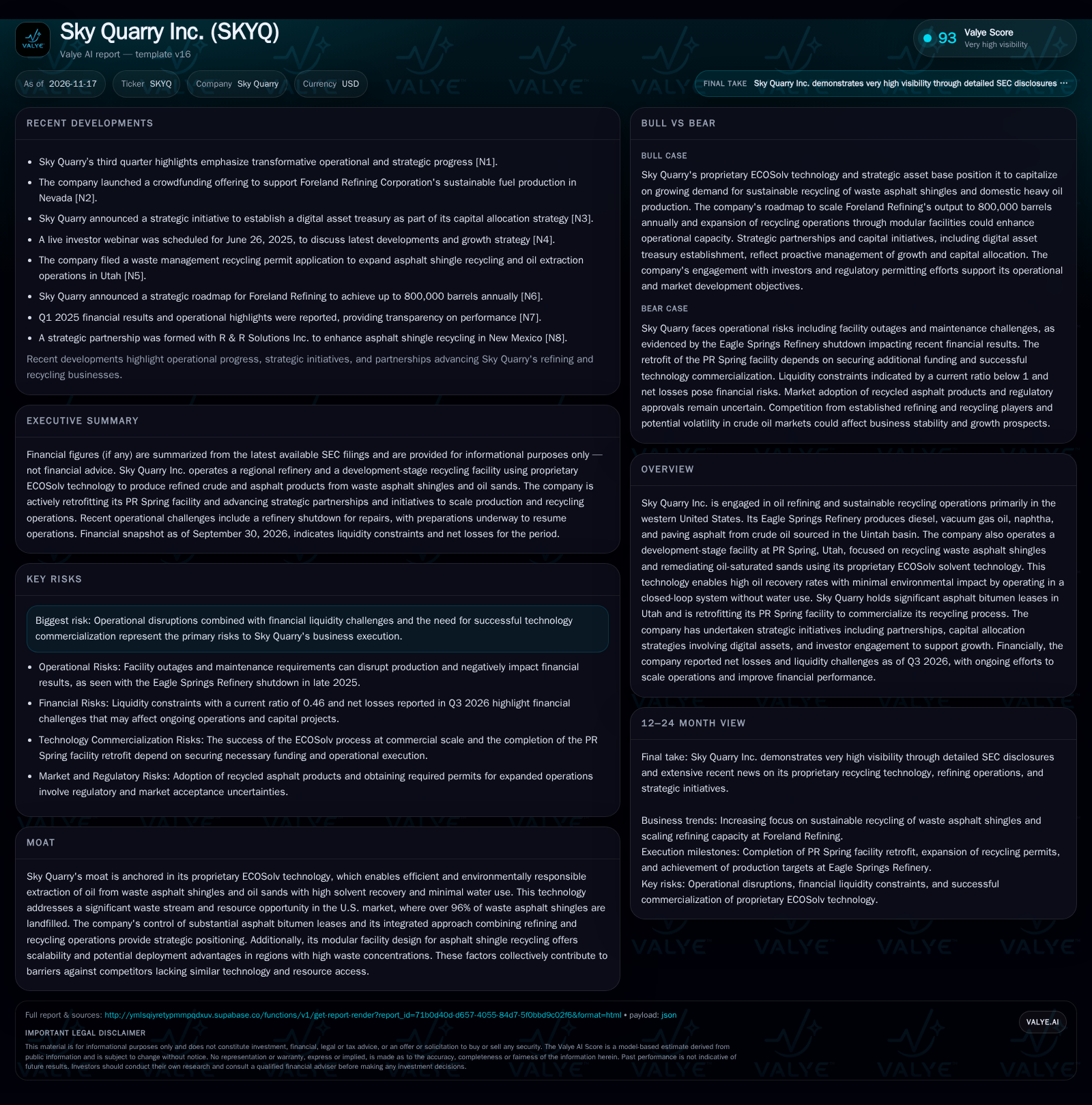
Sky Quarry’s most material current facts center on the juxtaposition of technological progress and financial vulnerability. As of September 30, 2026, the company reported current assets of $6.55 million against current liabilities of $14.33 million, resulting in a current ratio of just 0.46. Net income for the same period was a loss of approximately $3.9 million, with basic and diluted EPS of -$0.44 per share. [S2]
Operationally, the Eagle Springs Refinery experienced a shutdown in Q4 2025 for boiler repairs but is now preparing to resume operations, pending feedstock procurement. Meanwhile, the PR Spring facility retrofit—intended to commercialize the ECOSolv recycling process—has consumed $6.3 million to date, with an estimated $4.0 million more required for completion. [S2]
Strategically, the company has filed for recycling permit expansion in Utah, launched a crowdfunding effort for Foreland Refining, and established partnerships aimed at scaling its recycling technology. These actions reinforce Sky Quarry’s intent to commercialize its proprietary process and address a substantial waste stream, but also underscore its reliance on external capital and regulatory success. [N2] [N5] [N8]
How Sky Quarry’s Economics Could Shift with Commercial Scale
Sky Quarry’s business model blends traditional regional refining with the high-potential, but unproven, economics of advanced recycling. The Eagle Springs Refinery generates revenue by processing crude sourced from the Uintah basin into diesel, vacuum gas oil (VGO), naphtha, and paving asphalt. Margins in small regional refineries are typically thin and subject to volatile feedstock and energy costs, making operational uptime and scale critical for profitability.
The company’s real economic lever, however, may be the ECOSolv-enabled recycling of waste asphalt shingles and remediation of oil-saturated sands. If commercialized successfully, ECOSolv offers the prospect of converting a low- or negative-value waste stream—over 96% of U.S. waste asphalt shingles are currently landfilled—into saleable refined products and paving aggregate. The process is solvent-based, closed-loop, and waterless, which could lower operating costs and environmental compliance burdens relative to conventional processes.
Revenue potential hinges on several factors: (1) the cost and availability of waste feedstock, (2) the price and volume of recovered oil and aggregate, (3) the capital and operating cost profile of modular recycling facilities, and (4) the ability to monetize environmental benefits, such as landfill diversion credits or lower carbon intensity. Fixed costs are significant at the development stage (as evidenced by the ongoing PR Spring retrofit), but modularity could offer operating leverage if multiple sites are deployed near dense waste sources. [S2]
Technology, Permits, and Waste Access Define the Competitive Battleground
Sky Quarry’s moat is rooted in its ECOSolv process, which claims up to 95% oil separation in bench tests and recovers 99% of solvent in a closed-loop, waterless system. This technological edge could provide both cost and environmental advantages over legacy landfill or incineration approaches and over water-intensive oil sands remediation. However, the company’s competitive position is not yet proven at commercial scale.
The company’s control of 5,880 acres of asphalt bitumen leases in Utah, and its integrated approach—combining refining, recycling, and remediation—could create regional supply chain advantages and potential barriers to entry for competitors lacking similar technology or resource access. However, established regional refiners, traditional waste management firms, and emerging cleantech recyclers represent formidable competition. These entities may have greater access to capital, established customer networks, and, in some cases, regulatory relationships.
Market adoption is a further constraint: recycled oil and paving aggregate must meet performance and regulatory standards to displace virgin materials. Additionally, permitting for recycling and remediation projects can be protracted and unpredictable, providing both a barrier and a bottleneck. Sky Quarry’s success will depend on demonstrating reliable performance, securing regulatory approvals, and building partnerships with waste generators, municipalities, and infrastructure customers.
If ECOSolv Commercialization Unlocks Recycling Scale, What Would Prove It?
The bull case for Sky Quarry rests on successful completion and ramp-up of the PR Spring retrofit, followed by rapid deployment of modular recycling units in target regions. In this scenario, ECOSolv delivers reliable, high-yield oil recovery from waste shingles and oily sands at a cost below that of virgin production, and the company is able to secure long-term feedstock supply agreements and offtake contracts for refined products.
Evidence confirming this scenario would include: sustained, positive EBITDA from recycling operations; signed contracts with municipalities or construction firms for waste shingle supply; regulatory approval for expanded recycling at PR Spring; and successful launch of additional modular facilities in waste-dense geographies. Additional signals might be third-party validation of product quality and environmental performance, and the company’s ability to attract non-dilutive funding or strategic investment based on demonstrated operating metrics.
This pathway could enable Sky Quarry to move beyond survival financing and leverage its technology into a defensible, scalable, and environmentally differentiated business model.
Gradual Progress Amid Capital Constraints and Execution Risk
The most plausible trajectory for Sky Quarry is one of incremental progress, marked by ongoing capital-raising efforts, regulatory milestones, and measured operational expansion. Under this scenario, completion of the PR Spring retrofit is delayed by funding gaps or technical challenges, and Eagle Springs Refinery resumes but operates at suboptimal utilization due to feedstock and working capital constraints.
Commercial recycling ramps more slowly than projected, with initial volumes limited by regulatory permitting, waste supply aggregation, or technical teething. The company continues to post operating losses, relying on periodic external funding (such as crowdfunding, asset sales, or dilutive equity issuance) to bridge cash flow gaps. Partnerships and pilot projects generate proof points but do not yet translate into scale or profitability.
Confirmation of this scenario would come from continued financial losses, slow growth in recycling volumes, and a pattern of sequential capital raises.
Liquidity Crunch and Commercial Hurdles Derail Scaling Ambitions
The bear case centers on the risk that Sky Quarry’s liquidity constraints and execution challenges prove insurmountable before the business can achieve commercial scale. In this scenario, delays or cost overruns at PR Spring exhaust available cash before recycling operations generate meaningful revenue. The company is unable to secure timely regulatory approvals or attract sufficient waste feedstock at viable economics.
Eagle Springs Refinery fails to resume profitable operations or suffers further outages, compounding cash burn. The company is forced into highly dilutive financings, asset sales at distressed valuations, or even restructuring. Market adoption of recycled products lags, either due to technical shortcomings or lack of regulatory acceptance, and competitors with greater capital or established networks capture the opportunity.
Confirmation would come from worsening current ratios, growing payables or debt, delays in retrofit completion, or regulatory setbacks. A spike in shareholder dilution or going-concern warnings would further support this scenario.
Signals That Will Determine Sky Quarry’s Ability to Transition from Prototype to Platform
Progress and completion timeline for the PR Spring facility retrofit, including capital outlay and any cost overruns.
Permitting status and regulatory milestones for expanded recycling and oil extraction operations in Utah—delays or rejections would be material.
Ramp-up rate of Eagle Springs Refinery post-repair, including throughput volumes and margin contribution if disclosed.
Volume of waste asphalt shingles processed and oil/aggregate recovered at commercial scale—would help test the recycling economics thesis.
Signed long-term supply or offtake agreements with waste generators, municipalities, or infrastructure customers.
Operating cash flow trends and frequency/terms of external capital raises—recurring losses or dilutive financings would signal continued strain.
Evidence of third-party validation or certification of recycled product quality and environmental performance, supporting market adoption.
Disclaimer: This is research-only, informational analysis and not investment advice. It may include AI-generated interpretation and general industry context. Always verify important details using primary sources.

Comments